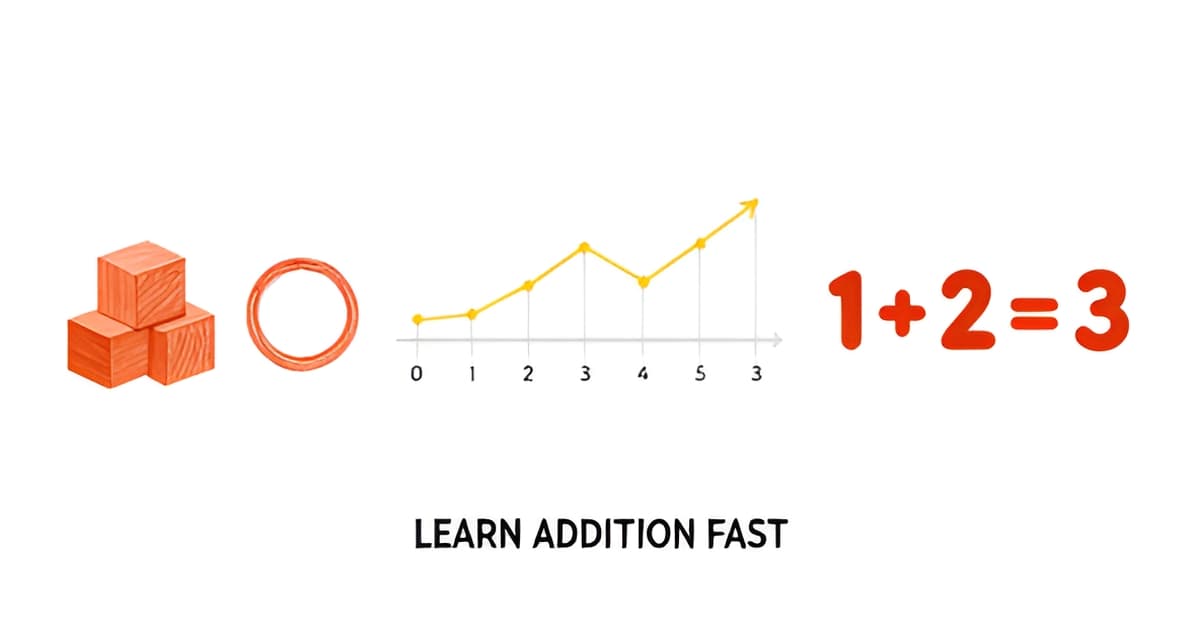
What is addition for kindergarten students?
Key Facts
- About 95% of kindergarteners arrive at school already mastering basic counting, yet very few can add according to Vanderbilt research.
- Teachers spend roughly 13 days per month re-teaching math skills students have already mastered, per a Vanderbilt analysis of 21,000 children.
- Only 1 in 10 kindergartners who start in the bottom fifth of math are proficient by third grade, an analysis of 400,000+ MAP scores found.
- Five-year-olds can already perform approximate addition on dot arrays before any formal instruction, a Harvard study in Cognition found.
- Kindergartners are expected to master addition facts with numbers up to 5, while advanced students work up to 12, education reporting shows.
- Knowing 5 + 4 = 9 gives kids three facts for free: 4 + 5, 9 − 5, and 9 − 4, the fact-family approach explains.
- Only 36% of elementary schools use high-quality instructional materials, according to EdReports data.
Addition Is New Territory (And It's Under-Taught)
Ask a room of parents what kindergarten math covers and most will say counting. Yet when researchers asked what children actually know at school entry, about 95% of kindergarteners had already mastered basic counting and number skills. Addition is different. Very few incoming kindergarteners have mastered it, which makes it genuinely new territory in the kindergarten year.
So what is addition for kindergarten students, really? It's the first experience of joining and separating sets. Three blocks plus two blocks makes five blocks. Five crackers shared with a friend leaves fewer on the plate. At this stage, addition isn't about memorizing flashcards. It's about understanding that putting groups together changes the quantity, and that numbers are symbols standing for those groups.
Here's the uncomfortable part: this new content often gets the least classroom time. The Vanderbilt analysis of national data on roughly 21,000 children found teachers spend the most math time, typically 13 days a month, re-teaching skills students have already mastered. Meanwhile, time spent on addition, place value, and other advanced content was associated with higher end-of-kindergarten math scores. Time spent re-teaching counting was negatively associated with scores.
That matters more than it might seem. Kindergarten math proficiency predicts later success across subjects, and children who start behind rarely catch up. According to an analysis of MAP scores from over 400,000 students, only 1 in 10 kindergartners who began in the bottom fifth of their class in math were proficient by third grade.
The good news is that children arrive with more mathematical intuition than adults assume. A Harvard study found that five-year-olds can already perform approximate addition on non-symbolic quantities, like arrays of dots, before any formal instruction. The teaching job is to connect that gut-level number sense to exact symbols, moving from physical objects, to drawings, to written numbers like 3 + 2 = 5.
The standard expectation is modest and achievable: addition and subtraction facts with numbers up to 5, with advanced kindergarteners working up to 12. The problem isn't the content. It's that it gets crowded out by redundant counting practice, and only 36% of elementary schools use high-quality instructional materials, so what children learn varies widely by classroom.
For parents and teachers filling that gap at home or in small groups, the practice matters as much as the teaching. Children thrive on repetition with small variations and incrementally harder challenges, which is why a tool like Printoodle lets you generate custom addition sheets matched to where your child actually is, whether that's joining dot sets or facts up to 5, and print fresh pages as the difficulty steps up.
How Kindergarteners Learn Addition: Concrete, Then Pictures, Then Numbers
Ask a kindergartener what 3 + 2 means, and the honest answer is usually "five!" followed by a shrug. The real answer is more interesting: addition at this age is the act of joining two groups of things and counting what you get. And how children learn it follows a surprisingly predictable path from blocks to pictures to plain old numbers.
Math researcher Amanda VanDerHeyden, founder of SpringMath, describes this path clearly: students should move from modeling problems with concrete objects, to using pictures of those objects, and finally to numbers in the abstract, like understanding that the symbol 3 stands for three actual things. In practice, that looks like this:
- Concrete: five blocks on the table, plus three more slid over, then counted together.
- Representational: a drawing of five circles and three circles, then counting the dots.
- Abstract: the written problem 5 + 3 = 8, where the numerals stand in for the objects.
Skipping straight to the abstract stage is where many well-meaning practice sessions go wrong. A worksheet full of bare equations means nothing to a child who has never physically joined two sets. The concrete step is not busywork; it is how the symbol 3 earns its meaning.
Here's the encouraging part: your five-year-old may already have a head start. A Harvard study published in Cognition found that children around age five can already perform approximate addition and subtraction on non-symbolic quantities, like arrays of dots, before any formal schooling. The authors concluded that math teaching "may be enhanced by building on this understanding." In other words, kids arrive with an intuitive number sense that exact, symbolic addition can attach to.
Development matters here too. David Geary, a University of Missouri researcher who followed 112 preschoolers through first grade, found that children who grasp that addition increases quantity and subtraction decreases it are much better prepared for school math. His advice for parents is refreshingly simple: give kids real experience manipulating set sizes, pairing number words with actual quantities.
So what does this mean for the standard "what is addition for kindergarten students" question you're probably trying to answer at the kitchen table? The kindergarten expectation is typically addition and subtraction facts with numbers up to 5, with advanced kindergarteners working up to 12. Once your child can join blocks, then draw dots, then read the equation, they've genuinely learned addition rather than memorized it.
This is also where custom practice earns its keep. Children thrive on "small variations on a theme and incrementally harder challenges," as JUMP Math founder John Mighton puts it. With a tool like Printoodle, you can generate addition sheets that match exactly where your child is, whether that's dot pictures or written facts up to 5, and print fresh variations whenever they're ready for the next step. The same approach works across early learning, from kindergarten sight words to kindergarten writing paper, so math practice fits into a routine your child already knows.
If you want to keep the feel light while the difficulty climbs, pair a sheet with something playful like a kindergarten maze printable. VanDerHeyden's own guidance is that practice for young children should "look and feel like a game." Blocks first, drawings second, numbers last, and a little fun throughout.
Teach Fact Relationships, Not Isolated Problems
Here's a trick that saves your kindergartner real effort: one fact can become four. When a child knows that 5 + 4 = 9, she effectively knows three more facts for free: 4 + 5, 9 − 5, and 9 − 4. That's the core of teaching fact relationships instead of drilling isolated problems.
This isn't just a cute shortcut. Dr. Nicki Newton puts it plainly: "Fact families aren't a worksheet. They're a way of thinking." Facts stick when kids see how they connect to each other, not when they drill them one at a time in isolation. And the evidence backs her up. A randomized controlled trial by Paliwal and Baroody (2020) followed children in kindergarten through third grade over 12 weeks and found that structured instruction on the addition-subtraction connection led a large majority of children to learn and reliably use the strategy.
So what does this look like in practice? Instead of a page of random problems, you build practice around fact families: 5 + 4 sits next to 4 + 5, and 9 − 5 and 9 − 4 follow right behind. Your child starts seeing 9 as a number that can be taken apart and put back together, which does far more for mathematical thinking than counting alone, according to reporting on kindergarten math instruction.
Difficulty matters just as much as structure. The research-backed range for kindergarten addition is:
- Facts with numbers up to 5 as the standard expectation for kindergartners
- Numbers up to 12 for advanced kindergarteners who are ready for more
- Paired addition and subtraction facts, so each new problem reinforces a family
Stay in that range and something interesting happens, according to John Mighton, founder of JUMP Math: children love repetition, exploring small variations on a theme, and incrementally harder challenges, often more than adults do. The key is that the repetition has to land on appropriately challenging content. Re-drilling counting skills your child has already mastered is where repetition becomes redundancy, and the research links time spent on mastered skills to lower end-of-kindergarten math scores.
This is where custom practice sheets earn their keep. With Printoodle, you can generate addition pages tuned to exactly the right level, facts up to 5 for a child building confidence, or up to 12 for one who's ready to stretch, with related facts grouped so the "three for free" principle does the heavy lifting. The same approach works across early learning: whether you're building kindergarten sight words pages, kindergarten writing paper, or a kindergarten maze printable for a brain break, the goal is the same: practice that feels like play and lands at the right difficulty.
Print it. Doodle it. Done.
How to Create Custom Addition Practice Sheets with Printoodle
Here's the gap you're up against: only 36% of elementary schools use high-quality instructional materials, so teachers routinely patch together their own resources. That patchwork means wide variation in what kindergarteners actually learn, and it's exactly the problem a custom practice sheet solves.
With Printoodle, you can generate a print-ready addition worksheet in seconds, leveled to where your child actually is. The research-backed target range is clear: kindergarteners are expected to master facts with numbers up to 5, while advanced students can work up to 12, according to education reporting on kindergarten math. You describe what you want, spend a credit, and download a print-ready PDF in Letter or A4.
Here's how to make it work for a kindergartener:
- Start at the up-to-5 level. Addition is one of the few skills kindergarteners haven't already mastered: about 95% arrive knowing basic counting, but very few can add.
- Ask for paired facts on the same sheet. When a child knows 5 + 4 = 9, she effectively knows 4 + 5, 9 − 5, and 9 − 4 for free.
- Add a theme your child loves, whether dinosaurs or unicorns. Practice should feel like a game, and kids respond to "incrementally harder challenges," as JUMP Math's John Mighton notes in the same Hechinger report.
- Step up to the up-to-12 range only when the up-to-5 facts feel automatic. Small variations on a theme beat big jumps.
Everything you generate lives in your library, and reprints are always free, so you can print the same sheet again when a child wants to repeat a favorite. That's a feature, not a bug: repetition of appropriately challenging content helps, while repetition of already-mastered content doesn't.
Addition sheets also pair naturally with Printoodle's other kindergarten tools. After math practice, a kindergarten sight words sheet covers early reading, kindergarten writing paper gives kids a place to practice number and letter formation, and a kindergarten maze printable makes a fun reward that still builds fine motor and planning skills.
Print it, doodle it, done.
Why Starting Now Matters: The Kindergarten Window
When a child enters kindergarten with a firm grasp of basic counting, addition arrives as the next logical step. Research confirms that approximately 95% of students arrive already proficient in numbers one through ten and one-to-one correspondence, leaving addition genuinely new territory. Yet the data reveals a striking inefficiency: teachers typically devote 13 days per month of math instruction to skills students have already mastered, while addition and subtraction, skills very few incoming kindergarteners possess, receive far less deliberate focus.
This gap carries significant weight. Studies tracking ECLS-K data from over 21,000 children found that instructional time spent on advanced content like addition and subtraction is positively associated with higher end-of-kindergarten math scores, whereas time spent re-teaching mastered counting skills actually correlates with lower achievement. A 2013 University of Colorado Boulder analysis reinforced this, showing students exposed to higher-level concepts learned more math overall. The implication is clear: kindergarten is the window when addition should be introduced, not revisited.
Perhaps most urgent is the long-term predictive power of these early skills. Chalkbeat’s analysis of MAP scores from 400,000+ students who started kindergarten in 2021-22 found that only 1 in 10 kindergartners starting in the bottom fifth of their class in math were proficient by third grade. Students still struggling at the end of first grade had just a 2% proficiency rate by third grade. Kindergarten math proficiency is especially predictive of future success across all subjects, including reading, making this early window critical and nearly impossible to recover once closed.
Long before formal schooling, children develop an intuitive, approximate number sense. Five-year-olds can perform approximate addition and subtraction on non-symbolic quantities like dot arrays, and they understand the inverse relationship between the two operations. Experts emphasize that building on this natural understanding, rather than starting with isolated memorization, creates a stronger foundation. When a child knows that 5 + 4 = 9, they effectively hold the key to three related facts: 4 + 5, 9 − 5, and 9 − 4. This fact-family thinking is far more powerful than drilling problems in isolation.
The most effective approach follows a concrete-to-abstract progression. Students first model problems with physical objects, then move to representational drawings, and finally work with abstract number symbols. Research consistently shows that fact relationships, understanding how numbers connect, do more for kindergarteners' mathematical thinking than counting alone. Children thrive on “repetition, exploring small variations on a theme and incrementally harder challenges,” and interventions that feel like a game rather than a drill yield the best results.
The data makes one thing certain: waiting is not an option. Kindergartners who start behind rarely catch up, and the skills they build, or fail to build, during this window echo through every subsequent subject. Custom, appropriately-leveled practice that follows this progression offers a way to intervene early, before gaps solidify into long-term deficits.
Printoodle makes it easy to create custom addition practice that follows this research-backed progression. Generate kindergarten sight words sheets, kindergarten writing paper, or kindergarten maze printable activities that pair related facts and build confidence through incremental challenge. Print it. Doodle it. Done.
Frequently Asked Questions
What does addition actually mean for a kindergartener?
What addition facts should my kindergartener be able to do?
Should I start with worksheets or use hands-on objects first?
Doesn't my five-year-old already know how to count? Isn't that enough?
How important is it to teach addition in kindergarten, really?
Should I drill random math problems or teach fact families?
How do I keep addition practice fun instead of feeling like a drill?
Small Numbers, Big Window
So, what is addition for kindergarten students? It's the first real experience of joining and separating sets, learned through blocks, then drawings, then symbols like 3 + 2 = 5, and it's one of the few math skills kindergarteners haven't already mastered. That makes it genuinely new territory, and a window worth using: only 1 in 10 kindergartners who start in the bottom fifth in math become proficient by third grade, according to an analysis of 400,000+ student MAP scores. The recipe from the research is simple: keep practice in the facts-up-to-5 range, teach fact families so one fact unlocks three more, and make it feel like a game with incrementally harder challenges. Printoodle makes that easy to do at your kitchen table, generate custom addition sheets matched to your child's level, then round out the routine with kindergarten sight words, kindergarten writing paper, or a kindergarten maze printable for a playful brain break. Start with a handful of blocks, print a sheet, and let the repetition do its quiet work. Print it. Doodle it. Done.