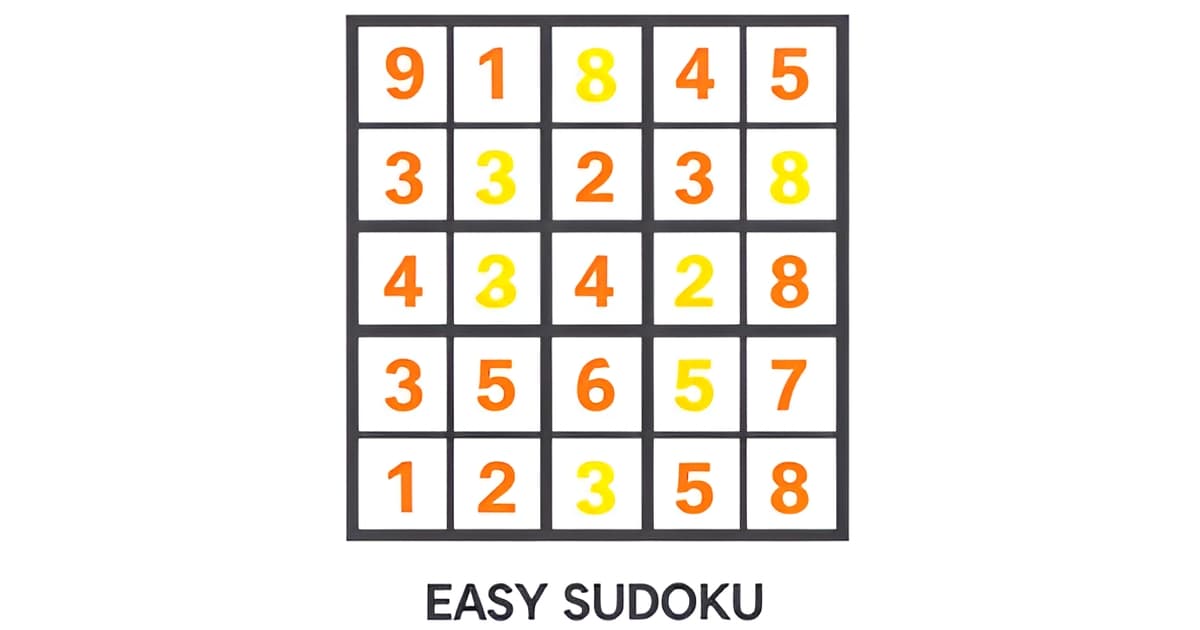
What is an easy Sudoku puzzle for beginners?
Key Facts
- An easy Sudoku is a 9×9 grid of 81 cells where plenty of pre-filled givens, single-candidate cells, and pure logic, no guessing, carry beginners to the finish according to Reader's Digest.
- Difficulty is measured in givens: the fewer starting numbers on the grid, the harder the puzzle per BBC Bitesize.
- Easy puzzles hide 'low-hanging fruit', cells where only one number fits, placed there by design, and harder grids contain fewer of them Reader's Digest explains.
- Championship solvers from Cracking the Cryptic warn that guessing prevents you from finding the logic most puzzles inherently possess according to expert insights.
- The digits in any complete Sudoku row, column, or box always sum to 45, a quick mistake check before errors snowball per Reader's Digest.
- BBC Bitesize publishes printable PDF packs of 30 puzzles per difficulty level, refreshed every weekday morning on its site.
- Rudolph Academy offers 15 printable Level 1 worksheets with roughly 40+ beginner puzzles, each with its own answer key for classroom use.
The beginner's head start: what makes a puzzle easy
So, what is an easy Sudoku puzzle for beginners? It's a standard 9×9 grid (81 cells, nine 3×3 boxes) that comes pre-loaded with plenty of starting numbers, contains many cells where only one candidate can fit, and can be solved entirely through logic without guessing. That definition holds up across every serious source on the game, from BBC Bitesize to competitive solvers.
The single clearest signal of difficulty is the number of givens. Reader's Digest puts the rule plainly: the fewer the given numbers, the more challenging the grid will be. BBC Bitesize agrees, noting that the harder the difficulty, the fewer numbers you'll see at the start. Easy puzzles flip that equation in your favor, filling in enough of the grid that you always have somewhere to start.
Those extra givens aren't random generosity. They create what solvers call "low-hanging fruit": cells where, thanks to the placement of the givens, only one number is possible. Reader's Digest points out that these cells exist by design, and the harder the puzzle, the fewer of them you'll find. On an easy grid, they're everywhere, which means you can chain together quick wins and watch the puzzle unfold.
Here's the short version of what to look for in a genuinely beginner-friendly puzzle:
- Plenty of pre-filled numbers that give you a head start
- Lots of single-candidate cells you can fill immediately
- A solution reachable through pure logic, with no guessing
- Rows, columns, and boxes that are already crowded enough to work with
That last point about guessing matters more than it sounds. A legitimate Sudoku grid should require no guessing at all, and the co-founders of Cracking the Cryptic, YouTube's biggest Sudoku channel, warn that guessing avoids finding the logic most puzzles inherently possess, so you neither solve efficiently nor improve. If a puzzle only cracks when you take a wild stab at a cell, it's poorly made, whatever its label says.
The good news is that easy puzzles are easy to find. If you'd rather print than squint at a screen, a sudoku generator like the one on Printoodle lets you pick an easy difficulty and download a print-ready PDF in seconds, and the same site's sudoku printable pages work well for kids' pencil-and-paper practice. Teachers will appreciate that beginner puzzles let students work at their own pace and build confidence before moving up a level.
One last reframe for anyone intimidated by the grid of numbers: Sudoku isn't about maths, it's about logic. Start with an easy puzzle, hunt for the single-candidate cells, and the rest follows.
How to solve an easy puzzle without guessing
The best news about easy Sudoku? You never need luck. Every fair puzzle is built so pure logic carries you from the first square to the last, and the solving workflow below is the one beginner guides agree on.
Start where the grid is already crowded. Focus on rows, columns, or 3×3 boxes that have plenty of numbers filled in, because these areas "often give you quicker wins, building confidence as you progress," according to 247 Sudoku's logical solving guide. A row with six givens leaves only three candidates to place, which is a far friendlier problem than a row with two.
Work one number at a time. Scan the grid for a single digit, say all the 5s, and use elimination: if a 5 already sits in a row, column, or box, no other 5 can go there. This is how you find the "low-hanging fruit" that Reader's Digest notes is placed in easy grids by design, cells where only one candidate is possible thanks to how the givens are arranged. Harder puzzles hide this fruit; easy ones hand it to you.
The consensus workflow, confirmed across sources, looks like this:
- Pick the row, column, or box with the most numbers already placed.
- Choose one missing digit and eliminate every cell where it can't fit.
- Fill in any cell where only one candidate remains, then repeat.
- Move to the next easiest region, never the hardest one.
Resist the urge to guess. "A legitimate or fair Sudoku grid should require no guessing at all," as Reader's Digest puts it, and Rudolph Academy's beginner strategies list "Use Logic, Not Guessing" as the final rule. Even championship solvers back this up: Simon Anthony and Mark Goodliffe of Cracking the Cryptic argue that guessing "avoids finding the logic that most Sudoku puzzles inherently possess," so you neither solve reliably nor improve your skills.
One useful check as you go: the digits in any complete row, column, or box always sum to 45. It's a quick way to spot a mistake before it snowballs.
If you want practice material that guarantees this logic-only experience, a sudoku generator set to easy difficulty produces grids with plenty of givens, and a sudoku printable gives you a pencil-and-paper copy in seconds. Print it, grab a pencil, and let the logic do the work. That's the whole game.
Creating and printing easy puzzles with Printoodle
Once you know what makes a puzzle genuinely easy, the next question is practical: where do you get one on paper? You already know the definition, so hold any generator you try to that standard: plenty of givens, single-candidate cells, and a solution that never demands guessing. As Reader's Digest puts it, "the fewer the given numbers, the more challenging the grid will be," and the single-solution cells beginners rely on are placed there "by design."
The free-generator world gives you a few options. FreeToolskit.dev offers a browser-based tool that can generate printable puzzles at any difficulty level with PDF or SVG export, no sign-up required. Amuse Labs' PuzzleMe covers Easy, Medium and Hard tiers plus sizes from 4×4 mini grids up to 16×16, with beginner aids like a Smart Tutor. BBC Bitesize publishes printable PDF packs of 30 puzzles per difficulty level, refreshed every weekday.
Those are solid for casual one-off printing. Where they get tedious is repetition: a teacher running a Friday puzzle station, a parent stocking a rainy-day binder, or a party host putting a sudoku sheet in every goody bag needs the same easy difficulty again and again, on demand.
That's the gap Printoodle's sudoku printable and sudoku generator fill. You pick the easy difficulty, generate a fresh print-ready PDF in seconds, and download it. Every puzzle lands in your library, and reprints are free forever, so the twenty-fifth copy of the classroom worksheet costs nothing. New accounts get 10 credits on email verification, and credit packs start at $5, which suits the parent or teacher who prints in bursts rather than on a subscription schedule.
A quick checklist for any generator you use, free or paid:
- Easy mode means many givens, not just a smaller grid
- Every puzzle ships with a solution or answer key
- Output is print-ready PDF, sized for Letter or A4
- Each print is a fresh puzzle, so no one copies their neighbor
The payoff is confidence. Rudolph Academy notes that beginner puzzles let students work at their own pace and build confidence before moving up, and answer keys make that work in classrooms and at kitchen tables alike. Generate an easy grid, hit print, and hand over the pencil. Print it. Doodle it. Done.
ctaText: "Generate your first easy sudoku puzzle free. Print it. Doodle it. Done." socialProofText: "Parents, teachers, and party hosts use Printoodle to print fresh puzzles in seconds, with free reprints forever."
Frequently Asked Questions
What is an easy sudoku puzzle for beginners?
How many starting numbers should an easy sudoku puzzle have?
Do I ever need to guess when solving an easy sudoku puzzle?
What's the best way for a beginner to solve an easy sudoku?
Is sudoku a math game? I'm bad at numbers.
Where can I print easy sudoku puzzles for kids or students?
Key Takeaways
{ "title": "Logic Over Luck: Your Sudoku Confidence Starts Now", "content": "An easy Sudoku puzzle for beginners is defined by a standard 9×9 grid packed with plenty of starting numbers, creating those crucial "low-hanging fruit" cells where only one candidate fits, all solvable through pure log