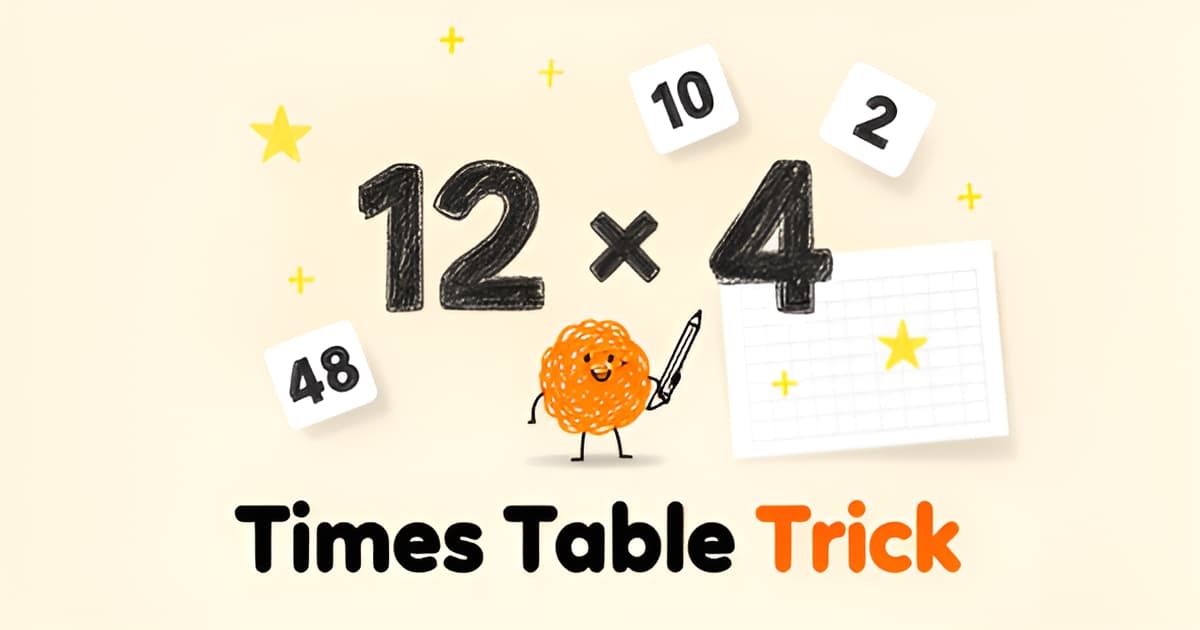
What is the 12 multiplication trick?
Key Facts
- The 12 multiplication trick splits any problem into two easy facts: multiply by 10, multiply by 2, then add, so 12 × 4 = 40 + 8 = 48, according to Bored Teachers.
- Every 12 times table product is exactly double the matching 6 times table fact, since 6 is half of 12, per DoodleLearning's teacher-authored guide.
- The ones column of the 12 times table repeats a 0, 2, 4, 6, 8 cycle across all products from 12 to 144, Komodo Math notes.
- Research-backed guidance recommends just 5–10 minutes of focused daily practice, called spaced practice, over long drill sessions, according to Mathnasium.
- The standard automaticity benchmark is recalling a math fact within 2 seconds, roughly 30 problems in 60 seconds, per Hoboken's K-12 math fluency curriculum.
- Timed 'mad minute' tests can actually hurt fluency progress, research shows, so educators advise celebrating strategies rather than speed, according to curriculum guidance.
- The 12 times table is typically the final table students learn, yet 12 runs real life: dozens of eggs, 12 inches per foot, 12 months, and 24 hours, Smartick's math educators point out.
Why the 12 Times Table Trips Kids Up (and Why It Still Matters)
The 12 times table is the last one most kids tackle, often treated as an afterthought once the 1-10s are locked down. Yet these facts appear constantly in real life, by the dozen in a box of eggs, in the 12 inches that make up a foot, the 12 months on a calendar, and the 24 hours that split a day. For many children, simply memorizing the row of products feels like climbing a wall with no handholds. Rote repetition alone often fails here because the brain struggles to find a pattern in numbers that don’t follow the clean sequences of the lower tables.
The good news is that a mental math trick can short-circuit this struggle. The most widely cited approach is the "10 times plus 2 times" rule: to multiply any number by 12, multiply it by 10, multiply it by 2, and add the two results together. A worked example makes it click, 12 × 4 becomes (10 × 4) + (2 × 4), which is 40 + 8, totaling 48. This decomposition method is supported by multiple education sources, which also point to complementary strategies like doubling the 6 times table (since 6 is half of 12) or recognizing the repeating 0, 2, 4, 6, 8 pattern in the ones column. Educators emphasize that these tricks work best after a child understands multiplication as equal groups, paired with short daily practice sessions of just 5–10 minutes. This spaced practice strengthens memory and keeps stress low, unlike timed "mad minute" tests, which research shows can actually hinder fluency progress.
For parents and teachers looking for a tangible way to reinforce these strategies, a printable guide can provide the structured practice that research says is most effective. Printoodle offers a 12 multiplication table generator that creates personalized, print-ready activity pages in seconds, perfect for quick daily drills. You can also grab a general multiplication table worksheet from the same platform to build broader fact fluency. The goal is simple: print it, doodle it, and move on.
10 × n + 2 × n decomposition method
Doubling the 6s strategy
0, 2, 4, 6, 8 ones-column pattern
The 12 Multiplication Trick: 10 Times Plus 2 Times
So, what is the 12 multiplication trick? It's simpler than it sounds: to multiply any number by 12, you multiply that number by 10, multiply it by 2, then add the two results together. As Bored Teachers puts it, "12's rule is 10 times the number plus 2 times the number," with the classic worked example 12 × 4 = 40 + 8 = 48.
Why does this work? Because 12 is just 10 + 2, so you can split the problem into two easy pieces. Komodo Math calls this "partitioning": 4 × 12 becomes 4 × 10 plus 4 × 2, giving 40 + 8 = 48. Both halves are facts kids usually know cold already.
Smartick frames the same idea a different way: "To multiply by 12, we add a zero to the number we're going to multiply and then we add double the original number to the result." Try it with 12 × 5: add a zero to make 50, then add double of 5 (which is 10), and you get 60. Same math, friendlier packaging.
Here's the trick applied to a few more facts:
- 12 × 3 = (10 × 3) + (2 × 3) = 30 + 6 = 36
- 12 × 7 = 70 + 14 = 84
- 12 × 9 = 90 + 18 = 108
- 12 × 12 = 120 + 24 = 144
Notice how each answer lands on the full 12 times table sequence: 12, 24, 36, 48, 60, 72, 84, 96, 108, 120, 132, 144. That gives students a built-in way to check their work.
Decomposition beats finger-counting in 12s for a practical reason: counting on in 12s means students "lose track and make silly mistakes... as we're short a few fingers to keep track properly," according to DoodleLearning. Teacher Mhairi Sim notes her students found the chunking method "super helpful and much less daunting." When the answer is built from two known facts, there's nothing to lose count of.
One caveat from educators: introduce the trick only after your child understands what multiplication actually means. Research summarized by Mathnasium shows that students who grasp the concept behind multiplication learn facts faster and remember them longer. The trick is a shortcut, not a substitute for understanding.
To make daily practice easy, print a 12 multiplication table your child can keep at the desk, or a full multiplication table for reference across all the facts. Five to ten focused minutes a day, what researchers call spaced practice, beats a long drill session every time. Print it, doodle on it, and let the 10-plus-2 pattern do the heavy lifting.
Four More Ways to Crack the 12s
Not every brain clicks with the same trick, and that's fine. If "multiply by 10, then add the double" feels clunky for your child, there are three other routes up the 12s that work just as well.
Double the 6s. Every product in the 12 times table is exactly double the matching product in the 6 times table, because 12 is two 6s. So 12 × 4 becomes 6 × 4 = 24, then double it to get 48. Teacher Mhairi Sim calls pointing this out to students "worth it," noting her students found the strategy "super helpful and much less daunting." One prerequisite matters here: kids should be solid on their 6s before leaning on this method, since the whole shortcut depends on it.
Spot the ones-column pattern. Look down the answers (12, 24, 36, 48, 60, 72, 84, 96, 108, 120, 132, 144) and the ones digits repeat in a cycle: 0, 2, 4, 6, 8, 0. Once a child sees the pattern, the table stops feeling like twelve random facts and starts feeling like one predictable sequence. Kids who like spotting structure often latch onto this faster than any calculation method.
Climb between "safe ledges." The team at Komodo Math suggests memorizing just three anchor facts: 5 × 12 = 60, 10 × 12 = 120, and 12 × 12 = 144. From there, your child "climbs" up or down by 12. Stuck on 9 × 12? Climb down from 120 and land on 108. It's the same instinct mathematicians use when route-finding, as Komodo's co-founder puts it: they're always looking for the best path through a problem.
A quick note on what to skip: repeated addition (adding 12 over and over) technically works, but kids lose track and make mistakes, since we're short a few fingers for counting on in 12s.
Whichever strategy clicks, short practice beats long drills. Research-backed guidance from Mathnasium recommends just 5–10 minutes of focused daily practice, called spaced practice, to strengthen memory while keeping stress low. That's exactly what a printable 12 multiplication table is for: Print one from Printoodle, tape it to the fridge, and do a two-minute climb through the ledges each morning. If you want the full grid for comparing all the strategies side by side, a standard multiplication table printable works well alongside it.
How to Practice the Trick in 5-10 Minutes a Day
Knowing the 12 multiplication trick is one thing; making it stick is another. The good news is that the research is clear on what actually works, and it doesn't involve marathon drilling sessions.
Before you introduce any shortcut, make sure your child understands what multiplication means. Research shows that students who grasp the concept behind multiplication, such as equal groups, learn facts faster and remember them longer. And since the doubling-the-6s strategy depends on it, your child should be solid on the 6 times table first, as DoodleLearning's teacher-authored guide recommends.
Once the concept is in place, keep practice short. Aim for 5–10 minutes a day with focus. This approach, called spaced practice, strengthens memory and keeps stress low, according to Mathnasium's guidance on teaching times tables. Skip the "mad minute" timed tests, though. Hoboken's K-12 math fluency curriculum notes that research shows timed tests can actually hurt fluency progress.
A simple daily routine might look like this:
- Day 1–3: Practice the 10-plus-2 decomposition out loud (12 × 4 = 40 + 8 = 48).
- Day 4–6: Switch to doubling the 6s, and point out the 0, 2, 4, 6, 8 pattern in the ones column.
- Day 7–10: Mix strategies and ask your child to explain which one they chose and why.
- Ongoing: Spot-check a few facts each day to keep recall sharp.
Here's the part many parents miss: celebrate strategies, not speed. "If your child explains how they solved a problem, that's a win, even if it took time," as Mathnasium puts it. Hoboken's curriculum guidance agrees: "Fast is not always best. It is important to celebrate strategies rather than speed."
That said, fluency does have a benchmark. The standard automaticity target is recall within 2 seconds, roughly 30 problems in 60 seconds. Treat that as a long-term goal your child reaches naturally through daily practice, never something you chase with a stopwatch.
For practice material, Printoodle's 12 multiplication table printable gives you the full run of products from 12 to 144 for reference and marking practice, while the complete multiplication table helps your child see how the 12s connect to the 6s and everything else. Print a copy, stick it where homework happens, and let the five-minute sessions do their quiet work.
Print it. Doodle it. Done.
Real-World Hooks That Make the 12s Stick
Twelve shows up everywhere once you start looking, and that's exactly why the 12 multiplication trick is worth mastering. As Smartick's math educators point out, schools often treat the 11s and 12s as afterthoughts, yet these tables keep gaining importance because dozens, inches, months, and hours all run on 12.
Think about a carton of eggs. Three dozen is 36, and you just used 12 × 3. A ruler is 12 inches, so a 5-foot bookshelf is 12 × 5 = 60 inches. A year is 12 months, and a full day is 24 hours, which is 12 × 2. When kids see the 12s in their own kitchen and calendar, the facts stop feeling arbitrary.
- Eggs and dozens: 12 × 2 = 24, 12 × 4 = 48, 12 × 6 = 72
- Inches in a foot: 12 × 7 = 84 inches in 7 feet
- Months in a year: 12 × 12 = 144 months in 12 years
- Hours on a clock: two 12s make 24 hours
These hooks also make practice easier to sell at home. According to Mathnasium's guidance on teaching times tables, short sessions of just 5 to 10 focused minutes a day, a technique called spaced practice, strengthen memory better than long drills and keep stress low. A dozen-egg carton on the counter is a better prop than any worksheet.
The 12s also carry a hidden confidence boost: the ones column of every product follows the repeating pattern 0, 2, 4, 6, 8, as Komodo Math notes. Spotting that pattern turns a wall of numbers into something predictable. And since the 12 times table is typically the last one students learn, finishing it feels like a genuine milestone.
The Full 12 Times Table
| × | 12 |
|---|---|
| 1 | 12 |
| 2 | 24 |
| 3 | 36 |
| 4 | 48 |
| 5 | 60 |
| 6 | 72 |
| 7 | 84 |
| 8 | 96 |
| 9 | 108 |
| 10 | 120 |
| 11 | 132 |
| 12 | 144 |
Keep this table handy for quick checks, or print a full 12 multiplication table from Printoodle for the fridge or a homework binder. If your learner is working through other tables too, Printoodle's multiplication table generator covers the whole family.
Ready to put it into practice? Generate a personalized printable practice sheet with your child's name on it, print it out, and stick to those short daily sessions. Print it. Doodle it. Done.
Frequently Asked Questions
What exactly is the 12 multiplication trick?
My child only knows the 6 times table. Can they still learn the 12s?
Will using tricks keep my child from actually learning multiplication?
My child gets anxious with timed tests. Is that normal?
Are there other ways to learn the 12 times table besides the 10-plus-2 trick?
How can I practice the 12s in short bursts without it feeling like drill work?
Your Turn: Put the 12 Trick to Work
So, what is the 12 multiplication trick? It's the 10-times-plus-2-times rule: split any number times 12 into an easy times-10 and a times-2, then add the pieces, 12 × 4 becomes 40 + 8 = 48. Backed up by doubling the 6s, the 0-2-4-6-8 ones-column pattern, and safe-ledge anchor facts, the trick turns twelve intimidating facts into a handful of easy moves. The path forward is simple: make sure your child understands multiplication as equal groups, pick whichever strategy clicks, and practice in short 5–10 minute daily sessions rather than stressful timed drills. Research on spaced practice shows those brief, consistent sessions strengthen memory and keep stress low. When you're ready to start, Printoodle can generate a personalized 12 multiplication table or a full multiplication table printable in seconds, tape it to the fridge, do a two-minute climb through the facts each morning, and let the pattern do the heavy lifting. Print it. Doodle it. Done.