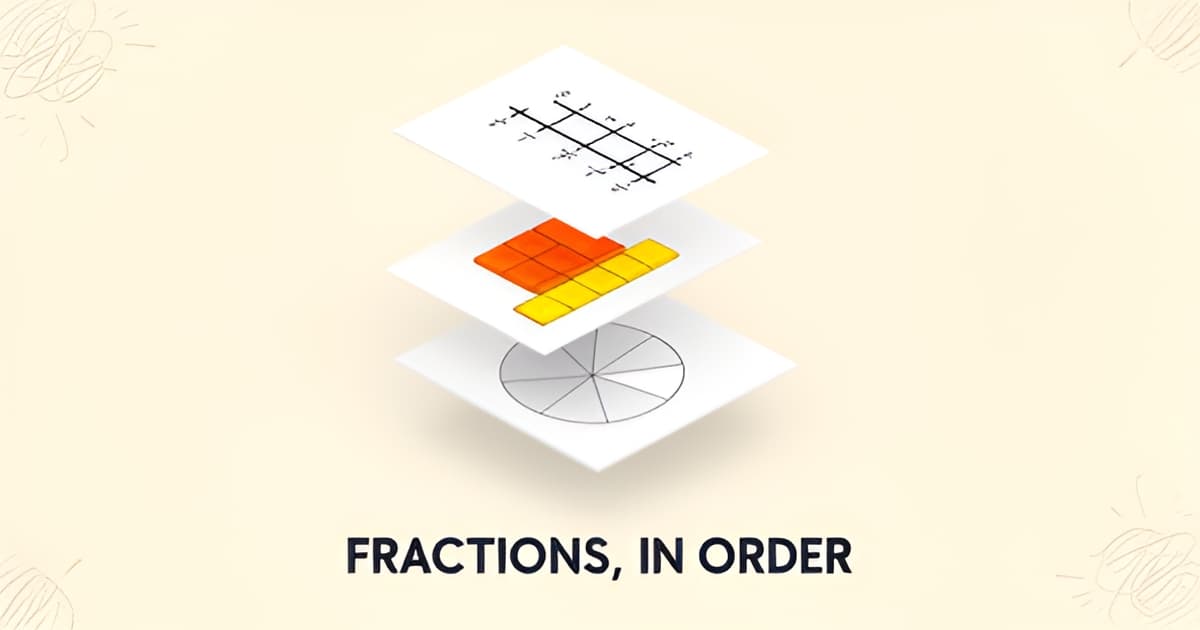
What is the best order for teaching fractions?
Key Facts
- 45% of students in a 6-year study of over 2,000 learners could not correctly answer a basic fraction addition problem on pre-tests, according to peer-reviewed research.
- Second graders already use dedicated brain circuits to process non-symbolic ratios, a UW–Madison neuroscience study found.
- Foundational fraction understanding can be built in just 13 hours of targeted instruction, according to Frax efficacy research.
- Number lines are rated the most effective instructional representation of fractions, educational research confirms.
- The federal What Works Clearinghouse rates teaching fractions as numbers on number lines as Moderate Evidence, per its practice guide.
- 49% of students who were a grade level below peers after grade 2 reached proficiency by the end of grade 3 with targeted fraction support, Frax research shows.
- Researchers warn that premature overemphasis on algorithms may hinder fraction understanding in both the short and long term, the longitudinal study found.
Why Fraction Instruction Goes Sideways (and What the Research Says About Order)
It happens quietly. A student stares at two fractions, looking ready to add them, and writes 2/5 + 2/3 = 4/8. This mistake isn't random, it’s the predictable result of treating numerators and denominators as separate whole numbers. In a 6-year study spanning 12 research teams and over 2,000 students, 45% of learners could not answer a basic fraction addition problem correctly on pre-tests, underscoring the high cost of poor sequencing. When instruction isolates fractions into one late unit or relies on tricks like "keep it, change it, flip it," students memorize procedures without building the conceptual understanding needed for long-term success.
The research reveals why sequence matters more than effort. Students often apply whole-number logic to fraction symbols, choosing 2/5 over 2/3 because 5 is larger than 3, a widespread gap identified in peer-reviewed research. Neuroscience backs this up: second graders already process non-symbolic ratios using brain circuits that fifth graders "recycle" for symbolic fractions, yet traditional instruction relying on "lots and lots of pizzas" fails to capitalize on this pre-wired ability. Experts argue that starting with area models like circles and rectangles limits students later, as length models such as number lines and Cuisenaire rods better support understanding fraction magnitude and computation with greater complexity.
A coherent sequence begins with informal sharing and fairness, then quickly introduces fractions as numbers using number lines as the central representation. From there, unit fractions serve as the foundational construct, and fraction walls become the first pedagogical choice for equivalence, shifting the goal from wall-building to student conjecture-making. Conceptual understanding of computation must precede procedures, helping students see why multiplying 1/2 by 1/4 results in 1/8, for instance, before any algorithm is introduced. The evidence is clear: introducing fractions earlier, in parallel with whole numbers, and avoiding premature tricks sets the stage for algebra readiness and prevents the long-term struggles that occur when fractions are treated as computational pieces to memorize rather than numbers with magnitude.
Printoodle supports this research-backed sequence with printable resources designed for each stage. Teachers can generate number-line worksheets to anchor fraction magnitude, fraction walls for equivalence exploration, and themed vocabulary word searches created with the word search maker or printable word search to reinforce key terms early. These tools align with the recommendation to introduce fraction vocabulary alongside whole numbers rather than waiting for a dedicated unit, helping students build familiarity before abstract operations.
The Evidence-Backed Sequence: Five Stages for Teaching Fractions in Order
If you've ever wondered what is the best order for teaching fractions, the research points to a clear answer: start with fairness, move to the number line, and save the algorithms for last. When kids' brains are already wired to handle ratios, the sequence you choose matters more than the pizza you cut.
A UW–Madison neuroscience study found that second graders already use dedicated brain circuits to process non-symbolic ratios, and fifth graders "recycle" those same circuits for symbolic fractions. Researcher Edward Hubbard suggests instruction should capitalize on that perceptual ability rather than relying on "lots and lots of pizzas."
That finding lines up with the federal What Works Clearinghouse practice guide and a six-year longitudinal study tracking over 2,000 students in Grades 3 through 10. Together, they support a five-stage sequence:
- Informal sharing and fairness activities. Before any symbols, students share cookies or candy bars where the whole and equal parts matter. The innate sense of fairness drives the need for equal shares.
- Fractions as numbers on number lines. The WWC rates this Moderate Evidence, and research cited by ExploreLearning calls number lines the most effective instructional representation of fractions. Don't wait for a dedicated fractions unit; fractions are just numbers.
- Unit fractions and magnitude. The Springer study argues unit fractions like 1/4 and 1/3 should be the "central construct" that connects everything else. Students who struggle often treat numerators and denominators as two separate whole numbers.
- Equivalence and comparison. Fraction walls are the recommended first pedagogical choice here, with the goal of student conjecture-making rather than wall-building itself. Third grade work covers denominators 2, 3, 4, 6, and 8, then equivalence like 1/2 = 2/4.
- Conceptually grounded computation, then ratios. Students should see why 1/2 × 1/4 = 1/8 before memorizing the procedure. The WWC guide ends with ratios and proportions taught conceptually, using bar diagrams and ratio tables, before cross-multiplication appears.
The stakes are real. In the Springer study, 45% of students could not correctly answer a basic fraction addition problem on pre-tests. The same research warns that "premature overemphasis on algorithms may actually hinder student understanding in both the short and long term," so skip the "keep it, change it, flip it" shortcuts.
Printoodle-generated printables map neatly onto each stage: number-line worksheets for stage two, fraction walls for stage four, and a fraction vocabulary word search made with a word search maker or printable word search to keep terms like numerator and equivalent circulating all year, not just during the unit. Print it. Doodle it. Done.
Which Models to Use at Each Stage (and When to Ditch the Pizza)
Starting with food and area models makes sense for a first introduction, kids already understand the idea of sharing a pizza or candy bar fairly, and that perceptual sense of "fair share" is exactly what the What Works Clearinghouse practice guide recommends as the entry point. Research confirms that second graders already use a pre-wired brain network to process non-symbolic ratios before they ever see a symbolic fraction, so leaning into that natural sense of fairness is a smart bridge to more abstract ideas. But as the complexity of the math increases, those same area models hit a wall; a peer-reviewed 6-year study found that 45% of students couldn't even answer a basic fraction addition problem correctly on pre-tests, and educators quickly discover that you "cannot" show a fraction greater than one using a single pizza model. At that point, length models take over as the dominant representation. Number lines are rated the most effective instructional representation of fractions because they let students see a fraction as a single quantity with magnitude rather than two separate numbers fighting for attention, and they are the only model that can comfortably represent fractions greater than one or perform operations like multiplication where the product gets smaller. Printoodle-generated number-line worksheets and fraction walls can support this progression, moving students from the familiar context of sharing toward the conceptual understanding that lays the foundation for algebra.
Putting the Sequence to Work with Printoodle Printables
A good sequence only pays off when the printables match the stage your students are in. The stakes are real: in a six-year study of over 2,000 students in Grades 3–10, 45% couldn't correctly answer a basic fraction addition problem on pre-tests. Matching resources to where kids actually are in the progression is how you avoid adding to that number.
Before you teach anything, test the prerequisites. Neil Almond at Third Space Learning puts it plainly: "Test the prerequisites and start from there." A short diagnostic quiz or even a printable word search covering prior vocabulary tells you which stage to start at, so you're not reteaching equivalence to kids who never grasped equal parts.
Here's how the stages map to resources you can generate in Printoodle in a few minutes each:
- Stage 1 (informal sharing): simple fair-share worksheets built around cookies or chocolate bars, leaning on kids' innate sense of fairness before any symbols appear.
- Stage 2 (fractions as numbers): number-line worksheets and quick-check exit tickets. Number lines are rated the most effective instructional representation of fractions, and the federal What Works Clearinghouse guide gives this approach Moderate evidence support.
- Stage 3 (unit fractions): magnitude-comparison pages built on unit fractions like 1/4 and 1/3, which researchers identify as the central construct connecting later ideas.
- Stage 4 (equivalence): fraction wall printables. Fraction walls are the recommended first pedagogical choice for equivalence, with the goal of prompting student conjectures rather than just building the wall.
- Stage 5 (computation): visual-model worksheets that show why procedures work, since premature algorithm emphasis can hinder understanding in both the short and long term.
Vocabulary shouldn't wait for a dedicated unit, because fractions are just numbers and deserve early introduction. Build a fraction word search with the word search maker featuring terms like numerator, denominator, equivalent, and unit fraction, and run it as a warm-up in week one. A ready-made printable word search works well as a low-stakes vocabulary check later in the unit, too.
A practical rollout over four weeks: week one, diagnostics plus informal sharing activities; week two, number-line work with daily exit tickets; week three, unit fractions and magnitude comparisons; week four, fraction walls and equivalence conjectures, saving computation for after students can explain why 1/2 × 1/4 equals 1/8 visually. Every page you generate lives in your library, so reprints stay free all year.
One rule to hold the line on: skip trick-based printables entirely. "Keep it, change it, flip it" encodes a procedure with very little meaning into long-term memory, and students who learn fractions as memorized computational pieces tend to stall before algebra. Generate pages with visual models instead, and let the sequence do the heavy lifting.
Print it. Doodle it. Done.
Fraction Teaching Mistakes to Avoid (and How to Check You're On Track)
You probably recognize the signs: a student confidently tells you that 2/5 is bigger than 2/3 because 5 is more than 3, or they try to apply a "keep it, change it, flip it" rule to a problem that doesn’t even involve division. These moments aren’t just confusing, they’re symptoms of a teaching sequence that missed the foundational steps.
Research across multiple sources confirms that the order matters significantly. A 6-year study following over 2,000 students found that 45% were unable to answer a basic fraction addition problem correctly on pre-tests, highlighting the high cost of getting the sequence wrong. The good news is that the research also points to a more effective path. Studies show that foundational fraction understanding can be built in as little as 13 hours of targeted work when the sequence aligns with how students actually learn.
One of the most persistent mistakes is treating numerators and denominators as separate whole numbers rather than a single quantity. This often happens when fractions are isolated into a single unit late in the year or introduced only through area models like pizzas. Neuroscience research from UW–Madison reveals that second graders already use brain networks to process non-symbolic ratios before formal instruction begins, suggesting we should capitalize on this pre-wired sense rather than relying solely on traditional food-based examples. Furthermore, multiple sources agree that number lines are the most effective representational tool for helping students see fractions as numbers with magnitude, not just two numbers written side-by-side.
Avoiding premature algorithms and trick-based shortcuts is also critical. The "keep it, change it, flip it" approach is frequently criticized for encoding a procedure with very little meaning into long-term memory. Instead, the evidence-backed sequence begins with informal understanding of sharing and fairness, then leverages that perceptual ratio sense before introducing symbolic fractions. Crucially, countries where math performance is demonstrably higher introduce fractions earlier, often in parallel with whole numbers, rather than waiting for a dedicated unit in third grade.
So how can you check if your students are on track? Simple formative checks can reveal whether a student truly sees a fraction as one quantity. Ask them to compare 3/8 and 3/10 without relying on common denominator procedures, can they reason about the size of the parts? Can they place fractions accurately on a number line, showing their understanding of magnitude? These checks move beyond rote procedure and reveal the conceptual understanding that predicts long-term success.
If you're looking for resources to support this sequence, Printoodle offers a range of tools designed to reinforce fraction concepts. You can generate number-line worksheets to help students visualize magnitude, create fraction walls for equivalence exploration, or use the word search maker to build familiarity with key fraction vocabulary in a low-stakes, engaging format. These resources align with the research-backed progression, supporting everything from informal sharing activities to more formal computation. Print it. Doodle it. Done.
Frequently Asked Questions
What is the best order for teaching fractions?
Why do so many students struggle with adding fractions?
Should I teach fractions with pizza and circle models?
When should kids start learning fractions, isn't third grade too early or too late?
Are tricks like "keep it, change it, flip it" okay for teaching fraction division?
How can I check if my students really understand fractions?
The Secret to Fraction Mastery: Sequence Over Shortcuts
When fraction instruction feels like memorizing tricks, it’s usually because the sequence missed the foundation. Research spanning six years and 2,000 students shows that 45% of learners struggle with basic fraction addition when numerators and denominators are treated as separate whole numbers rather than a single quantity with magnitude. The evidence is clear: starting with informal sharing and fairness, then leveraging students' pre-wired brain circuits for ratios before symbolic fractions, sets the stage for long-term success. Using number lines as the central representation, rather than relying solely on area models like pizzas, helps students see fractions as numbers with magnitude, a critical bridge to algebra readiness. Introducing fractions earlier, in parallel with whole numbers, and avoiding premature shortcuts like 'keep it, change it, flip it' prevents the long-term struggles that occur when students view fractions as computational pieces to memorize instead of numbers to understand. Printoodle supports this research-backed progression with printable number-line worksheets, fraction walls for equivalence exploration, and vocabulary builders like word searches that reinforce key terms early, helping students build familiarity before abstract operations. Print it. Doodle it. Done.