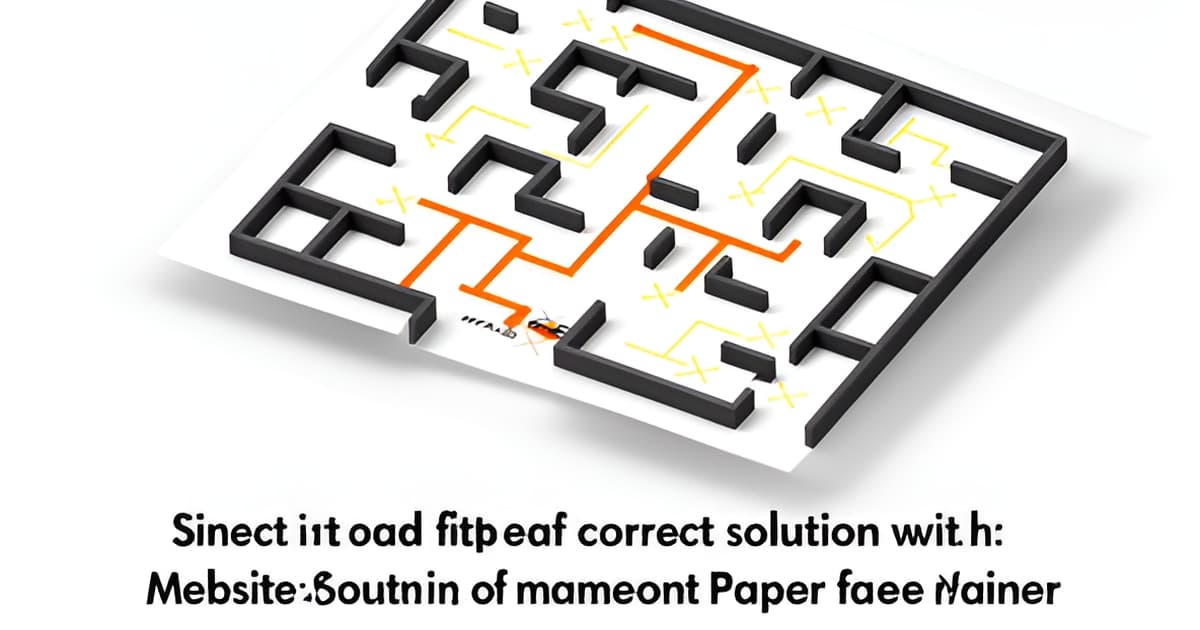
What is the best way to do a maze?
Key Facts
- Maze difficulty is driven by three measurable factors: total path length, number of turns, and long blind alleys, according to Rutgers research.
- Solvers who scan ahead with their eyes cut off-path errors by about 25%, but pay for it in slower total solving time, the study found.
- Exploration and off-path wandering consume 15–25% of total solving time on harder mazes, researchers report.
- Thicker paths with thinner walls measurably increase maze-solving time, a finding replicated in two experiments.
- Wavy, curved walls take longer to solve than straight ones because visual crowding limits perception, the Journal of Vision study concludes.
- The most reliable maze-solving technique is the never-double-back rule, which works on all maze types, per Puzzle Genius.
- BFS node expansion highly correlates with the number of steps a human takes to solve a maze, per 2025 research.
Why Mazes Feel Harder Than They Should
You've traced three dead ends, backtracked twice, and now you're staring at the entrance wondering how a page of printed lines can beat you. If you've ever searched for what is the best way to do a maze, the answer starts with understanding why mazes feel so much harder than they look.
Maze difficulty isn't random. Research from Rutgers University identified the three biggest drivers as total path length, the number of turns, and the presence of long "blind alleys". Blind alleys are especially punishing because every one you enter demands backtracking, which eats time and chips away at your confidence.
Your eyes are working against you, too. A 2025 study in the Journal of Vision found that solving time increases with thicker paths (which means thinner walls), and that mazes with wavy, curved walls take longer to solve than those with straight ones. The researchers concluded that visual crowding is a primary limiting factor: mazes are cluttered, complex stimuli, and your visual system can only process so much at once.
There's also a hidden trade-off in how you solve. The Rutgers researchers found that solvers who spend more time scanning ahead with their eyes make fewer mistakes, roughly 25% less time spent off-path, but that extra exploration increases total solving time. Rushing feels faster and costs you errors. Meanwhile, exploration and off-path wandering together account for 15-25% of total solving time, so how you manage that balance matters a lot.
Here's the good news: knowing what makes a maze hard tells you exactly how to beat it.
- Long blind alleys mean backtracking is inevitable, so treat wrong turns as data, not failure.
- More turns mean more decision points, so slow down at junctions rather than at straightaways.
- Crowded, wavy-walled designs strain your eyes, so give yourself an uncluttered page and good lighting.
- Scanning ahead reduces errors, so invest a few seconds looking before committing to a path.
One caveat worth knowing: there's no single magic method that solves every maze first try. As the folks at Puzzle Genius put it, mazes aren't sudoku, and a well-designed maze always requires a little trial and error. That's part of the fun.
This is also why difficulty varies so much between printable mazes. When you generate a maze in Printoodle, you can dial these same levers up or down: simpler mazes for a five-year-old's rainy afternoon, turn-dense ones for a Halloween party challenge alongside a round of halloween trivia, or a family trivia game to go with it. Print it. Doodle it. Done.
What Is the Best Way to Do a Maze? The Reliable Techniques
So you're staring at a maze, pencil hovering, and you want to know the best way to do a maze without wasting twenty minutes in dead ends. The good news: there are two techniques that actually work, backed by both puzzle experts and university research.
The single most reliable technique is what Puzzle Genius calls the "Hansel and Gretel" method: never double back. Like the fairy-tale siblings dropping breadcrumbs, you mark your path as you go and refuse to revisit any corridor you've already traveled.
This approach works on all maze types, as long as you follow the rule strictly. When you hit a dead end, you retrace to the last untried junction and take the unexplored branch instead. It's methodical, and it guarantees you'll eventually reach the exit.
Here's where it gets interesting. A Rutgers study on human maze-solving strategies found a real trade-off between exploring with your eyes and trusting your gut.
Solvers who paused to scan ahead with their eyes cut their off-path errors by about 25%. But that extra scanning added to their total solving time. In other words, you choose speed or accuracy:
- Explorers scan the path visually before committing, making fewer wrong turns but finishing slower.
- Impulsive solvers rely on immediate visual cues and move fast, at the risk of time-consuming errors.
- Exploration and off-path wandering together eat up 15–25% of total solving time on harder mazes.
Neither style is wrong. If you're racing a sibling at the kitchen table, go fast. If you want a clean, first-pass solve, slow down and scan.
Here's what nobody selling you a "secret trick" will say: no single method guarantees a first-try solution. As Puzzle Genius puts it, "mazes are not sudoku and cannot be solved first time with logic alone. A well-designed maze always requires a little bit of trial and error. It's all part of the fun."
That's worth remembering when you're generating mazes for the family. A maze that's too easy to brute-force isn't much fun, and one that's genuinely tricky means a few wrong turns. If you're building printable mazes for a game night, pair them with a halloween trivia round or a family trivia game so everyone stays engaged between turns.
The best way to do a maze, then, is simple: mark your path, never double back, decide whether you're playing for speed or accuracy, and accept that a dead end or two is the point.
How to Match Maze Difficulty to the Solver
Finding the right challenge starts with understanding what makes a maze feel impossible or effortless. Research into perceptual psychology shows that wall style alone can change how long it takes to reach the end: thicker paths, which create thinner walls, increase solving time, and mazes with wavy or curved walls take longer to solve than those with straight walls because they create a sense of visual crowding. For younger solvers, the goal is usually speed and confidence, while older kids and adults often enjoy the mental stretch of a denser layout.
The structural elements of a maze, specifically the number of turns and the presence of blind alleys, are the primary levers for matching difficulty to the solver. Blind alleys require back-tracking, which adds time and can frustrate beginners. Academic research identifies total path length, the number of turns, and long blind alleys as the main drivers of challenge. For a child just starting out, a design with fewer turns and no dead ends keeps the experience positive and frustration-free. As solvers age and develop spatial reasoning, introducing dense branching and curved walls provides the right amount of complexity to keep them engaged without feeling overwhelmed.
The most reliable approach to solving any maze is the "Hansel and Gretel" method, committing to the rule of never double-backing. Following this single rule guarantees a solution with maximum efficiency, regardless of the maze's complexity. It removes the guesswork and helps solvers build a mental map of the correct path as they go.
Matching a maze to the person solving it is about balancing structure and visual design. By adjusting path thickness, wall curvature, and the number of decision points, you can create a experience that feels just right, challenging enough to be engaging, but not so difficult that it becomes discouraging. Whether for a rainy-day activity or a birthday party game, the right maze turns a simple puzzle into a satisfying win.
halloween trivia and family trivia game are great ways to extend the fun beyond the page.
Print it. Doodle it. Done.
Making It Happen with Printoodle
You've learned the techniques. Now let's put them to work with mazes you actually designed yourself, tuned to exactly who's holding the pencil.
Printoodle generates print-ready mazes in seconds, and the same levers researchers identified as difficulty drivers map directly onto what you control. A study on maze difficulty found that total path length, number of turns, and long "blind alleys" are the primary factors that make a maze hard, because dead ends force backtracking. So when you're generating a maze for a six-year-old, keep the alleys short and the turns few. For a puzzle-hungry ten-year-old, crank both up.
Visual design matters just as much as structure. A Journal of Vision study found that path thickness significantly impacts solving time, and mazes with wavy walls take longer to solve than straight-walled ones because they feel visually crowded. That gives you two more dials: clean straight walls for beginners, denser curvy layouts for solvers who want a real challenge.
Here's your quick tuning guide:
- Easy: short paths, few turns, minimal dead ends, straight walls
- Medium: add longer blind alleys and more decision points
- Hard: thin paths, wavy walls, dense branches throughout
One more design tip from the research: solvers using the reliable "never double-back" method cruise through mazes with easy early sections, so front-load your trickiest branches near the start if you want to slow them down.
Mazes also pair beautifully with other activities for party nights. Generate a themed maze, then round out the evening with a halloween trivia round in October, or a family trivia game where kids race through a maze while adults answer questions. Everything lands as a print-ready PDF, sized for Letter or A4, and your library keeps every maze you've made so reprints are always free.
Want to try before you spend a credit? Grab the free sample, fire up the maze generator, and put the difficulty levers to the test. Print it. Doodle it. Done.
Frequently Asked Questions
What is the best way to solve a maze without getting stuck in dead ends?
Why do some mazes feel much harder than others even if they look similar?
How does wall design affect how long it takes to solve a maze?
Is it better to scan ahead before committing to a path or just move quickly?
Can a maze be too easy, or does a little difficulty make it more fun?
How can I customize maze difficulty for different age groups or skill levels?
Key Takeaways
{ "title": "The Maze Whisperer's Guide", "content": "Mazes are less about luck and more about the smart trade-offs we make between speed and certainty. As we've seen, the hardest challenges usually come down to three things: long blind alleys that force backtracking, dense turns that multiply de