What is the correct order to teach phonics?
Key Facts
- English's 26 letters represent 44 phonemes, yet roughly 84% of English words are phonetically regular according to literacy research.
- Phonics approaches deliver an average of +5 months of additional reading progress based on 228 studies.
- One-to-one phonics support boosts progress by +8 months, versus +4 months for small groups of up to five children per EEF Toolkit findings.
- The National Reading Panel found systematic phonics works best in kindergarten and 1st grade, based on 66 treatment-control comparisons in its landmark meta-analysis.
- More than 40 states have now passed laws requiring evidence-based reading instruction Education Week reports.
- Targeted phonics interventions work best with sessions four to five times a week over up to 14 weeks according to EEF guidance.
- Most phonics sequences start with just 8 letters before moving to CVC blending, digraphs, and vowel teams per one widely used scope and sequence.
Why There's No Single "Correct" Phonics Order (But There Is a Right Way)
Ask ten reading specialists "what is the correct order to teach phonics" and you'll get ten slightly different answers. That's not a failure of the field. Research from the National Reading Panel, the Education Endowment Foundation, and literacy experts like Joan Sedita all point to the same conclusion: no single universal sequence exists, but the principles that define a correct one are well established.
Here's the tension. English has 26 letters that represent 44 phonemes, so there's no one obvious starting point, and every program makes its own reasonable choices about which letter-sounds to introduce first. What makes a logical sequence possible at all is that roughly 84% of English words are phonetically regular, which means patterns can be taught in a deliberate order rather than memorized word by word.
So what does a "correct" order actually require? According to Keys to Literacy, any sound sequence should be:
- Explicit: letter-sound relationships are taught directly, not left for children to infer.
- Systematic: a planned set of phonics elements is taught in sequence.
- Cumulative: each new skill builds on prior knowledge.
- Simple to complex: basic concepts come first, harder ones later.
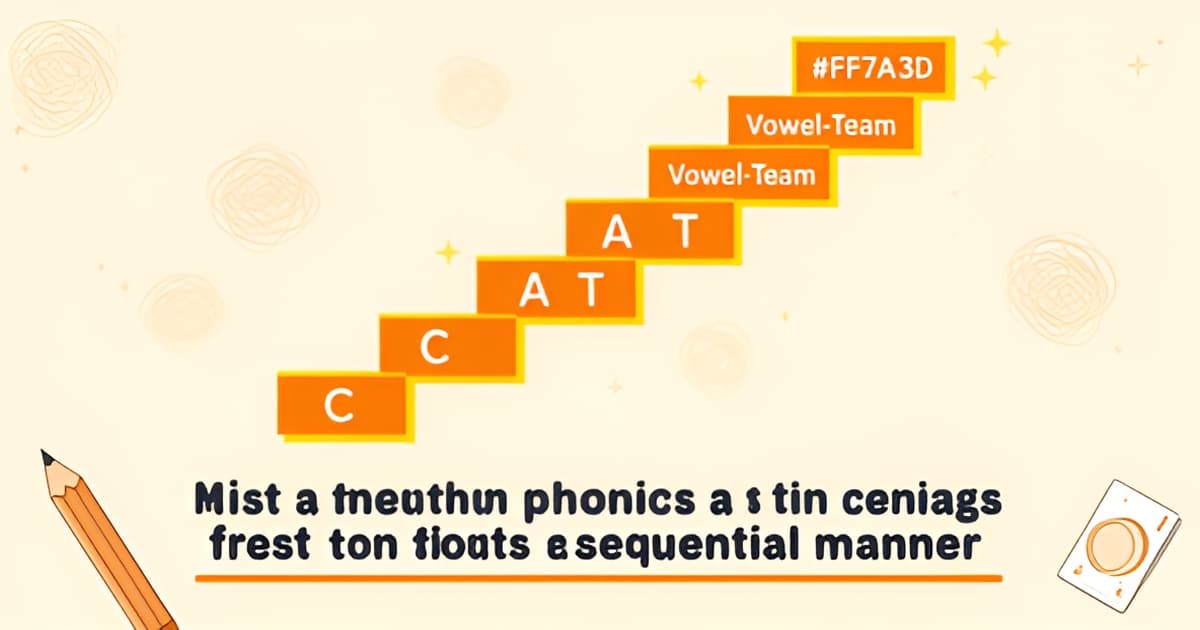
In practice, most well-regarded sequences start with a small set of letter-sounds (around 8 letters), move into blending CVC words, then progress through digraphs, silent-e, blends, vowel teams, diphthongs, r-controlled vowels, and finally affixes and trigraphs, per one widely used scope and sequence. The exact order within those stages varies by program, and that variation is fine.
The practical takeaway: if your school already uses an explicit, systematic phonics program, follow that program's own sequence rather than mixing in a second one. Consistency matters more than picking the "perfect" order, and the evidence favors any structured approach over leaving letter-sound relationships to chance.
One note on materials: whatever sequence you follow, your practice pages should match the current step. If your class is working on digraphs this week, a word search built from ch and sh words reinforces exactly that skill. Tools like Printoodle's word search maker let you generate a printable word search from your own word list in seconds, so your materials track your sequence instead of fighting it.
The Research-Backed Principles That Define a Correct Sequence
If you're wondering what is the correct order to teach phonics, the honest answer is that no single universally agreed sequence exists. What research does converge on is a set of principles that any correct order has to follow, and those principles are remarkably consistent across major literacy bodies.
The foundation comes first. According to the National Reading Panel's findings, phonemic awareness and letter knowledge are the two best school-entry predictors of early reading success. Children need blending and segmenting skills before letter-sound information becomes useful to them, which is why any sound sequence starts with oral sound work alongside a small starter set of letters, typically around eight.
The strongest evidence base belongs to synthetic phonics, where children convert letters into sounds and blend them. The NRP found positive effects for disabled readers, low-achieving students, and low-SES children, and the EEF Teaching and Learning Toolkit, drawing on 228 studies, reports that phonics approaches deliver an average of +5 months of additional progress. The delivery model matters, too:
- +8 months additional progress when phonics support is delivered one-to-one
- +4 months when delivered in small groups of up to five children
- Regular sessions four to five times a week, sustained for up to 14 weeks, work best for targeted interventions
Timing also shapes what "correct" means. The NRP's meta-analysis found systematic phonics produced its strongest effects in kindergarten and 1st grade, which is why more than 40 states have now passed laws requiring evidence-based reading instruction. Start early, start explicit, and keep it cumulative: each new grapheme or pattern builds on what a child already knows.
That match-to-knowledge principle is the one teachers most often overlook. The EEF is explicit that teaching should be matched to children's current level of phonemic awareness and their knowledge of letter sounds and patterns, or graphemes. A whole-class sequence is a map, not a mandate; your small-group materials need to reflect where each group actually sits on that map.
This is where your practice materials do real work. Whatever step your class has reached, whether that's CVC blending or vowel teams, the practice should use only the graphemes taught so far. Tools like Printoodle's word search maker let you build a printable word search from exactly the word set for the current stage, so a digraph week gets digraph words and nothing ahead of sequence.
One caveat from the research: the EEF notes that digital approaches tend to be less successful than those led by a teacher or teaching assistant. Printables work best as materials in your hands during teacher-led, small-group, or one-to-one delivery, precisely the formats where the impact data is strongest.
A Practical 11-Step Phonics Teaching Sequence
So what does the correct order to teach phonics actually look like in a real classroom? While no single universally agreed sequence exists, one widely used progression moves from simple to complex in a way that honors the research on systematic instruction. Treat it as a well-grounded example you can adapt, not the singular answer.
Start with letter-sound recognition using a small set of roughly 8 letters, chosen so children can build words quickly. From there, the progression builds each new skill on the last:
- Blending CVC words through word families like -at, -in, and -og
- Digraphs (ch, sh, th, ph, wh), then silent e (kit to kite)
- Beginning blends (sl, tr, bl, gr, st) and ending blends (nd, st, nt, mp)
- Vowel teams (oa, ai, ee, ea), diphthongs (oy, ou, ow, oi), and r-controlled vowels (ar, or, er, ir, ur)
- Prefixes and suffixes (un-, re-, -ful, -ness), then trigraphs and triple blends (tch, spr, str)
The logic is cumulative. Since English's 26 letters represent 44 phonemes, and roughly 84% of English words are phonetically regular, children who master this ladder can decode most of what they meet, according to literacy experts. If you're already using a published systematic program, follow its own sequence rather than swapping in a different one.
Timing matters as much as order. The Education Endowment Foundation finds targeted phonics interventions work best with regular sessions four to five times a week over up to 14 weeks. That's a practical planning window: one focused teaching block, revisited with steady practice, outperforms sporadic exposure.
Practice materials should match whatever step your class is on. A word search maker built around your current digraph list, or a printable word search packed with the week's CVC words, gives students applied decoding practice rather than rote rule-drilling, something researchers increasingly favor. Printoodle lets you generate these from your own lesson material in seconds, so the practice pages always mirror your sequence exactly.
One caveat: keep printables teacher-led. The EEF notes that technology-only approaches tend to underperform those led by a teacher or teaching assistant, so use generated materials within your direct instruction, small groups, or one-to-one support, where impact reaches +8 and +4 months of additional progress respectively. The materials serve the sequence, never replace it.
Print it. Doodle it. Done. Generate your next phonics practice pack at printoodle.com, and follow Printoodle for more teacher-tested activity ideas.
How to Turn the Sequence Into Practice Materials (Without Overteaching)
A beautifully sequenced scope and sequence means nothing if the practice materials don't match it. The National Reading Panel warned that programs focusing too heavily on letter-sound drills without opportunities to apply those skills are unlikely to be effective. Kids need to use what you just taught them, on words that actually contain it.
That's where stage-matched practice packs come in. The idea is simple: whatever step your class is on, every printable you hand out should reinforce exactly that step and nothing beyond it. If you're on CVC blending, the word search contains only CVC words. If you've just introduced digraphs like ch, sh, and th, the flashcards show digraph words, not vowel teams they haven't met yet. This is what makes practice cumulative rather than scattered, and it's why the sequence matters more than the materials themselves.
The risk to avoid is the opposite problem: too much teaching. Researchers like Mark Seidenberg caution that once children have mastered foundational phonics, many pick up the remaining nuances through statistical learning from reading text, and that time spent explaining obscure rules is time not spent reading. Devin Kearns has raised similar concerns about "endless explanation of rules" that adds unnecessary load for kids. In practice, that means your printables should lean toward application (finding, reading, sorting, writing words) rather than rule recitation.
Here's what a stage-matched pack looks like in practice. With a tool like Printoodle, you can generate practice materials in seconds that match whatever your sequence says comes next:
- A word search maker lets you build a puzzle from your current word set, whether that's CVC words for step two or digraph words for step three, so kids hunt for decodable words instead of random vocabulary.
- Flashcards generated from the same word list give you quick warm-up drills for small-group time, keeping review tight and on-stage.
- Worksheets built from your lesson material can ask kids to read, sort, or write words from the current step, applying the skill rather than restating the rule.
- A printable word search or bingo page makes a low-stakes review activity for the end of the week, when kids have had several exposures and need consolidation, not new explanation.
One important caveat on delivery: printables work best as teacher-led supplements, not independent screen time. The Education Endowment Foundation notes that digital technology approaches tend to be less successful than those led by a teacher or teaching assistant. The same toolkit found phonics interventions deliver around +5 months of progress on average, rising to +8 months for one-to-one delivery and +4 months for small groups of up to five children. Hand your printed materials to a grown-up and run them in those formats.
Timing matters too. Targeted interventions show the best results with regular sessions four to five times a week over up to 14 weeks, which is exactly the kind of rhythm a reusable pack supports. Since Printoodle keeps everything you generate in a library with free reprints forever, you can reprint the same digraph word search for the next group without rebuilding anything. Print it, run it with a small group, and move on to the next step in your sequence.
Frequently Asked Questions
Is there one officially correct order to teach phonics?
What does a typical phonics teaching sequence actually look like?
Should phonemic awareness come before phonics?
How effective is systematic phonics instruction, really?
Can you teach too much phonics?
How often should phonics practice sessions happen?
Beyond the Perfect Sequence: Making Phonics Practice Count
There is no single, universally agreed-upon order for teaching phonics, but the research is clear about what matters: instruction must be explicit, systematic, and cumulative, progressing from simple to complex so each new skill builds on what came before. The strongest evidence supports synthetic phonics, which the National Reading Panel found delivers the best outcomes for struggling readers and students from low-SES backgrounds, with regular sessions four to five times a week over up to 14 weeks producing the best results. While a widely used practical sequence starts with roughly eight letter-sounds, moves through CVC blending, digraphs, and silent-e, then progresses to vowel teams and r-controlled vowels, the exact path matters less than consistency. If your school already uses an explicit, systematic program, following that program's sequence is the best move, consistency outweighs the search for a perfect order. The goal is to ensure practice materials always match the step your class is on, turning theory into decodable application rather than rote drilling. Tools like Printoodle's word search maker let you generate printable word searches from your own lesson material in seconds, so your practice pages reinforce the exact sequence you're following instead of fighting it. Print it. Doodle it. Done.