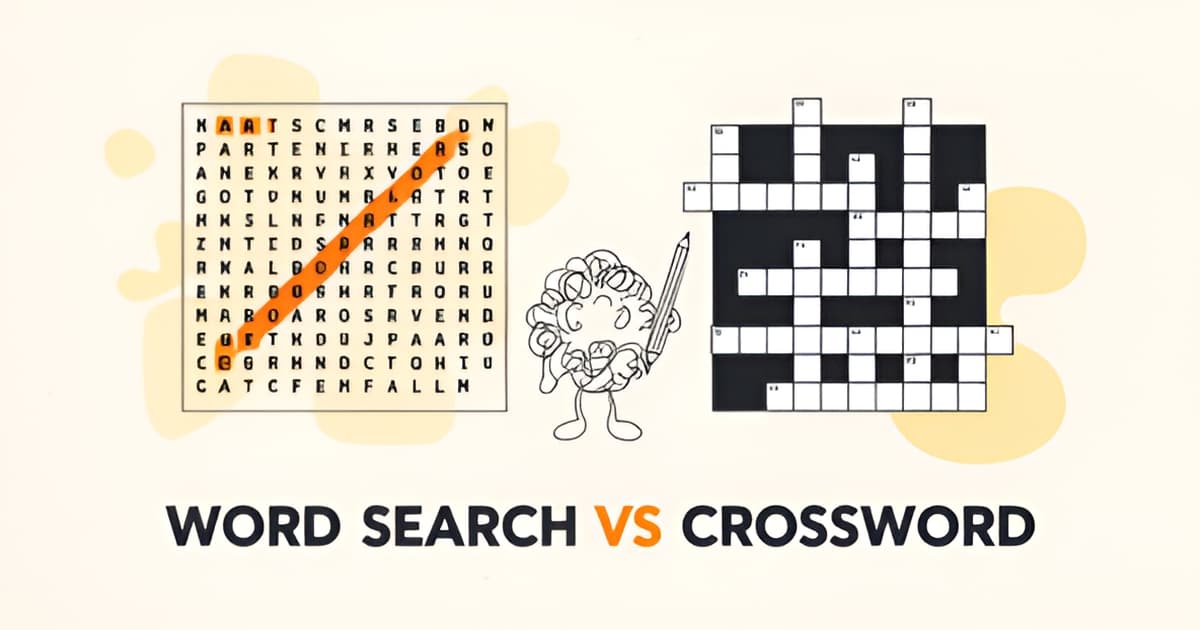
What is the difference between a word search and a crossword puzzle?
Key Facts
- A crossword can permanently stump you, while a word search answer can always be found by scanning the grid, according to Arkadium's comparison.
- Dental students who reviewed material with puzzles outscored the control group in 3 of 4 sessions (p < 0.05), per a peer-reviewed study.
- Crosswords challenge verbal skills, trivia, and memory, while word searches train visual scanning and pattern recognition, Arkadium explains.
- In a study of 60 dental students, puzzle groups scored up to 9.3 out of 10 versus 4.6 for controls in some sessions, the PMC study found.
- A 2024 study of more than 9,000 people found board games and puzzles were the strongest predictors of reasoning skills, National Geographic reports.
- Students with mild cognitive impairment who did crosswords for 12 weeks showed modest cognitive improvement in a 2022 NEJM Evidence study, per National Geographic.
- Word searches work on any device and print for offline use, offering a subscription-free resource for classrooms, according to ClassroomReview.
How They Work: The Core Mechanical Gap
At first glance, both puzzles look like a grid of letters. The experience of solving them, though, couldn't be more different, and that difference explains a lot about when to reach for each one.
A word search hands you the answers upfront. Your job is to find and circle them inside a grid of jumbled letters, where words run horizontally, vertically, diagonally, or even upside down. A crossword flips the equation entirely: you get clues, and you write answers into intersecting rows and columns, with each letter filling exactly one tile and the answer length matching the tile count. That intersecting structure is literally where the crossword gets its name, as Arkadium's puzzle comparison explains.
This mechanical gap shapes how each puzzle feels to play. Word searches produce what Arkadium calls a "chill" experience with a "seamless gameplay loop" that induces a relaxed flow state. You can play one with the TV on or music in the background, because your eyes do most of the work through visual scanning and pattern recognition. If a word is hard to spot, patience always wins: a difficult word can eventually be found by slowly scanning the entire grid.
Crosswords don't offer that safety net. A tough clue can permanently stump you, because the answer lives in your vocabulary and general knowledge, not in the puzzle itself. Arkadium's example: a clue reading "Irish boys" resolves to "lads," but only if you already know the lingo. That's why crosswords are widely considered more difficult than word searches, demanding fuller attention in a "punctuated" rhythm of reading a clue, thinking, guessing, and revising. They're also well suited to solving with a friend who can toss out suggestions.
The two puzzles even train different mental muscles. Word searches challenge visual scanning, word recognition, and pattern recognition, while crosswords challenge verbal skills, trivia knowledge, memory, and problem-solving. Arkadium's analogy is a useful one: neither exercise at the gym is "better," they just target different muscle groups. An educational study in dental training echoed this, noting that word searches help learners recognize and memorize words and their spelling, while crosswords act as a "structural, self-learning educational tool" that reinforces lecture material, as documented in the PMC study on puzzle-based learning.
So the practical takeaway is simple. Want to unwind and sharpen your focus amid clutter? Reach for a word search. Want a real mental workout that combines riddle-solving with vocabulary? That's crossword territory. If you'd like to try the relaxed version first, you can generate a custom printable word search on Printoodle from any theme or word list, or use the word search maker to build one from your own material in seconds.
What Your Brain Is Actually Doing
Your brain doesn't treat these two puzzles the same way, even though both sit quietly on a page of letters. When you work a crossword, you're running a full verbal workout: recalling trivia, weighing synonyms, and testing answers against intersecting letters. When you scan a word search, you're doing something closer to visual athletics, sweeping the grid for patterns until a word snaps into focus.
According to Arkadium's comparison of the two formats, crosswords challenge verbal skills, general knowledge, memory, and problem-solving, while word searches build visual scanning, word recognition, and pattern recognition. The difference shows up in how each one feels to solve. A word search creates what Arkadium calls a "seamless gameplay loop" that induces a relaxed flow state, because a stubborn word can always be found by slowly scanning the whole grid. A crossword is more punctuated: read the clue, think, guess wrong, solve. And a crossword clue can permanently stump you, since the answer lives in your memory, not on the page.
Here's the part worth remembering: neither puzzle is "better." Arkadium puts it well with a gym analogy. One exercise isn't superior to another; it just targets different muscle groups. These puzzles work the same way, training different cognitive capabilities:
- Crosswords exercise verbal ability, trivia recall, and deductive problem-solving
- Word searches train visual scanning, sustained attention, and pattern recognition
- Both reinforce vocabulary and spelling, just through different mechanisms
The research backs the learning angle, too. A peer-reviewed study with dental students found that word searches help learners read and memorize words "in a way that they enjoy," while crosswords act as a self-learning tool that reviews and reinforces knowledge. In that study, students who completed puzzle-based review sessions outscored the control group in three of four sessions (p < 0.05).
If you want to sharpen focus amid visual clutter, pick a word search. If you want riddle-solving with a linguistic twist, go with a crossword. And if you're building either one for a classroom or a rainy afternoon, Printoodle's word search maker and printable word search tools let you theme the grid around whatever your learners are studying, so the cognitive workout matches the moment.
Which One Fits Your Mood and Goals
Picture this: the TV is on, dinner is simmering, and you want something to do with your hands. One puzzle fits that moment perfectly. The other will stop you mid-stir until you figure out a five-letter word for "Irish boys." That's the real difference between the two, and it's worth knowing before you print anything.
Ask most people what is the difference between a word search and a crossword puzzle, and they'll describe the mechanics: circling hidden words in a jumbled grid versus solving clues and filling intersecting answers. But the deeper difference is the mental state each one puts you in. According to a comparison from puzzle developer Arkadium, word searches are a "chill" experience that induces a relaxed flow state, while crosswords are more "punctuated," demanding your fuller attention.
The word search loop is forgiving by design. A difficult word can always eventually be found by slowly scanning the entire grid, so you're never truly stuck. That's why it works as a background activity alongside music or a show, and why it targets visual scanning and pattern recognition rather than trivia recall. If you want a printable word search for exactly this kind of low-stakes evening, Printoodle can generate one from any theme in seconds.
Crosswords operate differently. The rhythm is read the clue, think, guess, sometimes get it wrong, and the clue-solving component is why crosswords are largely considered the harder of the two. A tough clue can permanently stump you, since the answer exists nowhere in the puzzle itself. That friction is also the appeal, especially when you tackle one with a friend who can toss out suggestions.
So how do you choose? Match the puzzle to the mental state you want:
- Winding down with background noise on? A word search keeps your hands busy without hijacking your focus.
- Want to feel sharp and stretch your vocabulary? A crossword challenges verbal skills, memory, and problem-solving.
- Puzzling with a partner? Crosswords shine here, since two brains cover more trivia.
- Helping a kid practice spelling? Word searches let learners memorize words "in a way that they enjoy," as researchers noted in a study on puzzle-based learning.
Neither is better, as Arkadium puts it, any more than one gym exercise is better than another; they simply target different cognitive muscle groups. Pick based on the evening you're having, not the puzzle you think you should be doing.
Print vs. Digital: Where Each Lives
Paper or pixels? When you're weighing what is the difference between a word search and a crossword puzzle in practical terms, the honest answer on format is: not much. Neither medium belongs exclusively to either game. According to one detailed comparison, both puzzles live everywhere: on websites, apps, and online publications digitally, and in books, magazines, newspapers, and worksheets on paper. You can solve a crossword on your phone during a commute or fill in a word search from a puzzle book at the kitchen table.
Where the formats diverge is in how people actually use them. Word searches have carved out a particular niche as a screen-free wellness activity, something you can print once and work on away from a screen entirely. The same comparison notes that word searches induce a relaxed flow state, which makes them a natural fit for unplugged downtime in a way that attention-demanding crosswords, with their punctuated clue-solving rhythm, don't always match.
Classrooms tell a similar story. Word searches work across any device, from desktop to smartphone, and come with print options for offline use, according to ClassroomReview's look at how adults and teachers use them. That flexibility matters for teachers juggling mixed device access, and for parents trying to cut screen time without cutting the fun. The same source highlights another practical advantage: new puzzles appear regularly across educational and recreational topics, giving teachers a constantly refreshing resource that doesn't require subscriptions or complicated software. That's a real barrier removed for classrooms on tight budgets.
For teachers who want puzzles tied to their own material, the options break down like this:
- Print from a puzzle library for instant, screen-free handouts
- Generate puzzles from your own vocabulary lists or lesson content
- Use free online generators when you need something topical in a hurry
- Keep a stash of themed printables for early finishers and substitutes
The research backs the classroom case, too. A peer-reviewed education study found word searches help learners recognize and memorize words "in a way that they enjoy," which supports learning words and their spelling. Students in the study were given 30 minutes to complete both puzzle types, and the puzzle groups outperformed controls in 3 of 4 sessions (p < 0.05).
If you're leaning toward the printable route, a word search maker like Printoodle's lets you build a themed grid from your own word lists in seconds, and every printable word search you create stays in your library with free reprints forever. Print it, doodle it, done.
Frequently Asked Questions
What is the difference between a word search and a crossword puzzle?
Which is harder, a crossword or a word search?
What skills does each puzzle exercise?
Can word searches and crosswords actually help you learn?
When should I pick a word search instead of a crossword?
Do I need a screen to play either puzzle?
So, Which Grid Is Calling Your Name?
The answer to what is the difference between a word search and a crossword puzzle comes down to the experience you want, not which puzzle is superior. A word search hands you the words and asks your eyes to hunt, creating a relaxed flow state perfect for winding down with the TV on. A crossword asks your memory and vocabulary to fill the gaps, in a punctuated rhythm that can stump you for good. Neither is better, they just train different cognitive muscle groups, and both have a place in classrooms and living rooms alike. Research even backs the classroom case: in a peer-reviewed study with dental students, puzzle-based review groups outscored controls in three of four sessions. Ready to put the relaxed one to work? Use Printoodle's word search maker to build a themed grid from your own words, or grab a printable word search in seconds. Print it, doodle it, done.