What is the easiest way to do long multiplication?
Key Facts
- There is no single easiest method, PlanBee's guide says the best multiplication method depends on the child's age, confidence, and the numbers involved, per primary education research.
- Schools teach multiplication in a defined sequence: repeated addition in Year 2, partitioning in Year 3, the grid method in Year 3/4, and long multiplication by Year 5/6, according to PlanBee's curriculum guide.
- The recommended practice rhythm is just 3–10 mixed problems per day plus one deeper weekly session, spread across a 10–12 session learning arc, per method guides.
- Times-table fluency up to 10×10 is the benchmark that makes everything else possible, knowing 6 × 4 = 24 unlocks 60 × 4 and 16 × 4, according to mathematics educator Nina Boal.
- A simple efficiency trick: putting the number with 0s or 1s on the bottom of a problem like 14056010 × 23456548 can skip roughly six steps, per a credentialed math educator.
- Human calculator Shakuntala Devi multiplied two random 13-digit numbers in 28 seconds, but experts warn such mental shortcuts cause errors when carrying 33 instead of single digits, per contributor accounts.
- Misaligned digits cause more long multiplication errors than weak math, graph-paper-style straight columns are the fix, per practice recommendations.
Why Long Multiplication Feels So Hard for Kids
Ask a frustrated nine-year-old what is the easiest way to do long multiplication and you'll usually get a shrug. That shrug is the real problem: kids get handed a mechanical procedure, multiply by the ones digit, then the tens, then add the partial products, without anyone explaining what any of it means. According to PlanBee's primary education guide, children are taught different multiplication methods precisely so they understand how multiplication works, "not just how to follow a procedure."
When the procedure arrives before the understanding, carrying feels arbitrary. A child who hasn't grasped place value doesn't see why that little 2 scrawled above the tens column matters, or why the second row of working gets shifted one place to the left. PlanBee notes that children must understand place value to "remember to multiply by tens, not just by the tens digit." Without that foundation, every step is guesswork, and errors pile up fast.
Here's the honest answer, and it's not a trick: the easiest method depends on the child's age, confidence, and the numbers involved. PlanBee puts it plainly: the best multiplication method varies by learner. Younger children benefit from practical and pictorial approaches, while older or more confident children can handle short and long multiplication for bigger calculations. There is no single shortcut that works for everyone.
That's why schools follow a deliberate progression rather than jumping straight to columns. The sequence PlanBee describes looks like this:
- Year 2: repeated addition (3 + 3 + 3 + 3)
- Year 3: partitioning numbers into tens and ones
- Year 3/4: the grid method as a bridge toward formal written methods
- Year 4/5: short multiplication
- Year 5/6: long multiplication with two-digit numbers
Each stage builds on the last, so by the time a child meets the standard algorithm in Year 5 or 6, the place value ideas underneath it are already familiar. The grid method sits in the middle of that journey as the connective tissue: it shows partial products visually, which makes the carrying in the column method feel logical rather than magical.
This is also why generic worksheets so often disappoint. A page of 30 identical column-method problems might suit a confident Year 6 pupil, but it overwhelms a Year 4 child still finding their feet with partitioning. Practice matched to the child's current stage works better, and that's the thinking behind tools like Printoodle's long multiplication worksheets, which let you generate pages pitched at whichever step of the progression a child is actually on. The same logic applies later, when long division worksheets become the natural next challenge in the formal written methods sequence.
Understanding why long multiplication feels hard is the first step to making it feel easy. The method itself is rarely the villain; it's being handed the ending of a story without the beginning.
The Easiest Path: Partial Products, Then the Box Method, Then Columns
If you're looking for the easiest way to do long multiplication, the honest answer is that it's a path, not a single trick. Education specialists consistently describe a three-stage progression: partial products first, the box method second, and the standard column algorithm last, once the "why" is secure.
Stage 1: Partitioning and partial products. Before touching columns, break the problem apart by place value. Take 34 × 27 and split the 27 into 20 and 7:
- 34 × 20 = 680
- 34 × 7 = 238
- 680 + 238 = 918
According to the most detailed method guide on this question, partial products make the algorithm feel logical rather than mechanical, because every step traces back to place value. Children as early as Year 3 learn partitioning, and primary curriculum guides treat it as the foundation for everything that follows.
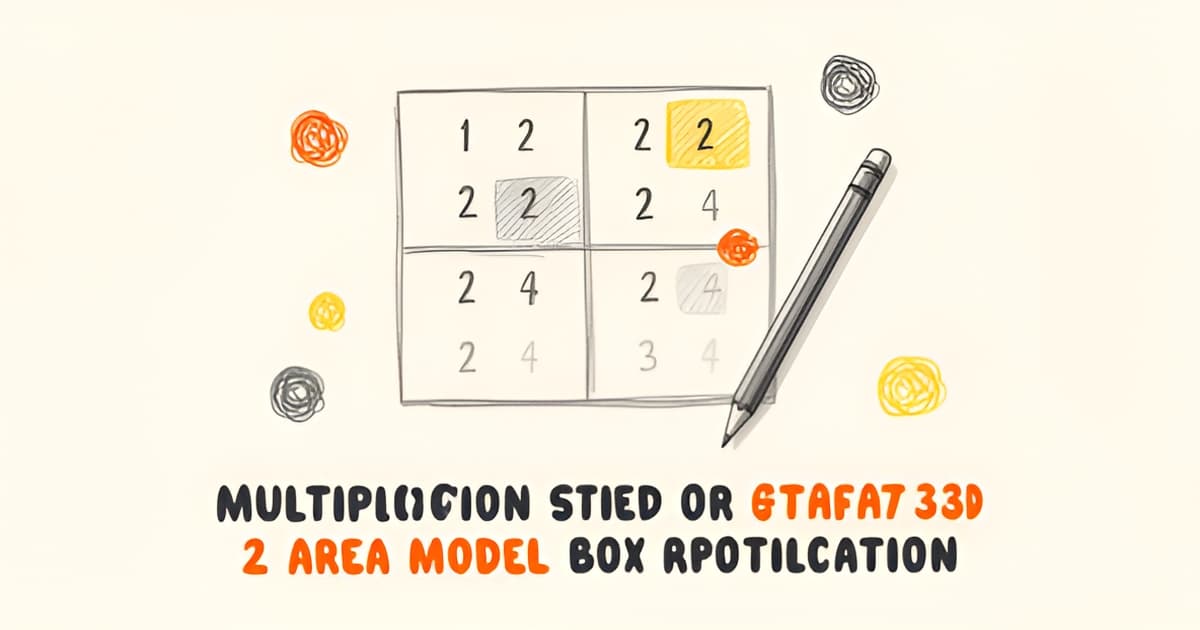
Stage 2: The box (grid) method. Draw a rectangle, split it into a grid, and fill each cell with one partial product. For 34 × 27, you'd have four boxes: 30×20 = 600, 30×7 = 210, 4×20 = 80, 4×7 = 28. Add them up and you get 918 again.
The box method earns its place because it shows visually why carrying happens in the column method, and it reduces cognitive load while a child builds confidence. PlanBee positions the grid method as the bridge between partitioning and formal written methods, typically taught in Year 3/4 before short and long multiplication arrive in Year 5/6. It's also where structured practice pages help most: Printoodle's long multiplication worksheets can mix box-model layouts with explicit partial-product notation, matching the recommended structure.
Stage 3: The standard column algorithm. Once the two earlier stages feel natural, the columns stop being mysterious. Multiply by the ones digit, then the tens, then add the partial products:
    34
  × 27,,  238   (34 × 7)
  680    (34 × 20, shifted one place),,  918
The critical insight, per the teaching progression research, is that children must multiply by the tens, not just the tens digit. That shift in the second row is exactly what the box method made visible.
Three habits make the whole path faster:
- Memorize multiplication facts up to 10×10 first; fluency there carries everything else.
- Practice 3–10 mixed problems daily, with one deeper problem-solving session each week.
- Write digits in straight columns; neat alignment prevents most errors. Graph-paper-style layouts help.
A quick estimation check keeps things honest: 34 × 27 should land near 30 × 30 = 900, and it does. Once this progression clicks, the same formal-written-methods sequence continues naturally, and Printoodle's long division worksheets make the obvious next step. Print it. Doodle it. Done.
Before You Start: The Habits That Make Any Method Work
Wondering what is the easiest way to do long multiplication often leads people hunting for a trick, but the sources agree the real shortcut is preparation. Before any method clicks, a handful of habits determine whether the process feels smooth or frustrating. Nail these first and every approach gets easier.
Start with times tables. Nina Boal, who holds a B.A. in Mathematics & Education, puts it plainly: "first, learn your multiplication facts." The benchmark is fluency up to 10×10, and it matters more than it sounds. As PlanBee's teaching guide explains, knowing 6 × 4 = 24 is what lets a child handle 60 × 4 or 16 × 4, because times tables facts are the foundation every written method rests on.
Neatness comes second. Quora contributor Michael Bauers recommends "practice writing clearly, and keeping the digits in nice straight columns." Misaligned digits cause more errors than weak math does. Graph paper helps, and so do practice pages with built-in column structure, like the long multiplication worksheets you can generate on Printoodle with grid-aligned layouts.
Here's the full pre-flight checklist:
- Memorize multiplication facts up to 10×10 before touching multi-digit problems.
- Write digits in neat, straight columns. Graph paper or a structured worksheet makes this automatic.
- Start with 2-digit × 2-digit problems, then scale up once those feel comfortable.
- Put the number with 0s or 1s on the bottom. Boal's tip: rearranging 14056010 × 23456548 into 23456548 × 14056010 lets you skip roughly six steps.
Then build in error checks. Rounding estimation is the fastest one: before solving 34 × 27, round to 30 × 30 = 900. If your final answer lands nowhere near 900, something went wrong and you'll know where to look. A calculator double-check at the end catches anything estimation misses, and it costs nothing.
One caution from the research: don't chase speed early. Bauers notes that speed is unimportant at first, and Ken Booth's account of Shakuntala Devi's method, multiplying two random 13-digit numbers in 28 seconds, comes with a warning. When you're carrying 33 instead of single digits, he says, "you can easily make mistakes in the arithmetic." Accuracy first, fluency later.
For practice structure, the recommended rhythm is short daily mixed drills of 3–10 problems plus one deeper weekly session, spread across a 10–12 session progression. That's a manageable commitment, and printable pages make it easy to keep a fresh supply on hand. Once multiplication is solid, the same column-alignment habits carry straight into long division worksheets, the natural next step in the formal written methods sequence.
How to Practice It: A Simple Weekly Routine with Printable Pages
Knowing the method is only half the battle. The half that actually decides whether a child can do long multiplication is practice, and the research is refreshingly specific about what that practice should look like: short daily sessions, not marathon worksheet piles.
According to the practice recommendations that came up repeatedly in our research, the sweet spot is 3 to 10 mixed problems per day, plus one deeper problem-solving session each week. Spread that across roughly 10 to 12 sessions and you have a realistic learning arc that moves from place-value drills to area models and finally to the standard column algorithm. That's a few weeks of modest effort, not a heroic campaign.
Here's how a simple week breaks down:
- Days 1–3: Place-value and partitioning drills, so 34 × 27 reads as 34 × 20 plus 34 × 7 before anything else happens.
- Days 4–7: Area or grid method problems, 2-digit × 2-digit, where the boxes make the partial products visible.
- Days 8–10: The standard algorithm with the same numbers the child already solved with the grid, so the steps feel familiar rather than mechanical.
- Days 11–12: Larger numbers, zeros, and carrying, finished with an estimation check (34 × 27 ≈ 30 × 30 = 900) to catch wild answers.
Neatness matters as much as the schedule. One Quora contributor put it plainly: better to practice writing clearly and keeping digits in nice straight columns, since misaligned columns cause more errors than weak times tables. That's exactly why Printoodle's long multiplication worksheets use graph-paper-style grids and explicit partial-product notation: the page does the aligning so the child can focus on the maths. You can generate stage-matched pages too, whether your learner is still on the grid method or ready for full column multiplication.
One practical tip from the research before you start: memorize multiplication facts up to 10 × 10 first, because knowing 6 × 4 = 24 is what makes 60 × 4 or 16 × 4 tractable later. And once long multiplication clicks, long division worksheets are the natural next formal written method to pick up, since both belong to the same progression schools follow from Year 5 onward.
Print it. Doodle it. Done.
The Path, Not the Trick: Why Long Multiplication Takes a Sequence
Long multiplication stops feeling like a mysterious procedure and starts feeling like a familiar tool when it's approached as a progression rather than a single shortcut. As the research shows, the easiest method depends entirely on the learner: younger children benefit from concrete and pictorial approaches, while older or more confident learners can tackle the standard algorithm once place value is secure. This is exactly why schools follow a deliberate sequence, from repeated addition in Year 2, through partitioning and the grid method in Years 3 and 4, to short and long multiplication in Years 5 and 6. Each stage builds on the last, so by the time a child encounters the column method, the underlying concepts are already familiar. Generic worksheets often miss the mark because they don't match the child's current stage, which is why structured, stage-matched practice matters. Tools that let educators and parents generate pages pitched at the right step, whether that's the grid method or the standard algorithm, turn frustration into fluency. And once multiplication is mastered, the same column-alignment habits carry naturally into long division, the next logical step in the formal written methods sequence. Print it. Doodle it. Done.