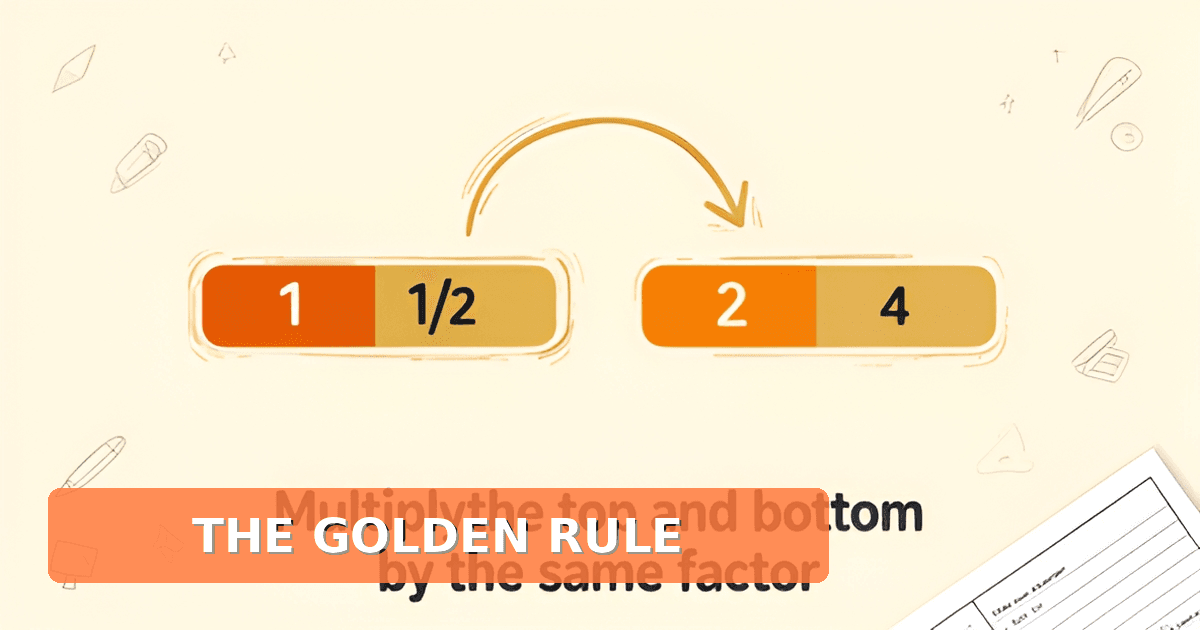
What is the golden rule of fractions?
Key Facts
- The golden rule of fractions: multiply or divide both numerator and denominator by the same non-zero number, and the value stays unchanged, per MathWorld.
- Students meet equivalent fractions in 3rd grade under Common Core (CCSS.Math.3.NF.3), extended in 4th grade, according to LibreTexts.
- Frax reports its fractions program was 3x more effective than the average intervention for 3rd-graders and 5x for 4th-graders, according to its research.
- Number lines and block models beat pie models for teaching fraction equivalence, especially with larger denominators, Frax findings show.
- TeachableMath warns that stating the rule upfront wastes a chance for students to build inductive reasoning skills, arguing for discovery first.
- Mathnasium claims 94% of parents report improvement in their child's math skills, per company-reported data.
- NCTM board member David Dai says teaching procedures over concepts leaves kids with a weak early foundation, telling Education Week.
Why Equivalent Fractions Trip Kids Up (and Why It Matters Later)
Fractions are often the first place in math where kids learn to follow a procedure without understanding why it works. Multiply both parts by 2, cross-multiply, flip and multiply: the steps come quickly, the meaning comes slowly, and the gap widens quietly.
David Dai, an 8th and 9th grade math instructor at Barton Academy and an NCTM board member, put the problem plainly in an Education Week interview: "We try [to] teach rules and procedures and algorithms for calculations, ... as opposed to developing a conceptual understanding for kids. Their foundation early on gets weaker."
Equivalent fractions sit right at the center of that weak foundation. Under the Common Core, students first meet them in 3rd grade (CCSS.Math.3.NF.3), and the idea gets extended in 4th grade (CCSS.Math.4.NF.1). The timing matters because equivalent fractions are the entry point to the golden rule of fractions: whatever you do to the denominator, you must also do to the numerator, and the value stays the same.
Why does a 3rd-grade topic deserve this much attention? Because so much of later math is built on top of it:
- Adding and subtracting fractions with different denominators requires renaming fractions as equivalents.
- Decimals and percentages are, at heart, equivalent fractions written in special notation.
- Algebra depends on the same move: multiply numerator and denominator by the same non-zero value without changing the expression.
- Ratio, proportion, and scale drawings all borrow the same logic.
As Third Space Learning notes, fractions in upper elementary "act as the foundation from which several other topics, such as decimals and percentages, are developed." A student who memorized the trick but never saw why 4/8 and 1/2 name the same amount will hit a wall when the trick no longer fits the problem.
There's also a pedagogical disagreement worth knowing about. Some educators argue that stating the rule upfront wastes a chance for students to build reasoning; the TeachableMath approach has kids discover patterns through paper-folding and fraction strips first. Others favor explicit instruction of the rule as a foundational principle. In practice, most classrooms need both: guided discovery with visual models, followed by a clear statement of the rule, then practice.
That's the gap tools like Printoodle's worksheet generators try to close. Teachers can build print-ready practice pages from their own lesson material, pairing visual exercises with clearly stated rules, and reprint them free whenever a student needs another pass. Fractions reward repetition done thoughtfully, and a shaky foundation is far cheaper to reinforce in 3rd grade than to rebuild in algebra.
What Is the Golden Rule of Fractions? The Definition That Fixes It
The golden rule of fractions is simple but powerful: you can multiply or divide both the numerator and denominator by the same non-zero number, and the fraction's value stays exactly the same. As MathWorld explains, citing Conway & Guy's The Book of Numbers, this principle creates equivalent fractions without changing the quantity represented. It is the foundation for simplifying, comparing, and operating with fractions across all grade levels.
One of the clearest ways to see this rule in action is with money. Four quarters make a dollar, and so do 10 dimes, both represent the same value, even though the numbers look different. Half a dollar can be written as 50/100, 1/2, or 2/4; multiplying the top and bottom by the same number keeps the "amount" unchanged. This concrete example helps students move from abstract symbols to real-world understanding.
However, there is one critical rule-breaker to remember: never multiply by zero. If you multiply the numerator and denominator by zero, the fraction becomes undefined, and the mathematical relationship collapses. The golden rule only works when the multiplier is a non-zero number.
Printoodle worksheets illustrate this rule clearly through practical, visual exercises that help students discover equivalent fractions through guided practice. Teachers can use the platform’s word search maker and printable word search tools to create custom activities that reinforce fraction concepts in an engaging format. These resources allow educators to generate print-ready pages that align with lesson material, making the golden rule accessible for classroom use.
word search maker and printable word search
Show It Before You Say It: Two Teaching Camps and a Workable Middle
The golden rule of fractions is straightforward: both the numerator and denominator may be multiplied by the same non-zero number without changing the fraction's value, creating an equivalent fraction. This principle forms the foundation for understanding equivalence, yet how educators introduce it remains a subject of debate. Research reveals a clear tension between two teaching camps. TeachableMath argues that stating the rule upfront denies students the chance to reason inductively, while Mathnasium and LibreTexts support explicit instruction as a necessary foundation. A three-step sequence offers a workable middle ground: begin with guided discovery using fraction strips or number lines, name the rule, then apply it through practice. This approach respects the logic students need while ensuring they have a clear procedure to rely on. Notably, Frax findings indicate that number lines and block models are more intuitive for teaching equivalence than pie models, particularly when denominators grow larger, as area models can require significant mental energy and risk subtle errors.
Printoodle worksheets illustrate this rule clearly by providing structured practice where students can apply the principle across varied representations. The platform’s tools allow teachers to generate customized exercises that reinforce the concept through visual and hands-on engagement. word search maker and printable word search activities can be adapted to include fraction terms, offering a playful way to revisit vocabulary while solidifying understanding. Whether used for quick classroom warm-ups or targeted review, these resources help bridge the gap between the rule and student application.
For parents and teachers looking to support fraction learning at home or in the classroom, Printoodle offers a free tier of 10 credits upon email verification, with credit packs available starting at $5. Once created, every worksheet can be reprinted forever at no additional cost.
Putting It on Paper: How to Practice the Rule with Printable Worksheets
Pull up a chair and let’s talk about putting that golden rule on paper. The heart of fraction work rests on a simple but powerful idea: you can multiply the top and bottom of any fraction by the same number, and its value stays exactly the same. It’s the engine behind equivalent fractions, and getting comfortable with it early makes everything else, adding, comparing, converting, a whole lot easier.
Printoodle worksheets turn this rule into a hands-on routine. A typical sequence might start with a visual match, where students pair a fraction like 2/3 with its twin 4/6 using shaded blocks or number lines. Next comes a fill-the-missing-numerator challenge: given 3/5 = __/10, the learner figures out the multiplier and fills in the blank. From there, the rule shows up in real-world contexts, pizza slices, a half-hour on the clock, or two-for-one free throw stats, so the math feels connected to things they actually notice.
What makes these sheets click is the variety of models. Some use area diagrams, but research notes that number lines and block models are often more intuitive, especially as denominators get larger. Printoodle lets teachers generate these different representations from their own lesson material, so students see the rule across multiple views instead of just one.
When it’s time for a break from the numbers, the classroom can switch gears with a quick word search. Teachers can pull up the word search maker to create a custom puzzle using fraction vocabulary, or grab a printable word search ready-to-go. It’s a low-pressure way to reinforce terms without feeling like another drill, and the free tier gives 10 credits on sign-up, with reprints free forever.
Frequently Asked Questions
What is the golden rule of fractions?
Why can't you multiply the top and bottom of a fraction by zero?
When do students learn the golden rule of fractions in school?
Is it better to teach the rule directly or let kids discover it themselves?
What's a real-world example that makes equivalent fractions click?
Which visual models work best for teaching equivalent fractions?
One Rule, Learned Once, Used Forever
So, what is the golden rule of fractions? Multiply or divide the numerator and denominator by the same non-zero number, and the fraction's value never changes. It's a one-line rule, but it carries everything that comes after it: adding unlike denominators, decimals, percentages, and eventually algebra. The real work isn't stating the rule, it's helping kids see why it's true, whether through fraction strips, number lines, or a dollar's worth of quarters and dimes. That's where thoughtful practice pays off. Printoodle lets teachers and parents generate print-ready worksheets from their own lesson material, pairing visual models with clearly stated rules, and every page can be reprinted free whenever a student needs another pass. If you're ready to reinforce the rule this week, start simple: build a short equivalent-fraction practice set, then mix in a lighter activity using the word search maker or a printable word search loaded with fraction vocabulary. Sign up for the free tier, 10 credits on email verification, credit packs from $5, and see what a well-designed page does for a shaky foundation. Print it. Doodle it. Done.