What is the Japanese trick for multiplication?
Key Facts
- About 40% of a Grade 4 class (8 of 20 learners) struggled with multiplication because they hadn't mastered their times tables, per a 2025 study.
- A four-week JaMM Mastery Program improved struggling Grade 4 students' speed, accuracy, and confidence in one-digit multiplication, with 6 of 8 participants saying it made problems faster and easier, according to the study.
- In a 2025 Turkish action research study, all 4 third-graders who had failed to learn multiplication through traditional methods succeeded with the Japanese line method, as documented in the research.
- The Japanese trick requires only counting skills, no prior knowledge of multiplication tables or addition, the action research study notes.
- Solving 9×8 with the line method means counting 72 intersections one dot at a time, which is why math educators call it inefficient for larger numbers.
- Students can grasp the commutative property just by rotating the paper 90 degrees, the 2025 action research found no lecture required.
- The method is really a geometric picture of long multiplication, summing products that are coefficients of the same power of 10, according to Archimedes Laboratory.
Why Times Table Drills Leave Some Kids Behind
Watch a classroom of nine-year-olds recite times tables and you'll spot them quickly: the kids mouthing along, hoping nobody calls on them. For some students, memorization simply doesn't stick, and the consequences compound fast.
The scale of the problem is easy to underestimate. In one 2025 study of a Grade 4 class, 8 of 20 learners, about 40%, struggled with multiplication because they hadn't mastered their tables. These weren't kids who couldn't do math. They were kids trapped at the first step, expected to recall 81 facts from memory before they'd ever been shown what multiplication looks like.
Rote drills create a second problem that's harder to measure: math anxiety. When a child blanks on 7×8 in front of peers, the failure feels personal rather than procedural. Research on visual-based methods links them to increased confidence and motivation, reducing math anxiety and improving performance. Meanwhile, a separate action research study in Türkiye worked with four third-graders who had all failed to learn multiplication through traditional methods. Every one of them. Memorization had already shut the door; the question was whether a different approach could reopen it.
The pattern shows up repeatedly in struggling learners:
- They can't retrieve facts from memory under pressure, even ones they knew yesterday.
- They think in pictures and patterns, so abstract recitation gives them nothing to hold onto.
- They've decided they're "bad at math" long before anyone shows them an alternative.
What these kids need is a way to see multiplication instead of recite it. That's exactly what the Japanese trick for multiplication offers: a method where you draw diagonal lines, count where they cross, and read the answer off the intersections. It requires only counting skills, with no prior knowledge of multiplication tables, which removes the exact barrier that's been holding these students back.
This is also why the trick works so well alongside traditional practice rather than instead of it. A child who first understands multiplication visually has a reason to then build fluency with a multiplication table or multiplication chart. Printoodle's worksheet generator lets teachers create pages that demonstrate the line-drawing method step by step, so kids can practice the visual process on paper instead of guessing at it from a textbook diagram.
The stakes are real. Curriculum standards expect students to know all one-digit products from memory by the end of Grade 3, and every year of falling behind makes the gap harder to close. The kids who struggle with drills don't need more drills. They need a picture.
What Is the Japanese Trick for Multiplication? Drawing Lines Instead of Memorizing
Imagine solving 12 × 32 without a single memorized fact. That's exactly what the Japanese multiplication trick promises: you draw lines, count where they cross, and the answer appears.
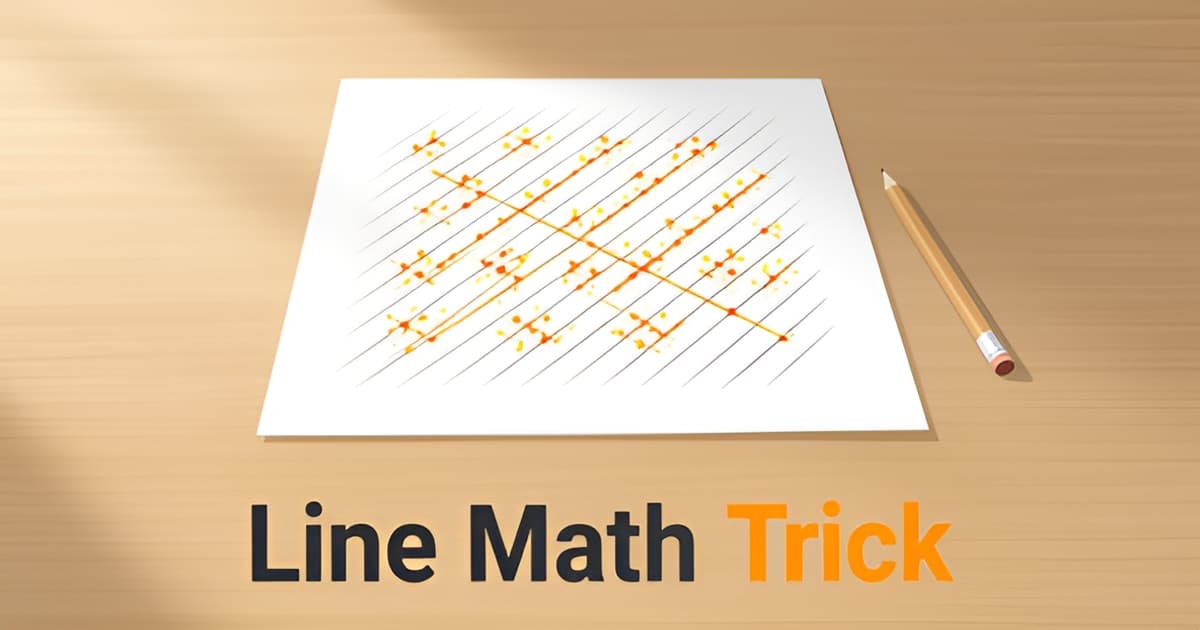
So what is the Japanese trick for multiplication? In its simplest form, you solve problems "by merely drawing a few lines and counting the points of intersections," as one math education guide puts it. Each digit in your first number becomes a set of diagonal lines drawn left to right. Each digit in your second number becomes diagonal lines drawn right to left, crossing the first set and forming a diamond pattern. Then you count.
Here's the full procedure:
- Draw diagonal lines for the first number: one line per digit, grouped left to right (tens first, then ones).
- Draw lines for the second number in the opposite direction, so they cross the first set.
- Group the intersection points into vertical clusters, which correspond to hundreds, tens, and ones.
- Count each cluster. If a cluster tops 9, carry the extra to the next cluster, just like regrouping in standard addition.
A worked example: 12 × 32 = 384. Draw one line for the tens digit of 12 and two lines for its ones digit. Then draw three lines for the tens of 32 and two for its ones, angled the opposite way. The intersections fall into three clusters: 3 in the hundreds corner, 8 in the tens, and 4 in the ones. Read them together and you get 384, matching the worked example used by math educators.
Carrying works visibly too. In a problem like 12 × 15, ten ones literally group together and shift over as one ten, added to the 7 tens to make 8. Kids can see regrouping happen instead of just trusting a rule.
The real surprise is what the method doesn't require. A peer-reviewed action research study notes that students can solve these problems "without requiring any prior knowledge of addition operations or multiplication tables." If a child can count, they can multiply. That's why the approach has helped third-graders who had failed with traditional methods, and why a four-week program with Grade 4 students improved speed, accuracy, and confidence.
Underneath the lines, this is still standard long multiplication. The parallel lines act as decimal placeholders and the intersection dots act as products, so the drawing is a geometric picture of the distributive property. Kids who learn both see the connection, and that's the payoff.
If you want to practice alongside the trick, Printoodle can generate step-by-step worksheets with pre-dotted guides and carrying boxes, and you can pair them with a multiplication table or multiplication chart for traditional fact practice. Print it, doodle it, done.
Why the Line Method Actually Works: Long Multiplication Drawn as a Picture
Here's the part that surprises most parents and teachers: the line method isn't a shortcut or a novelty. It's long multiplication, drawn as a picture. Once you see that connection, the "trick" becomes one of the best teaching tools you can hand a child.
Every line diagram is really a geometric version of the distributive property. When you draw 12 as one line and two lines, then cross it with the lines for 15, each cluster of intersections represents one of the partial products you'd compute in the standard algorithm. As math educators at Whizz explain, the lines are "really just a visual way of representing those four steps" of long multiplication, and Archimedes Laboratory describes the whole thing as summing "all the products that are coefficients of the same power of 10."
Even carrying becomes visible. Take 12 × 15: the ones cluster produces 10 dots, which literally bundle into one ten that moves over and joins the 7 tens to make 8. A child doesn't have to trust an abstract rule about regrouping. She watches ten ones become one ten on the page.
There's a bonus insight hiding in the paper, too. Rotate the diagram 90 degrees and the problem reads 15 × 12 instead of 12 × 15, with identical intersection counts. A 2025 action research study found that students grasp the commutative property simply by changing the orientation of the paper. No lecture required.
The evidence from 2025 backs up the pedagogy:
- A four-week JaMM Mastery Program with Grade 4 students improved their speed, accuracy, and confidence in one-digit multiplication.
- In that same study, 6 out of 8 participants said the method made solving problems faster and easier.
- In the Turkish action research, all four third-graders who had failed to learn multiplication through traditional methods succeeded with the line approach.
That last point matters most. These were students for whom the standard algorithm simply wasn't landing, and the visual method reached them where memorization and column arithmetic hadn't. The researchers noted the approach frees students from the limits of rote learning by letting them visualize the math, and it requires only counting, with no prior mastery of multiplication tables needed.
If you want to try this at home or in class, keep the problems small. The method shines for 2-digit numbers, where the dot counts stay manageable, and it pairs well with a multiplication table or multiplication chart for building fact fluency alongside the conceptual work. Printoodle's worksheet generator makes it easy to create step-by-step practice pages with pre-dotted guides and carrying boxes, targeting the exact difficulties students hit: counting dots, grouping clusters, and handling carry-overs.
The line method won't replace the algorithm your child eventually needs. But as a bridge from "memorize it" to "understand it," it's hard to beat.
Where the Trick Hits Its Limit (and How to Bridge to Real Fluency)
Every method has a breaking point, and for the Japanese multiplication trick it arrives quickly: ask a child to solve 9×8 with lines and they'll find themselves counting 72 intersections, one dot at a time. That's a lot of careful counting for a fact they could recall in half a second if it were memorized. The trick builds understanding beautifully, but it doesn't build speed.
The research is candid about this. One detailed analysis notes the method "isn't very useful when handling large numbers," and concludes it's best treated as a way to teach the basis of multiplication rather than a practical calculation tool. Meanwhile, Grade 3 standards still expect students to know from memory all products of two one-digit numbers by the end of the year. So the line method can't replace fluency practice; it has to run alongside it.
There's a practical wrinkle, too. A 2025 action research study documented the specific places kids get stuck with the line method:
- Marking and counting intersection points accurately
- Grouping dots into the correct place-value clusters
- Adding carry-over numbers when a cluster exceeds 9
- Transferring the result back into standard written form
None of these are reasons to skip the method. They're reasons to design practice around them: pre-dotted guides, color-coded lines for tens and ones, and explicit carrying boxes all help. Well-structured worksheets address exactly these pain points, which is where a tool like Printoodle earns its keep, generating step-by-step line-method pages you can print and reprint as often as needed.
The smart play is pairing. Use the line method to make multiplication visible and intuitive for small numbers, then shift the same facts into recall practice with a multiplication table and a multiplication chart kids can drill from. The visual work explains why 9×8 equals 72; the table work makes the answer instant.
The evidence supports this two-track approach. In the 2025 JaMM study, 6 out of 8 struggling learners said the line method made problems faster and easier to solve, and students asked for more equations beyond their allotted time. But those same learners still need automatic recall to handle multi-digit problems efficiently later on.
Think of the trick as an on-ramp, and think of fluency as the destination. A child who understands why the intersections form the product, and who can also recall that product from memory, has both halves of the skill. Understanding without recall is slow; recall without understanding is fragile. Give them both, and multiplication stops being intimidating.
Practice Pages You Can Print Today: Worksheets That Address the Known Sticking Points
Knowing where the Japanese multiplication trick breaks down for students is the secret to designing practice pages that actually work. The research is refreshingly specific about the pain points, and a good worksheet can address every one of them.
A 2025 action research study with third-graders who had failed with traditional methods documented exactly where learners get stuck: marking intersection points, counting dots, grouping intersections into place-value clusters, adding carry-over numbers, and drawing the diagonal lines in the first place. A generic worksheet ignores all of this. A well-designed one anticipates it.
Here's what the research suggests a strong Japanese multiplication worksheet should include:
- Pre-dotted intersection guides, so students spend their effort counting rather than hunting for where lines cross
- Color-coded line sets that distinguish tens lines from ones lines, an approach recommended in the same worked examples teachers rely on for 12×32 and similar problems
- Explicit carrying boxes, since the rule is simple but easy to fumble: when a cluster exceeds 9, carry to the next one
- Small-number problems, because the method gets inefficient fast: 9×8 alone means counting 72 intersections
The payoff is real when the practice is structured this way. In a four-week program with Grade 4 learners, 6 out of 8 struggling students said the method made multiplication faster and easier, and students asked for more equations beyond their allotted time. Roughly 40% of that class had not mastered their multiplication facts, which is exactly the audience a visual method serves best.
That's the thinking behind Printoodle's step-by-step Japanese multiplication worksheets. You describe the problem set you want, and the generator produces a print-ready PDF in seconds: pre-dotted intersections, color-coded line sets, labeled Hundreds/Tens/Ones clusters, and carrying boxes built in. Grab the free sample first, then generate your own set in the worksheet builder.
One honest caveat from the research: the line method is a bridge to understanding, not a replacement for fluency. Curricula still expect students to know one-digit products from memory by the end of Grade 3, so pair these pages with traditional practice. A printable multiplication table works well for reference during early practice, and a multiplication chart helps once students transition from counting dots to recalling facts. Print it, doodle it, done.
Frequently Asked Questions
What exactly is the Japanese trick for multiplication?
Can kids who don't know their times tables use this method?
Why does the Japanese multiplication method actually work?
Will this method help my child who has math anxiety?
Are there limitations to the Japanese multiplication trick?
How should I use this method with traditional math practice?
From Counting Dots to Knowing Facts: The Two-Track Path to Multiplication Confidence
So, what is the Japanese trick for multiplication, really? It's not magic and it's not a shortcut, it's long multiplication drawn as a picture, a geometric view of the distributive property that any child who can count can use. The evidence is encouraging: in a four-week program, 6 out of 8 struggling learners said the line method made problems faster and easier, and in separate action research, every third-grader who had failed with traditional methods succeeded with lines. The honest caveat stands too: the trick builds understanding, not speed, so pair it with fact practice using a multiplication table or multiplication chart. Your next step is simple: grab a pencil, draw 12 × 32, and watch a child's face when 384 appears from a handful of intersections. Then generate step-by-step practice pages with pre-dotted guides and carrying boxes in Printoodle's worksheet builder. Print it. Doodle it. Done.