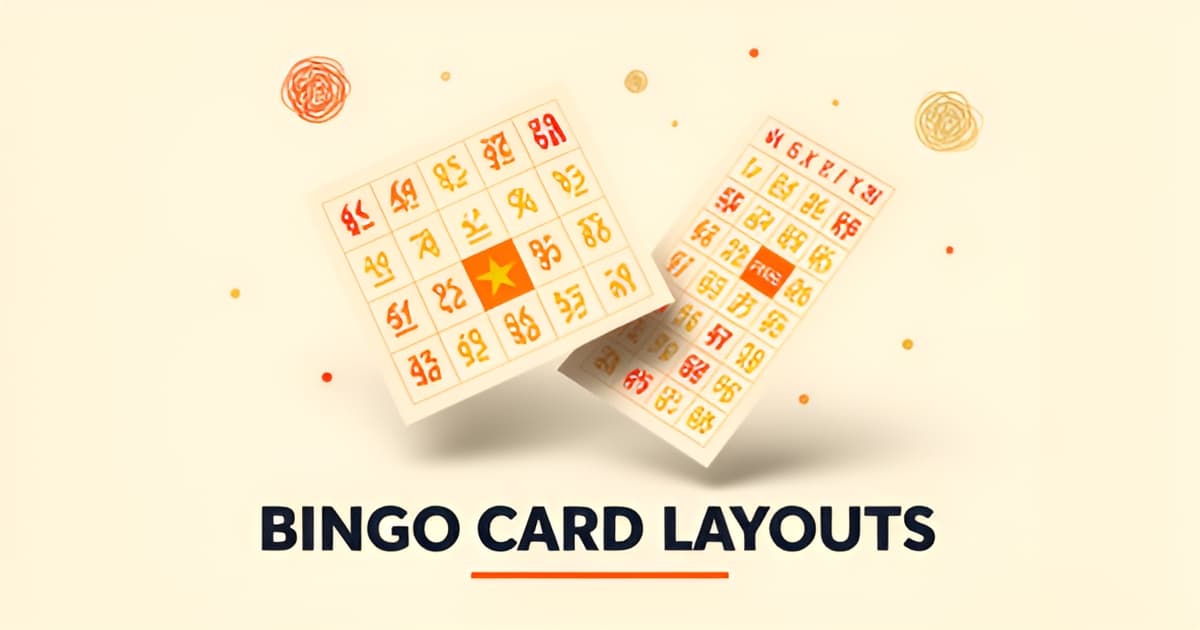
What is the layout of a bingo card?
Key Facts
- A 75-ball bingo card is a 5×5 grid with 24 numbers plus a FREE center square, with columns drawing from fixed 15-number ranges according to William Hill.
- There are roughly 552 septillion unique 75-ball bingo cards, so any dealt card has likely never existed before per Wikipedia's combinatorial math.
- The 90-ball UK 'Housie' ticket is a 9×3 grid holding 15 numbers, with each row containing five numbers and four blanks as Wikipedia describes.
- 90-ball tickets are sold in strips of six that cover every number from 1 to 90 exactly once per BMM Magazine.
- 90-ball bingo is the dominant format globally by player count, with wins for one line, two lines, or a full house industry comparisons note.
- Custom 5×5 bingo cards need at least 25 unique items (24 squares plus FREE), while 3×9 grids need 27 per generator documentation.
- Generators can produce batches of up to 50 unique cards by drawing a random subset of items for each player per bingo tool docs.
The Two Core Bingo Layouts
The 75-ball layout dominates North American play with its familiar 5x5 grid. Players scan columns labeled B-I-N-G-O, each anchored to a fixed number range: 1-15 for B, 16-30 for I, 31-45 for N, 46-60 for G, and 61-75 for O. A defining feature of this format is the FREE center square, which sits unmarked and counts as already daubed, leaving 24 active numbers per card. This structured column-ranging system makes called numbers quick to locate, contributing to the faster-paced nature of the game compared to other variants. According to industry research, the total number of unique 75-ball cards possible reaches approximately 552 septillion, calculated through the column combination math of 15x14x13x12x11 for the B/I/G/O columns and 15x14x13x12 for the N column, illustrating why every dealt card carries a truly one-in-a-kind combination.
The 90-ball format, often referred to as "Housie" in UK and European circles, structures its tickets as a 9x3 grid. Each row holds five numbers with four blank spaces distributed randomly, totaling 27 squares but only 15 numbers per individual ticket. Numbers are apportioned by column ranges of ten: 1-9, 10-19, up through 80-90. Winning lines in this format progress horizontally, with players aiming for one line, then two lines, before the full house conclusion. Research indicates this format holds the dominant position globally by player count, commonly sold in strips of six where the combined ticket strip covers every number from 1 to 90 exactly once.
Printoodle formats each of these standard grids automatically, removing the manual setup time for educators, party hosts, and families. Whether generating a 5x5 card with a FREE center for a themed activity or a 9x3 ticket strip for a classroom review, the tool handles the column logic and number placement instantly. Bingo card generator users can create custom batches, while those exploring literacy activities can try the reading bingo option for educational word-based play. Print it. Doodle it. Done.
Numbers, Ranges, and the Odds of Uniqueness
The standard 75-ball card used across North America starts with a 5×5 grid that leaves the center square marked FREE. Each column is locked to a specific 15-number range: the B column draws from 1–15, I from 16–30, N from 31–45, G from 46–60, and O from 61–75. This fixed-range structure makes called numbers quick to find, while the FREE center contributes to every pattern that crosses it. With 24 numbers placed across the remaining spots, no two generated cards are alike, statisticians have calculated roughly 552 septillion unique combinations, a figure corroborated by both Wikipedia and William Hill, noting the odds are good any dealt card has never existed before.
While the 75-ball format dominates U.S. play, the 90-ball version, called a ticket in the UK and Europe, takes a different shape. These cards are 9 columns wide by 3 rows tall, with each row holding exactly five numbers and four blank spaces randomly distributed. Numbers are apportioned by column: 1–9, 10–19, 20–29, 30–39, 40–49, 50–59, 60–69, 70–79, and 80–90. Tickets commonly come in strips of six, where the strip covers every number from 1 to 90 exactly once. Unlike the pattern-based wins of 75-ball, 90-ball rewards one line, two lines, or a full house across the horizontal rows.
For anyone building custom or themed cards, the math is straightforward: a 5×5 grid requires at least 25 unique items (24 numbers plus the FREE space), while a 3×9 grid needs at least 27 unique items. Generators pull a random subset from that pool to ensure every printout feels fresh. Printoodle formats each grid automatically, handling the column ranges and FREE center placement so organizers can focus on the game itself rather than the layout. Whether designing for a classroom, a bridal shower, or a rainy-day activity, the structure remains the same, the numbers change, but the grid logic stays consistent.
Bingo card generator on Printoodle, users can create customized grids with their own words, numbers, or images. The tool handles the column structure and FREE center placement automatically, producing print-ready PDFs in seconds. For those tracking reading progress or classroom objectives, the reading bingo generator offers a themed twist on the classic layout. Print it. Doodle it. Done.
From Standard to Custom: Themed and Educational Cards
Once you understand the layout of a bingo card, you can bend those same rules to fit almost any occasion, from a kindergarten sight-word game to a baby shower icebreaker. The grid doesn't care whether it holds numbers, vocabulary words, or pictures of dinosaurs. It just needs enough material to fill it.
That's where the math comes in. According to generator documentation, a themed 5×5 card needs at least 25 unique items (24 squares plus the FREE space), while a 3×9 ticket-style grid requires at least 27 unique items. If your word list falls short, you'll either repeat items or leave squares empty, and both weaken the game.
The column logic carries over too. A standard 75-ball card assigns each column a fixed 15-number range, which William Hill notes "makes called numbers quick to find." On a custom card, you can mirror that structure deliberately: put easy words on the left columns and harder ones on the right, so younger players scan confidently.
How generators keep every card different is the clever part. Rather than dealing all 25 items onto every card, they draw a random subset from your full item list for each one. This is the same principle that produces roughly 552 septillion unique 75-ball cards, a figure Wikipedia's combinatorial breakdown traces to the number of possible column arrangements. With a 40-word vocabulary list and 30 students, no two cards look alike.
When you're building custom cards, a few practices matter most:
- Gather more items than the grid requires, so the generator has room to randomize a distinct subset per card.
- Balance familiar and challenging elements, a design principle that keeps players of mixed ages engaged.
- Include clear instructions on the card itself, especially for classroom or party settings where you won't repeat the rules aloud.
- Print in sensible layouts: one card per page for 5×5 grids, or 4-up per page for ticket-style cards to save paper.
Classrooms are the most common destination for themed cards. Teachers use them for vocabulary review, math facts, and reading incentives, where each square holds a book genre or a reading challenge instead of a number. A reading bingo card works exactly like the numbered original: five in a row wins, but the row comes from finishing a mystery novel or reading aloud to a sibling.
The good news is that you don't have to build these grids by hand. Printoodle's bingo card generator handles the formatting automatically, so you paste your word list, pick a theme, and get a print-ready PDF with a unique card for every player. You bring the ideas; the grid does the rest.
How Printoodle Automates Your Grid
Knowing what the layout of a bingo card is only gets you halfway. Someone still has to build the grid, shuffle the entries, and lay everything out for printing, which is exactly where a generator earns its keep. Printoodle's bingo card generator handles that formatting automatically, so you skip straight to the printing part.
Here's why automation matters. A standard 75-ball card has 552 septillion possible unique arrangements, a figure Wikipedia's bingo card analysis calculates from the fixed column ranges, and William Hill notes the odds are good any freshly dealt card has never existed before. You don't want to replicate that randomness by hand. A generator pulls a random subset of your items for every card, which keeps each one genuinely different.
The formatting work happens behind the scenes. Printoodle arranges each grid into a print-ready PDF in your choice of Letter or A4, with a safe-for-kids default paper size and a simple toggle for the other. Layout options follow common conventions: one card per page for the 75-ball style, or a 4-up arrangement to save paper, an approach documented by other bingo generator tools as well.
Batch generation is where hand-making cards falls apart fastest. You can create anywhere from a single card up to 50 unique cards in one batch, which covers everything from a family game night to a full classroom. Every card in the batch gets its own random selection, so no two players are marking identical grids.
Customization options include:
- Card titles, so a birthday set or classroom activity is labeled the moment it prints
- Custom FREE center text, swapping the traditional free square for whatever fits your theme
- Color themes that match a party palette or a seasonal unit
- Your own words, numbers, or images placed into the grid
Those last two matter most for themed use. A 5×5 grid needs at least 25 unique items, counting the FREE square, while a 3×9 grid needs 27, so generator documentation recommends gathering your word list before you start. Design guidance also suggests balancing familiar and challenging elements and including clear instructions so players aren't guessing at the rules, advice from bingo card design tips that applies to any custom set.
The classroom case is the most fun. Teachers build reading bingo cards from book titles, genres, or reading challenges, and the generator handles the grid math and print layout automatically. Once your cards are generated, they live in your library where reprints are always free, so next term's batch takes seconds. Print it, doodle it, done.
Frequently Asked Questions
What are the key differences between the 75-ball and 90-ball bingo card layouts?
Why does a standard 75-ball bingo card have a FREE center square, and how does it affect gameplay?
How many unique bingo cards are possible, and why is each card so different?
What are the requirements for creating a custom or themed bingo card?
How are 90-ball bingo tickets structured, and why are they sold in strips of six?
Can I create a themed bingo card with words or images instead of numbers?
Your Grid, Ready in Seconds
So, what is the layout of a bingo card? A 5×5 grid with B-I-N-G-O columns, fixed number ranges, and a FREE center for the North American game, or a 9×3 ticket with fifteen numbers and four blanks per row for the UK version. That structure is why roughly 552 septillion unique cards can exist, per Wikipedia's bingo card analysis, and why no two players ever hold the same card. The best part is you don't need to memorize any of the math to put it to work. Whether you're prepping a classroom review, a baby shower icebreaker, or a rainy-day family game, Printoodle's bingo card generator handles the column logic, FREE center placement, and unique batches up to 50 cards, you just paste your list and print. Teachers can even turn book challenges into a reading bingo set in one sitting. Gather your 25 (or 27) items, pick a theme, and print it, doodle it, done.