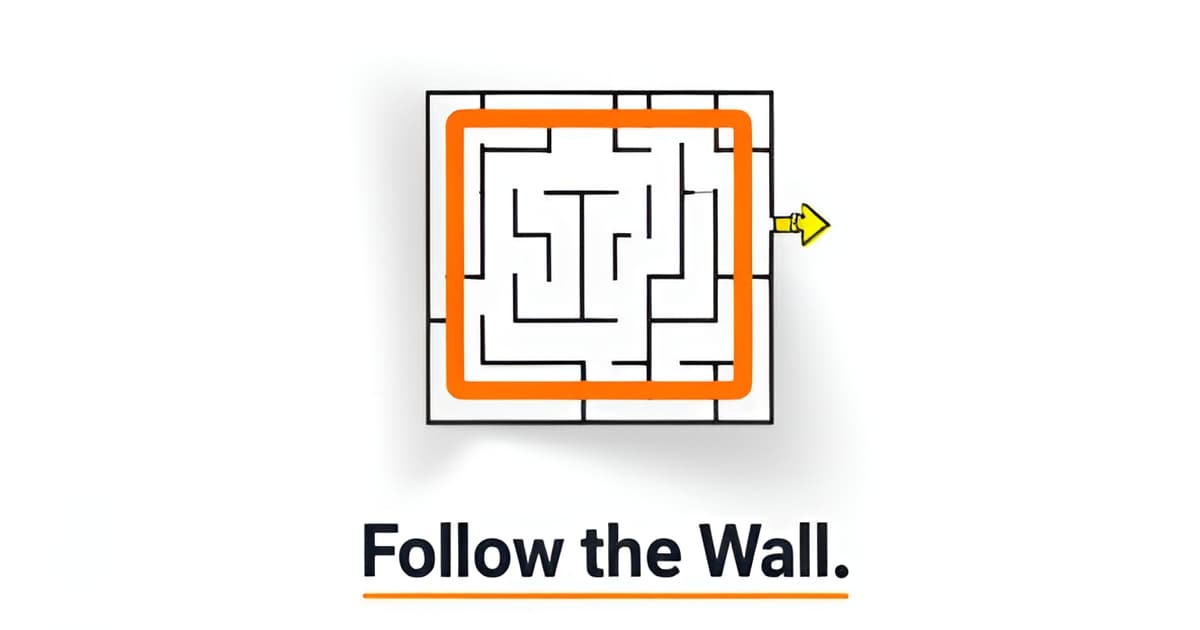
What is the right hand rule in mazes?
Key Facts
- The right hand rule means keeping your hand on the wall, turning right first, then straight, then left only when blocked, per robotics research.
- Wall-following robots solved mazes with a 90% success rate across ten trials, with mapping times as fast as 23 seconds, one study found.
- The rule is guaranteed to work only in simply connected mazes with no loops and all walls attached to the outer boundary, according to Wikipedia's maze-solving overview.
- Switching hands mid-solve can strand you circling a wall island forever, so you must commit to one side for the entire maze, maze designers explain.
- Kilibarda proved in 2017 that any automaton traversing 2D mazes reduces to a left- or right-hand-on-the-wall rule, per Math Stack Exchange.
- No simple right-hand-rule analog exists for 3D mazes because path space lacks a natural cyclic ordering, mathematicians note.
- Five major maze-solving algorithms are commonly compared: Random Mouse, Wall Follower, Pledge, Trémaux, and Dead-End Filling, robotics research shows.
Why Mazes Frustrate Kids (and Grown-Ups Too)
It starts with excitement: a fresh maze, a pencil, a kid who's sure they'll crack it in thirty seconds. Then come the dead ends. Five minutes later, the pencil is down, the page is pushed aside, and the maze joins the pile of abandoned rainy-day activities.
The problem isn't the kid. It's the strategy. Most people solve mazes the way the Random Mouse Method does, wandering until a path happens to work, and maze designers actually have a name for this kind of aimless backtracking. Without a system, every wrong turn feels like a personal failure.
That's where the answer to what is the right hand rule in mazes comes in. The rule is simple: keep your right hand on the maze wall at all times, turning right whenever you can, going straight when you can't, and turning left only when both right and straight are blocked. Once you pick a side, you stick with it for the entire maze, as maze designers explain. No memory of visited paths required, which is exactly why robotics engineers use the same technique for wall-following robots with ultrasonic sensors.
The reason this works on the mazes in your printer tray comes down to topology. The rule is guaranteed to work in "simply connected" mazes, meaning mazes with no loops and all walls attached to the outer boundary, according to the formal definition. In those mazes, wall following reduces to walking a single loop from start to finish, so you can't get lost. And here's the good news for families:
- Most printable mazes, including the ones Printoodle generates, are simply connected "perfect" mazes.
- Perfect mazes have exactly one path between any two points, with no loops to trap the rule.
- That makes a printed maze the ideal place to teach the technique: trace the right-hand wall with a finger or pencil and watch it work.
- Once kids know the trick, a frustrating puzzle becomes a confidence-building one.
The payoff is real. In robotics testing, wall-following methods solved mazes with a 90% success rate across ten trials, with mapping times as fast as 23 seconds. A kid with a pencil can expect the same reliability on a well-designed printable.
So the next time a maze lands in the recycling bin unfinished, don't chalk it up to patience. Teach the right hand rule, print a fresh maze, and let the wall do the navigating. Pair it with a round of halloween trivia or a family trivia game, and you've turned one printable into a whole afternoon.
How the Right Hand Rule Actually Works
So, what is the right hand rule in mazes, mechanically speaking? It's simpler than it sounds: you press your right hand against a wall and never let go. The wall guides you, and the exit eventually comes to you.
The rule breaks down into three moves. According to robotics research on maze mapping, the solver keeps their right hand in contact with the wall, turns right when possible, goes straight when no right turn is available, and turns left only when both right and straight are blocked. That's the entire algorithm. It needs no memory of where you've been, which is why it also powers wall-follower robots that navigate mazes with ultrasonic and infrared sensors.
- Turn right whenever a right-hand path opens up.
- Go straight if you can't turn right.
- Turn left only when you're blocked on both the right and straight ahead.
One point trips people up more than any other: you must commit to a single hand for the whole maze. As maze designers explain, once you choose your side, left or right, you stick with it. Switching hands mid-solve can strand you on a wall section that loops back on itself, and you'll retrace the same corridors forever.
Here's the elegant part. In a maze with no loops, where every wall connects back to the outer boundary, wall following works as a depth-first traversal of the maze's tree structure. As Wikipedia's maze-solving overview puts it, by keeping one hand in contact with one wall, the solver is guaranteed not to get lost and will reach an exit if there is one.
The topological intuition makes this click: if all the walls are connected, they can be deformed into a single loop or circle. Wall following then reduces to walking around that circle from start to finish. You can't miss the exit, because the exit is on your circle. One Hacker News commenter put it plainly: in a maze without cycles, the rule takes you through every part of the maze, guaranteeing you reach the goal.
That guarantee has real teeth behind it, too. Kilibarda proved in 2017 that any automaton capable of traversing 2D mazes can be reduced to a left- or right-hand-on-the-wall rule, so the technique isn't just a folk trick; it's the fundamental form of maze navigation.
This is exactly why printable mazes make such a good teaching tool for the technique. A simply connected maze from Printoodle's maze generator lets a kid trace the right-hand wall with a pencil or finger and watch the rule work, guaranteed, every single time. Pair the solve with a halloween trivia round or a family trivia game, and you've turned a rainy afternoon into a little lesson in graph theory.
When the Right Hand Rule Fails (and What to Do Instead)
So you've mastered the right hand rule, traced a dozen printable mazes with your finger, and now you're feeling invincible. Here's the catch: the rule has a blind spot, and maze designers know exactly where it is.
The right hand rule only works in what mathematicians call simply connected mazes: mazes with no loops where every wall connects back to the outer boundary, as maze designers explain. The moment a maze contains a free-standing wall "island" detached from the perimeter, the rule can fail. Technically these are called multiply connected mazes, and the islands create cycles that defeat wall-following entirely, as discussions among maze enthusiasts point out.
The failure mode is sneaky. The rule assumes the goal sits on the same cycle as the entrance. If the treasure in the middle of the maze sits on its own island, you can hug that right wall forever and never reach it, a limitation confirmed in this Math Stack Exchange analysis. You'll just loop endlessly around your own little wall circuit.
There's a second trap, too. Wall-following works when you start at the entrance. Begin at an arbitrary point inside a maze with islands and you might get stuck circling a wall that has no exit at all, according to Wikipedia's overview of maze-solving algorithms.
And then there's the third dimension. There's no simple right-hand-rule analog for 3D mazes with bridges or tunnels, because the space of paths doesn't have a natural cyclic ordering the way a flat maze does. Your right hand can't help you decide whether to go over or under.
When the rule breaks, you need a level-up technique:
- The Pledge algorithm: counts your turns (clockwise positive, counter-clockwise negative) and only lets you leave a wall when the count hits zero. It handles disjoint walls and works from any interior point to an outer exit.
- Trémaux's method: discovered in the 19th century and later recognized as equivalent to depth-first search, it marks passages as you go and is guaranteed to solve any maze with well-defined passages (though not necessarily by the shortest route).
- Dead-end filling: work backwards from every dead end until only the true path remains. Maze designers admit most mazes are also easier solved in reverse, since they're built start-to-goal.
Here's the good news for everyday puzzlers: most printable mazes, including the ones you can generate with Printoodle, are simply connected by design, so the right hand rule works every time. Trace the wall with a pencil or finger and you're guaranteed to find the exit. Save the Pledge algorithm for the truly devious puzzles, and pair your maze session with a halloween trivia round or a family trivia game for a full activity afternoon.
Teach the Rule With a Printable Maze You Made Yourself
The fastest way to make the right hand rule click for a child is to put a pencil in their hand and a maze in front of them. Once they've watched the technique work on paper, the abstract idea becomes muscle memory. And the best part: you don't need a textbook maze. You can generate a fresh, print-ready one in seconds with Printoodle's printable maze generator, sized for Letter or A4 paper, and print as many copies as your classroom or kitchen table demands.
Here's the key detail that makes this work: the rule is only guaranteed in simply connected mazes, meaning ones with no loops and every wall attached to the outer boundary, as maze designers explain. A standard generated "perfect maze" meets that condition, so the demonstration can't fail. That's what makes printable mazes such a clean teaching tool: the child traces the right-hand wall with a pencil or finger, and the path reliably leads to the exit.
Set it up as a two-round experiment:
- Print two copies of the same maze so the comparison is fair.
- Round one: the child keeps their right hand on the wall the entire way, never lifting the pencil.
- Round two: they switch to the left hand and stick with it, since once you pick a side you must keep it for the whole maze.
- Compare the two traced paths. They'll usually differ, and sometimes one is dramatically shorter.
The comparison sparks the best questions. Why did one hand take a longer route? Because neither hand is guaranteed the shortest path, only arrival at the exit. In one robotics practitioner's test maze, the right-hand path was less complex than the left-hand path, but that depends entirely on how the maze is laid out. Kids discover this themselves in about three minutes, which beats a lecture.
For younger solvers, keep it tactile: a finger tracing the wall works just as well as a pencil, and it's one of the everyday tools maze solvers actually use. For older kids, add a timer. Wall-following robots in one study mapped mazes in as little as 23 seconds with a 62-second average, so challenge your child to beat the machine.
Once the maze races wrap up, the printed page doesn't have to be the end of the activity. Pair the maze with a halloween trivia round for a classroom party, or fold it into a family trivia game for rainy afternoons. A maze warm-up plus trivia keeps hands busy and brains engaged, and every page lives in your Printoodle library, so reprinting for the next rainy day is always free. Print it. Doodle it. Done.
Print It. Doodle It. Done.
So, what is the right hand rule in mazes, in its simplest form? Keep your right hand on the wall, and don't let go. Turn right whenever you can, go straight when you can't, and turn left only when both are blocked. That's the whole technique, and it's one of the five major maze-solving algorithms researchers commonly compare, alongside the Random Mouse, Pledge, Trémaux, and Dead-End Filling methods (robotics research).
The catch is that the rule comes with one condition. It's guaranteed to work in simply connected mazes, where there are no loops and every wall connects to the outer boundary (maze designers explain this clearly). In that case, keeping contact with the wall means you'll walk every corridor and reach the exit without ever getting lost, because topologically you're just tracing one long line from start to finish.
That's why printable mazes are the perfect place to teach it. Print a maze, hand your kid a pencil, and have them trace the right-hand wall the whole way through. The everyday tools for this are exactly what you'd expect: a writing utensil, a finger, or just your eyes. No memory of past turns required, which is the same reason the rule works so well for maze-navigating robots.
Here's the quick recap before you print:
- Right hand on the wall, always. Stick with your chosen side for the entire maze.
- Priority order: right turn first, then straight, then left.
- It works in loop-free mazes where all walls attach to the outer boundary.
- It can fail in mazes with free-standing wall islands, so check your maze before you promise a win.
Once the maze is solved, keep the momentum going. Pair it with a themed halloween trivia round or a quick family trivia game for rainy afternoons, classroom stations, or party tables. One rule, one pencil, and you've got an activity the whole family can use.
Print it. Doodle it. Done.
The Wall Always Wins: A Simple Rule for Any Maze
From the Random Mouse Method's frantic wandering to the Right Hand Rule's steady guidance, the difference between a frustrating dead end and a confident exit comes down to strategy. We explored how keeping your right hand on the wall, turning right when possible, going straight when you can't, and turning left only when both are blocked, creates a reliable path through simply connected mazes. We also uncovered why this technique fails in multiply connected designs with free-standing wall islands, and how variants like the Pledge and Trémaux algorithms step in for those trickier puzzles. Whether you're a kid with a pencil or a robot with ultrasonic sensors, the principle remains the same: follow the wall, trust the topology, and the exit will find you. Printoodle's printable mazes turn this abstract concept into a hands-on lesson, proving that the right rule turns puzzles into practice. Print it. Doodle it. Done.