What is the standard size for bingo cards?
Key Facts
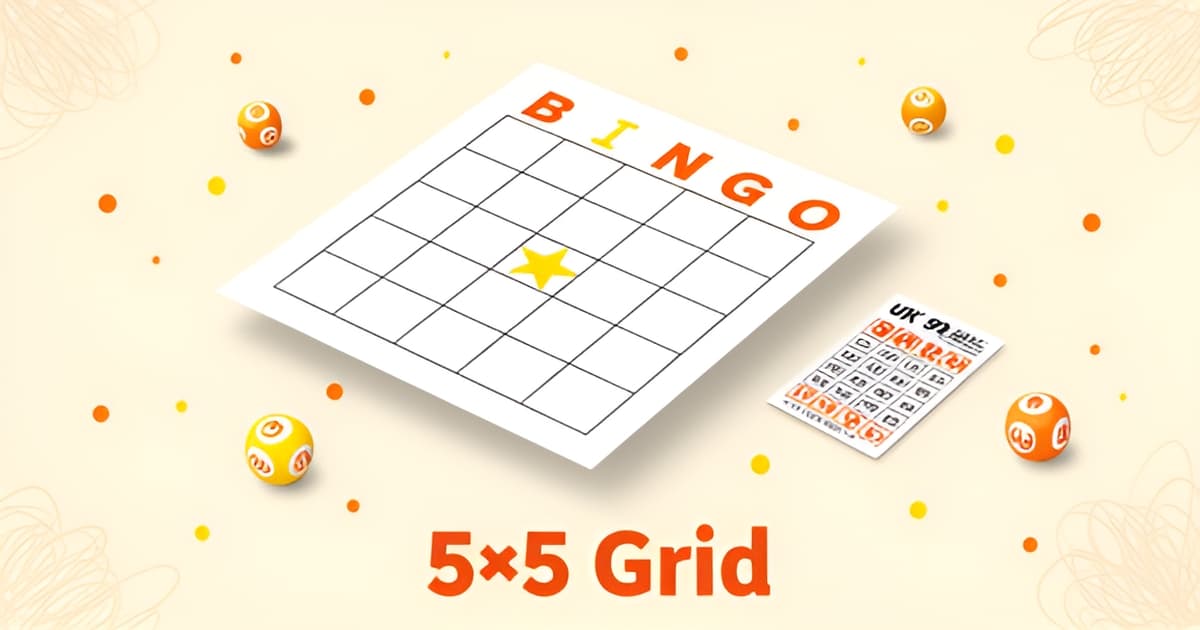
- The standard bingo card is a 5×5 grid with 25 squares, 24 numbers plus one free center square, according to bingo card specifications.
- 75-ball bingo splits numbers into five column ranges of 15 each: B covers 1–15 through O covering 61–75, per standard card rules.
- UK 90-ball tickets use 3 rows and 9 columns with 15 numbers, and strips of six cover every number from 1 to 90 exactly once, per bingo hall guidance.
- No official physical bingo card dimensions exist, the only consistent print guidance is 8.5 x 11 inch paper, according to printing resources.
- Classroom grids scale by age: 3×3 for young learners, 4×4 for longer games, and 5×5 for the classic experience, per teaching resources.
- Word bingo needs minimum item counts of 9, 16, or 25 items for 3×3, 4×4, and 5×5 grids respectively, per generator guidelines.
- Print at 100% or 'actual size' to avoid clipped squares, and use card stock for reusable cards, per printing best practices.
The Short Answer: Standard Size Means the Grid, Not Inches
Finding a single physical measurement for a bingo card is a futile exercise because the industry standard lives in the grid, not the inch. When people ask about the "standard size," they are really asking about the 5×5 layout that defines 75-ball bingo, where 25 squares are arranged in five rows and five columns, five of which are designated as free space in the center. This structure creates 24 playable numbers, with the columns labeled B-I-N-G-O and populated by number ranges of 1–15, 16–30, 31–45, 46–60, and 61–75 respectively. The 90-ball variant follows a completely different template, using three rows and nine columns with 15 numbers per ticket, though the 5×5 format remains the universally recognized benchmark for classic play. Tools for Educators even labels this specific layout as "Classic 5×5 BINGO," cementing its status as the default experience for both in-person halls and digital platforms.
The only physical dimension consistently mentioned across generator tools is the paper size: 8.5 x 11 inches. This is the recommended format for printing, though the actual card dimensions on the page depend on how many cards the printer places per sheet. A 5×5 grid typically prints one card per page for readability, while smaller 3×3 or 4×4 setups might fit two or four cards on a single sheet to save paper. For those planning to reuse cards, heavier card stock is advised, whereas standard printer paper suffices for one-off games.
Grid structure is the only true standard, and bingo card generator makes it easy to create cards that follow these exact layouts. Whether organizing a classroom activity or a neighborhood game night, the 5×5 card with its free center square remains the go-to format, but reading bingo offers a word-based alternative using the same grid principles for younger players.
The Other Standard: 90-Ball Tickets and Smaller Grid Variants
Cross the Atlantic and the "standard" bingo card changes entirely. If you've ever wondered what is the standard size for bingo cards in the UK, the answer is the 90-ball ticket: three rows, nine columns, and 15 numbers, with exactly five numbers on each row.
The 90-ball format is more structured than it first appears. According to bingo hall guidance, tickets come in strips of six, and each strip uses every number from 1 to 90 exactly once. The columns follow a set logic too: the first column holds numbers 1 through 9, and the last holds 80 through 90, with the ranges stepping up across the nine columns.
Beyond the two big formats, smaller grids fill specific niches, especially in classrooms and quick family games. As one teaching resource puts it, 3×3 works for young learners, 4×4 suits a longer game, and 5×5 delivers the classic experience. The 3×3 grid also doubles as the format for 30-ball bingo, a faster variant popular for short sessions.
For word bingo, the grid size depends on how many items you have. The minimums scale directly with the grid:
- 9 items for a 3×3 grid
- 16 items for a 4×4 grid
- 25 items for a 5×5 grid (24 if you use a free center square)
That flexibility is exactly why word bingo works so well with early readers. A reading bingo board turns sight words or book titles into the game itself, and a 3×3 grid keeps the challenge manageable for kids still building confidence. Tools like Printoodle's reading bingo generator let teachers drop in their own word lists and print a full class set in minutes.
One practical note on sizing: none of these grids come with a mandated physical dimension. What's standardized is the layout, not the paper. Most generators print on standard 8.5 x 11 inch sheets, fitting a 3×3 board four to a page, a 4×4 two to a page, and a 5×5 one to a page. When you design your own with a bingo card generator, you choose the paper size and cards per page, so the "right" size is whatever your players can read comfortably.
How to Print Bingo Cards at the Right Physical Size
Finding the right physical dimensions for a bingo setup starts with understanding that "standard size" describes the grid layout rather than a fixed inch measurement. Research into bingo card generators confirms that the universally recognized standard is the 5×5 grid used for 75-ball bingo, featuring 25 squares with columns labeled B-I-N-G-O and a free center square. For those running number-based games, 75 numbers are divided into five column ranges of 15 numbers each, creating the classic playing experience. The other major format in play is the 90-ball ticket, which uses a three-row, nine-column layout with 15 numbers per ticket, five per row.
When it comes to printing these cards at home or in a classroom, the practical physical size is entirely configurable based on your needs. The most common recommendation is to print on 8.5 x 11 inch paper at 100% or "actual size" so that nothing shrinks or gets cut off at the edges. How many cards appear on each page is where the trade-offs begin: a 5×5 grid typically prints one card per page for maximum readability, while smaller 3×3 or 4×4 grids can fit four or two per page respectively. This layout choice often comes down to who is playing, one card per page is easier to read for players with low vision, but four cards per page saves significant paper for large groups. For cards meant to be reused across multiple games, upgrading to card stock provides the durability needed to withstand repeated handling, whereas regular weight paper works fine for disposable cards used once and discarded.
If you are looking to generate cards tailored to your specific grid size and player count, Printoodle’s bingo card generator lets you set the number of cards, choose how many go on each page, and select your paper size before downloading a print-ready PDF. For word-based variants or classroom reading activities, you can also try the reading bingo tool to customize grids for younger learners. Print it. Doodle it. Done.
Make Your Own Correctly Sized Cards in Minutes
Now that you know the standard size for bingo cards comes down to grid structure, you're ready to make your own. The good news: you don't need design software or a trip to the teacher supply store. Pick your grid, pick your paper, and generate a print-ready PDF in minutes.
Start with the grid. A 3×3 card works best for young learners, a 4×4 grid stretches the game out a bit longer, and the classic 5×5 (25 squares with a free center) delivers the traditional experience, as bingo generator guidance puts it. If you're building word bingo for a classroom, remember the minimum item counts: 9 for 3×3, 16 for 4×4, and 25 for 5×5 (24 if you're using a free space). For a reading-focused twist, a dedicated reading bingo set works on the same grids.
Next, choose your paper size and layout. Most generators, including Printoodle's, default to 8.5 x 11 inch Letter paper (with an A4 toggle if you're printing outside the US). Then decide how many cards go on each page. This choice matters more than people expect:
- Four cards per page saves paper when you're printing for a big crowd.
- One card per page is easier to read, especially for players with low vision.
- Card-stock paper holds up if you want reusable cards; regular weight is fine for one-time games.
Whatever layout you choose, print at 100% or "Actual size" so nothing gets shrunk or cut off at the margins. That single printer setting is the difference between crisp, playable cards and squares that clip mid-number.
When you're ready, the bingo card generator walks you through exactly these choices: grid size, paper size, cards per page, and how many unique shuffled boards you need. You'll download a print-ready PDF, and since everything you make lives in your Printoodle library, reprints are always free when the dog eats a card or the class roster grows.
Print it. Doodle it. Done.
Frequently Asked Questions
What is the standard size for bingo cards in inches?
What's the difference between a 75-ball and a 90-ball bingo card?
How many cards fit on one page when printing?
What paper should I use for bingo cards I want to reuse?
Which bingo grid size is best for young kids?
How many words or items do I need for a custom bingo card?
Key Takeaways
{ "title": "Your Game Night Is Ready", "content": "From the classic 5×5 grid that defines 75-ball bingo to the structured 90-ball tickets across the pond, the true "standard size" for any card comes down to its layout rather than its inches. Whether you are organizing a classroom activity with w