What is the standard size of a bingo card?
Key Facts
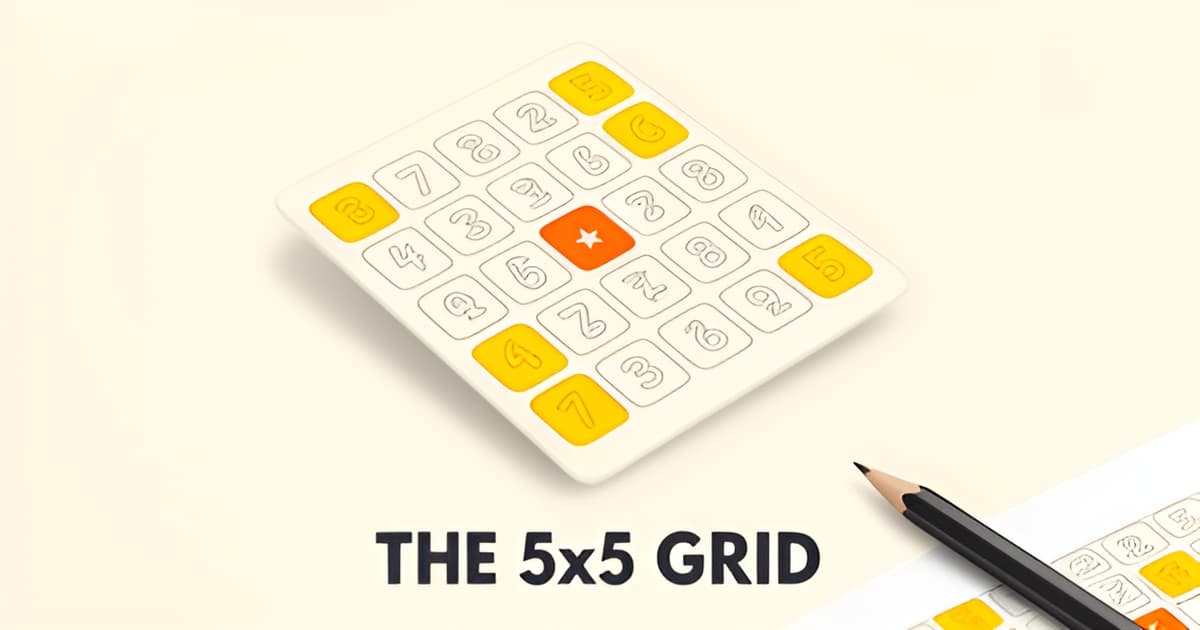
- A standard bingo card is a 5x5 grid of 25 squares, 24 numbers plus one free center space per Wikipedia.
- Each BINGO column uses fixed ranges: B is 1–15, I is 16–30, N is 31–45, G is 46–60, and O is 61–75 according to DigitalToolPad.
- No source defines a bingo card's physical size in inches, 'standard size' means the 5x5 grid structure, not measurements.
- The UK plays 90-ball bingo on a 9x3 ticket with 15 numbers and four blanks per row as LeoVegas describes.
- A 3x3 card (numbers 1–45) can produce 362,880 unique combinations, so no two classroom cards match notes Bingo Baker.
- Bingo cards print on US Letter (8.5 x 11 in) or A4 paper, typically 1, 2, or 4 cards per page per Canva's printing guide.
- The free center space only exists on 3x3 and 5x5 cards, a 4x4 grid has no true middle square per DigitalToolPad.
The Short Answer: 5x5 Squares, Not Inches
If you've ever searched for bingo card dimensions and come up empty-handed, there's a good reason for that. When people ask what is the standard size of a bingo card, they're usually asking about the grid structure, not the physical measurements, because no physical dimension in inches or centimeters is standardized anywhere in the industry.
The answer to the structural question is simple and universally agreed upon. A standard bingo card is a 5x5 grid containing 25 squares: 24 numbers plus one free space in the center. This is the North American 75-ball format, confirmed across multiple independent sources, from Wikipedia's bingo card reference to specialized generator tools like Bingo Baker. The five columns are labeled B, I, N, G, O, and each column draws from a fixed number range.
Those ranges are part of the standard, too:
- B: numbers 1 through 15
- I: numbers 16 through 30
- N: numbers 31 through 45, with 4 numbers plus the free space
- G: numbers 46 through 60
- O: numbers 61 through 75
The center free space matters more than it might first appear. Because the middle square comes pre-marked, any winning pattern that runs through the center requires one fewer call to complete, which subtly changes the pace of every game.
So if the grid is standardized, what about the paper? The closest thing to a physical standard is the print size: bingo cards are typically laid out on US Letter paper (8.5 x 11 inches) or A4, with common layouts of 1, 2, or 4 cards per page. That's a printing convention rather than an official card specification, but it's what nearly every generator and bingo hall follows in practice. Printoodle's bingo card generator follows the same conventions, producing print-ready PDFs with Letter as the default and an A4 toggle for international printers.
It's worth knowing where the 5x5 standard doesn't apply. The UK runs on 90-ball bingo, played on a 9x3 ticket with 15 numbers, five per row, and four blank spaces per row. LeoVegas describes it as "a three-row strip with some blank spaces" rather than a tidy square, which is why a UK "bingo card" looks nothing like the American version. Smaller grids exist for specific purposes as well: 3x3 cards (9 squares, numbers 1 through 45) work well for preschoolers and quick games, while 4x4 cards (16 squares, numbers 1 through 60) suit shorter sessions. Notably, the free space only appears on 3x3 and 5x5 cards, since 4x4 has no true middle square.
The same structural flexibility is why themed variants work so well. A game like reading bingo swaps numbers for words or tasks on the same 5x5 frame, so anyone who knows standard bingo can sit down and play immediately. Print it. Doodle it. Done.
The Full Anatomy of a Standard 75-Ball Card
When people ask what is the standard size of a bingo card, they are usually looking for the familiar 5x5 grid that dominates North American halls. This layout contains 25 squares total, with 24 numbers and one free center space, a structure confirmed across multiple sources including Wikipedia and DigitalToolPad. The columns are lettered B-I-N-G-O, each with a specific number range: the B column holds numbers 1 through 15, I contains 16 to 30, N spans 31 to 45, G covers 46 to 60, and O ranges from 61 to 75. The N column is unique, holding only four numbers plus the free space in the center, which is why patterns that pass through the middle require one fewer call to complete.
While the 5x5 grid is the universal standard in the US, the UK and many Commonwealth countries use a different format entirely. The 90-ball ticket presents as a 9x3 grid with 15 numbers distributed across three rows, leaving four blank spaces on each row. This strip-style layout differs fundamentally from the square card, and because the numbers are spread across a longer horizontal format, pattern variety changes compared to the 75-ball version.
For those looking to create their own cards, Printoodle’s bingo card generator produces print-ready PDFs that match these structural conventions, offering Letter-size output by default with an A4 toggle for international users. The platform defaults to the standard 5x5 layout while also supporting smaller 3x3 and 4x4 grids for preschool activities or quicker games. Whether printing one card per page for kids to write on or four-up layouts for classroom use, the generator aligns with the industry norms described by Canva and DigitalToolPad regarding paper weight and multi-card layouts.
Bingo card generator tools make it easy to customize cards for any occasion, from bridal showers to classroom lessons. If you prefer a word-based version, try the reading bingo generator for a different type of play.
Smaller Grids and Word-Based Variants
Not every bingo game needs the full 5x5 grid. If you've ever wondered what is the standard size of a bingo card for younger kids or quick party rounds, the answer is that smaller formats exist, and they're surprisingly well defined.
The 3x3 card holds just 9 squares and uses numbers from 1 to 45, making it ideal for preschoolers who are still building number recognition and for fast games that wrap up in a few minutes. According to DigitalToolPad's card guide, the 3x3 format keeps a free space in the middle, so only 8 squares carry numbers.
The 4x4 card offers a middle ground: 16 squares drawn from numbers 1 to 60. It suits slightly older kids and shorter sessions where a full 75-ball game would drag. One quirk worth knowing: the free space only exists on 3x3 and 5x5 cards. The 4x4 grid has no true middle square, so every square gets a number.
Here's a quick comparison of the smaller formats:
- 3x3: 9 squares, numbers 1–45, free space included, best for preschool and quick games
- 4x4: 16 squares, numbers 1–60, no free space, good for shorter rounds
- 5x5: 25 squares, numbers 1–75, the standard adults expect
Despite the smaller grid, the 3x3 format still offers plenty of variety. Bingo Baker notes that a 3x3 card can produce 362,880 unique combinations, so no two cards in a classroom pile will look alike.
Numbers aren't the only way to fill a grid. Once you shrink the format, swapping digits for words or pictures becomes the natural next step, and it's why these variants dominate classrooms and parties. Teachers use word cards for vocabulary review, sight-word practice, and reading challenges; party hosts use them for bridal shower trivia, baby shower gift games, and icebreakers where guests mark squares as they mingle.
Printoodle's reading bingo tool works exactly this way: instead of calling numbers, you fill the grid with book titles, genres, or reading milestones, and kids mark squares as they complete them. It turns a reading log into a game, which is a lot easier to sell to a seven-year-old.
If you want to build any of these formats yourself, a bingo card generator lets you pick your grid size, drop in your own words or images, and print on standard Letter or A4 paper. That flexibility is the real advantage of the smaller grids: the structure shrinks to fit the player, not the other way around.
Printing Your Cards: Paper Sizes and Layouts That Work
Once you've settled on your grid, the real question becomes what comes out of the printer. Here's the good news: since "standard size" refers to the 5x5 grid rather than a fixed physical measurement, you have flexibility in how you lay cards out on paper.
Paper sizes and card counts
Two paper sizes cover essentially every printer in the world: US Letter (8.5 x 11 inches) and A4. Canva's printing guidance recommends 8.5 x 11 inch paper as the default, and generator tools like BingoGen print on either Letter or A4 depending on your region.
On those sheets, the common layouts are:
- 1 card per page for large-print cards, classroom displays, or write-in cards
- 2 cards per page for write-in cards where players need handwriting room
- 4 cards per page for quick disposable cards, the layout BingoGen uses on A4 and Letter
Bingo Baker supports the same 1, 2, or 4 cards per page, with a landscape orientation for 2-up layouts.
Why write-in cards need more room
If your players will fill in their own numbers or words, don't cram four cards onto one sheet. DigitalToolPad's blank card guidance recommends 1–2 cards per page for write-in cards, since players need space to write legibly inside each square. A picture-based variant like a reading bingo card works the same way: kids write or draw in the squares, so bigger squares mean less frustration.
Paper weight matters more than you'd think
Match your paper to how long the cards need to survive. Canva's FAQ suggests heavyweight or card-stock paper for cards you'll reuse across multiple game nights, and inexpensive regular-weight paper for disposable cards. That tracks with how bingo halls evolved: early cards were stamped on thick cardboard and reused with tokens, while modern halls shifted to thin paper "flimsies" to cut costs, as Wikipedia's history of the bingo card notes.
Putting it together
Printoodle's bingo card generator follows these same conventions: print-ready PDFs default to US Letter with an A4 toggle, so your cards land on standard paper no matter where you print them. Pick your layout based on use, card stock for the reusable set, regular paper for the party pack, and print. Doodle it. Done.
Make Standard-Size Bingo Cards in Seconds with Printoodle
Now that you know the standard size of a bingo card is really about grid structure, you can put that knowledge to work in about thirty seconds. Printoodle's bingo card generator is built around the exact conventions that define the standard, so your cards come out looking like what players expect from the first print.
Every card follows the classic 5x5 grid with 24 numbers plus a free center space, the format confirmed across multiple independent references including Wikipedia's bingo card entry. The columns keep their proper ranges: B holds 1–15, I holds 16–30, N holds 31–45, G holds 46–60, and O holds 61–75. That means every card you generate plays correctly with a standard 75-ball caller, no fudging required.
Printing matches the conventions too. Your PDFs come out print-ready on US Letter (8.5 x 11 inches) by default, with an A4 toggle for readers outside North America. Those are the two paper sizes that bingo printing guides actually recommend. You also choose how many cards land on each page:
- 1 or 2 cards per page when players will write on the cards, since that leaves comfortable handwriting room.
- 4 cards per page for compact party sets and big classroom batches.
- Card stock for reusable game night sets; regular paper for disposable ones, per standard printing guidance.
If you want to stray from the numbers-only format, word-based variants work beautifully for kids and classrooms. A themed set like reading bingo swaps digits for book titles or literacy prompts while keeping the same 5x5 structure everyone recognizes.
The whole flow takes seconds: pick your theme, generate the set, download the PDF, and print. There's a free sample waiting so you can test the layout before spending a single credit. Print it. Doodle it. Done.
Frequently Asked Questions
What is the standard size of a bingo card in inches?
How many squares are on a standard bingo card?
What number ranges go in each column of a bingo card?
Is a UK bingo card the same size as an American one?
What size bingo card is best for young kids?
How many bingo cards should I print per page?
The Bottom Line: It's the Grid, Not the Inches
So, what is the standard size of a bingo card? It's a 5x5 grid, 24 numbers plus a free center space, with columns B-I-N-G-O drawing from fixed ranges of 1 through 75. No industry body standardizes physical dimensions in inches or centimeters; the closest convention is printing on US Letter or A4 paper with 1, 2, or 4 cards per page, a layout recommended by printing guides and used by bingo halls everywhere. Variants fill specific niches: the UK's 9x3 ninety-ball ticket, quick 3x3 cards for preschoolers, and 4x4 grids for shorter rounds. Knowing the structure means you can confidently build cards that play correctly with any standard caller. Printoodle's bingo card generator follows every one of these conventions, proper 5x5 grids, correct number ranges, Letter default with an A4 toggle, so your next game night set is about thirty seconds away. Want a word-based twist? Try reading bingo for classrooms. Print it. Doodle it. Done.