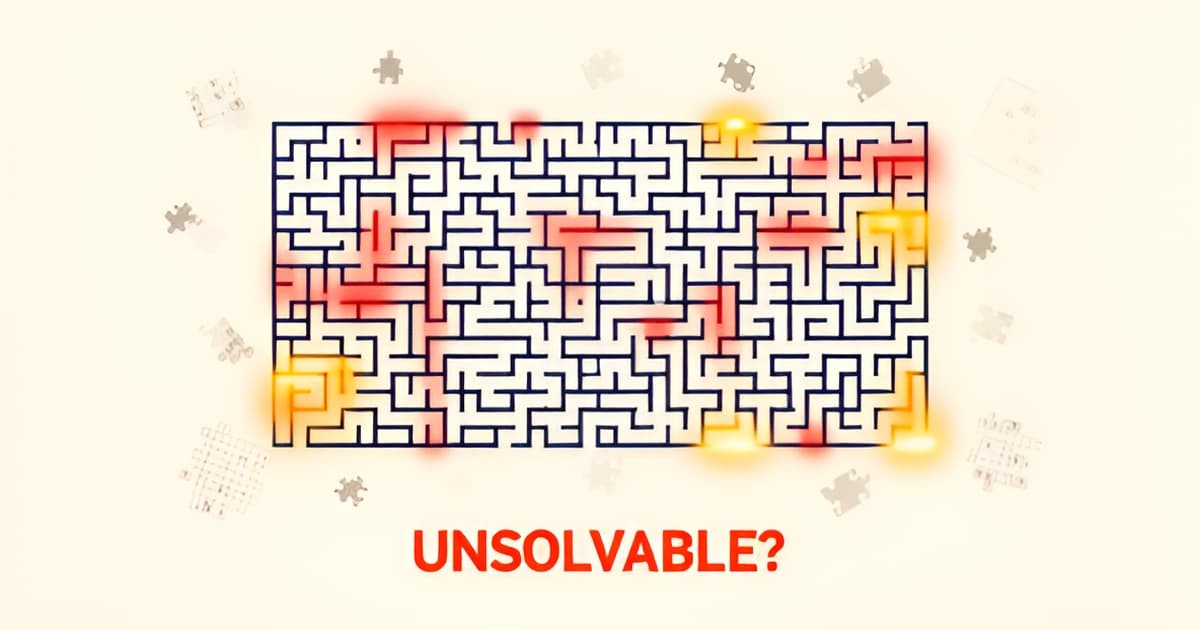
What is the world's most challenging puzzle?
Key Facts
- [
- "The Hardest Logic Puzzle Ever asks solvers to identify True, False, and Random gods in three yes/no questions using only two unknown words, "da" and "ja", creating 16 possible case combinations before the first question is even asked Wikipedia",
- "Patrick Berry's September 6, 2015 Sunday New York Times crossword took solvers on average more than 14 times as long as a typical Monday puzzle, making it the only puzzle ever rated "Extremely Hard" Puzzazz",
- "Physicists at the University of Bristol and University of Geneva built Hamiltonian-cycle mazes from quasicrystal patterns that grow exponentially in size and exist in an infinite number of configurations ScienceAlert",
- "A featured slide arrow maze offers 13 possible second moves, where the odds of stringing correct moves together collapse fast due to combinatorial explosion doyoumaze.com",
- "The Mega Arrow Maze has no dead ends, only incorrect loops, which its creator calls "maddening" and required five daily hints even for its own creator doyoumaze.com",
- "Empire State Building maze measures 3 feet wide by 9.5 feet tall, built pixel-by-pixel in Microsoft Paint over months, with two solution pathways and no solution file doyoumaze.com",
- "Maze generators offer explicit difficulty tiers up to \"Impossible,\" where one tool's setting uses maximum algorithmic complexity with hundreds of false routes ideal for challenge corners or end-of-term competitions jigsawmake.com"
- ]
Three Contenders For The Title
When you ask what is the world's most challenging puzzle, you quickly discover there's no single answer. Different puzzle communities crown different champions, and each one earns its title in a completely different way.
The strongest named claim belongs to logic. In 1996, MIT philosopher George Boolos published a puzzle he called the Hardest Logic Puzzle Ever, tracing its roots to logician Raymond Smullyan. You must identify three gods, True, False, and Random, using only three yes/no questions. The twist that makes it brutal: the gods answer in an unknown language, so "da" and "ja" mean yes and no in an order you don't know. You're juggling a liar, an unpredictable responder, and a vocabulary you can't decode, all at once.
If you prefer scale over logic, physicists hold the maze crown. Researchers at the University of Bristol and University of Geneva built Hamiltonian-cycle mazes from quasicrystal patterns, and the results stunned even them. Physicist Felix Flicker noted that "the sizes of subsequent mazes grow exponentially, and there are an infinite number of them." The work, published in Physical Review X, has real-world applications too, from carbon capture to protein folding.
For a data-driven answer, look at crosswords. Puzzazz built a Difficulty Index from hundreds of thousands of real New York Times solves, calibrated so a typical Monday puzzle scores 1.0. The hardest measured puzzle ever? Patrick Berry's Sunday crossword from September 6, 2015, which took solvers more than 14 times as long as a typical Monday puzzle. It was the only puzzle ever rated "Extremely Hard," and three times harder than the next toughest Sunday.
What ties these champions together is how they manufacture difficulty:
- Combinatorial explosion: one hard slide arrow maze offers 13 possible second moves, and your odds of stringing correct moves together collapse fast
- Misleading paths: long branching dead ends, or worse, loops with no dead ends at all, which one maze designer calls "maddening"
- Sheer scale: the Empire State Building maze measures 3 feet wide by 9.5 feet tall and took months to draw pixel by pixel
- Hidden information: unknown da/ja vocabulary or rebus tricks that change the rules mid-solve
There's a catch, though. Difficulty is relative, not absolute. Puzzazz's own authors note their index compares puzzles to each other, and a game design blogger points out that any puzzle will eventually defeat someone who isn't its designer. Even Monument Valley, famously easy, holds a 4.7 rating on Google Play because solvers enjoy challenges matched to their level.
That's the real insight. You don't need a physics lab or a Boolos-grade logic puzzle to test yourself. The same mechanics that make record-holders hard, branching, dead ends, and scale, can be dialed up or down in a printable maze you generate in seconds at Printoodle. Pair a tough maze with a round of halloween trivia or a family trivia game, and you've built your own challenge night at exactly the right level. Print it. Doodle it. Done.
The Mechanics Of Impossible
So what actually makes a puzzle brutal? Not its theme or its artwork. The hardest puzzles in the world, from Boolos's three-gods logic puzzle to physicists' quasicrystal mazes, all pull the same three levers: combinatorial explosion, misleading paths, and sheer scale.
Combinatorial explosion is the first lever. Boolos's famous puzzle asks you to identify three gods, True, False, and Random, in just three yes/no questions, and every answer comes back as "da" or "ja" in an unknown language. That's 16 possible case combinations in the solution table before you've even asked question one. Each question has to do double or triple duty because you can't afford to waste one.
Mazes explode the same way. One featured slide arrow maze gives you 13 possible second moves, and as one maze designer puts it, your chances of making the right sequence of moves in a row are near zero. The physicists behind the world's most fiendishly difficult maze found that their creations grow exponentially and exist in an infinite number of configurations, because finding a Hamiltonian cycle, a path visiting every point exactly once, is extremely hard by definition.
Misleading paths are the second lever. A good puzzle doesn't just block you; it confidently sends you the wrong way. The Mega Arrow Maze has no dead ends at all, only incorrect loops, which its creator calls maddening. Long dead ends with multiple branches do the same work in a classic maze. Jigsaw solvers know the cousin of this trick: the "false fit," a small piece placed incorrectly that quietly ruins everything around it.
Scale is the third. The Empire State Building maze runs 3 feet wide by 9.5 feet tall, built pixel-by-pixel in Microsoft Paint over months, with two solution pathways and no solution file. Difficulty climbs with size, which is why a 10x10 maze takes kids 3–7 minutes while 20x20 to 30x30 grids suit older solvers, per this maze generator comparison.
Here's the practical takeaway: these levers are dial-able. A printable maze generator controls exactly the variables that make the world's hardest puzzles hard:
- Grid size, from a friendly 5x5 up to 200x200 cells
- Dead-end density and branching, the misleading-path factor
- Loops instead of dead ends, for experienced solvers
- Difficulty tiers, some tools go all the way to "Impossible"
- Randomized generation, so every printout is unique and nobody can copy
That's the bridge between a physics lab and your kitchen table. Printoodle's maze generator lets you scale the same mechanics to whoever's solving, whether that's a five-year-old on a rainy afternoon or a classroom challenge corner. Pair a fiendish maze with a halloween trivia round or a family trivia game and you've engineered a proper competition. Print it, doodle it, done.
From Elite Mazes To Printable Fun
The physicists who built the world's most fiendishly difficult maze didn't set out to stump you. Felix Flicker's team at Bristol and Geneva was studying quasicrystal structures when they noticed the Hamiltonian paths they'd constructed formed mazes that grow exponentially, in an infinite number of configurations, work published in Physical Review X. That's the extreme end of a spectrum, and it raises an honest question: if you're asking what is the world's most challenging puzzle, the answer is "relative to whom?"
Difficulty is measurable, but only within a population. Puzzazz built its Difficulty Index from hundreds of thousands of real New York Times crossword solves, calibrating a typical Monday puzzle to 1.0. The hardest puzzle in their dataset, Patrick Berry's September 6, 2015 Sunday crossword, took solvers more than 14 times as long as a Monday. It was the only puzzle ever rated "Extremely Hard." Yet even Puzzazz's authors note their scale is relative, comparing puzzles to each other rather than to any absolute standard.
Maze designers know the same truth. The hardest mazes on one enthusiast site earn their reputation through specific, tunable mechanics: long dead ends with multiple branches, sheer scale, and loops instead of clean dead ends. One slide arrow maze offers 13 possible second moves. A Mega Arrow Maze with "no dead ends, only incorrect loops" required five daily hints from its own creator. These are design levers, not accidents, and that's the bridge to mazes you can actually print.
Modern maze generators expose exactly those levers as difficulty settings. One tool's "Impossible" tier uses maximum algorithmic complexity with hundreds of false routes, described as ideal for a challenge corner or an end-of-term competition. Grid sizes scale from 10x10 (typically 3 to 7 minutes for the target age group) up to 200x200 cells. The mechanics that make elite mazes brutal, combinatorial explosion and misleading paths, are the same ones a generator dials up or down.
That's why we built Printoodle's maze generator around tunable challenge rather than one fixed difficulty. A few of the dials that matter:
- Grid size: a 10x10 for a five-year-old's rainy day, a 30x30 for older students who want a real fight.
- Dead-end density and branching, which control how often a solver hits a wall and has to backtrack.
- Scale, the quiet difficulty multiplier; the Empire State Building maze measures 3 feet wide by 9.5 feet tall and has no solution file.
- Randomized output, so you can print multiple unique mazes at the same difficulty and nobody copies anyone.
There's a learning payoff too. Mazes build spatial reasoning, working memory, and planning-ahead skills, and every wrong turn delivers immediate feedback without judgment. Pair a hard maze with a round of halloween trivia or a family trivia game and you've got a full challenge corner for a classroom or a rainy afternoon.
The world's hardest puzzles belong to logicians and physicists. The right puzzle for your solver is the one scaled exactly to them. Print it. Doodle it. Done.
Your Turn: Generate A Challenge
Reading about the Hardest Logic Puzzle Ever is one thing. Feeling your brain stall halfway through a maze is another, and you can get that experience in about five minutes without a physics lab.
The research on puzzle difficulty points to a sweet spot. Puzzazz's Difficulty Index, built on hundreds of thousands of real crossword solves, shows difficulty is a measurable spectrum, from a typical Monday at 1.0 up to Patrick Berry's 2015 Sunday puzzle at more than 14 times that. But game design commentary adds a caution: extreme difficulty causes abandonment, with one writer describing quitting The Witness entirely after getting stuck. Challenge keeps solvers engaged; impossibility makes them walk away.
That's exactly why maze generators let you tune difficulty deliberately. According to a maze worksheet generator guide, a 10x10 grid typically takes 3 to 7 minutes for its target age group, while 20x20 to 30x30 grids suit older students, and randomized generation means every printout is unique so nobody can copy a neighbor's route. The same mechanics that make the world's hardest puzzles brutal, like combinatorial explosion and misleading paths, are the ones you can dial up or down.
Here's a simple way to run your own difficulty experiment with Printoodle's maze generator:
- Print a small grid and time yourself. Note where you hesitate.
- Move up one difficulty tier and repeat. Watch how dead ends and branches slow you down.
- Hand the same tier to a friend or kid and compare solve times. You'll see firsthand why difficulty is relative, not absolute.
Every junction is a low-stakes decision, and every wrong turn is immediate feedback without judgment, which is why mazes build spatial reasoning and planning-ahead skills while still feeling like play. You get the satisfaction of the solve without the abandonment risk of a puzzle designed for someone who isn't you.
If you want a companion challenge after the maze run, test the whole household's knowledge with a halloween trivia round or a full family trivia game. Print it, doodle it, done.
Frequently Asked Questions
What is the world's most challenging puzzle?
What is the Hardest Logic Puzzle Ever and why is it so difficult?
What's the hardest maze ever created?
What's the hardest crossword puzzle ever measured?
Is puzzle difficulty objective or subjective?
What actually makes a puzzle or maze hard to solve?
The Architecture Of Challenge
From the three-gods logic puzzle that forces solvers to decode an unknown language to physicists' infinitely expanding quasicrystal mazes, the world's hardest challenges share a common DNA: combinatorial explosion, misleading paths, and sheer scale. These same principles power the maze generators at Printoodle, where grid size, dead-end density, and branching complexity are dials you can turn to match any solver's skill level. Whether you're a parent seeking a rainy-day activity or a teacher building a classroom challenge corner, the same mechanics that stumped logician George Boolos and physicist Felix Flicker are available at your fingertips. The research is clear: difficulty is relative, not absolute, and the best puzzles keep solvers engaged without driving them away. Print it. Doodle it. Done.