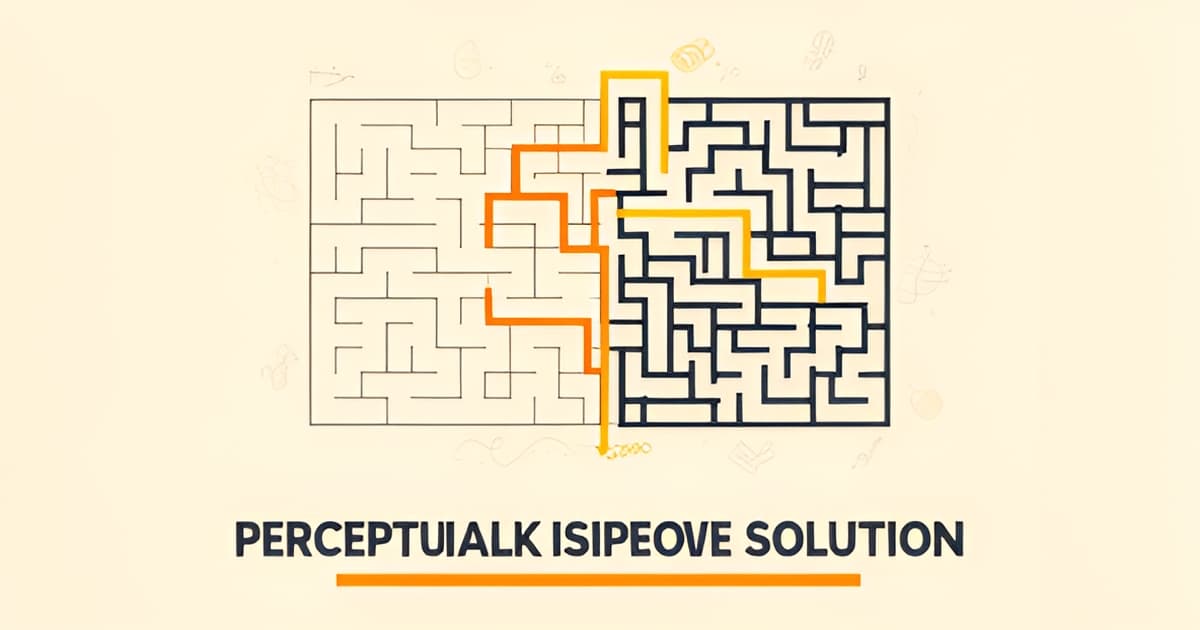
What makes a maze difficult?
Key Facts
- Mazes with identical topology can solve differently based purely on appearance, as thicker paths and thinner walls measurably increase solving time source
- Wavy walls slow solvers down compared to straight walls, likely due to greater visual crowding limiting lookahead source
- Visual crowding limits how far ahead a solver can see, with critical spacing at roughly 0.4–0.5 times eccentricity, making maze performance fairly scale-invariant source
- In a goal-oriented maze study, 21 of 21 participants reached the learning criterion versus only 3 with vague instructions source
- Forks work best when evenly distributed along the correct path, as having to cross only one fork means only needing luck once source
- Loops defeat 'always turn left' strategies only when start and finish sit on opposite sides of the loop source
- Even a single straight corridor can be perceptually hard if rendering makes the path difficult to trace, proving difficulty lives in the eye of the solver source
Why Two Identical Mazes Can Feel Totally Different
Picture this: you've spent twenty minutes picking what looks like the perfect maze, and your eight-year-old finishes it in forty seconds flat. Or worse, the "easy" one you printed for a party leaves a table of kids frustrated and wandering off toward the snack table. Understanding what makes a maze difficult turns out to be far trickier than most people assume, because difficulty lives on two separate dials, and most of us only know how to turn one of them.
The dial most people know is structural: path length, turns, forks, dead ends, loops. If you've ever designed a maze by hand, you've probably fiddled with these. Puzzle designers on community forums treat difficulty almost entirely as this topological question: how many forks sit along the correct path, how long the wrong paths run, how much the solution winds away from the exit before reaching it.
But here's where guessing fails. Research published in January 2025 in Attention, Perception, & Psychophysics demonstrated something maze designers had long suspected but never proven: two mazes with identical topology can solve completely differently based on appearance alone. Same corridors, same branches, same dead ends. Different wall thickness, different line style, different solving time.
In the study's controlled experiments, mazes drawn with thicker paths (and thinner walls) took measurably longer to solve than their identical-topology counterparts. Wavy walls slowed solvers down too, likely because mazes are, in the researchers' words, "complex, cluttered stimuli" limited by visual crowding, which constrains how far ahead a solver can clearly see. The researchers even noted that a maze with a single straight corridor from start to finish could still be perceptually hard if it's rendered the wrong way.
So when you're choosing or designing a maze, you're really managing two dimensions at once:
- Structural difficulty: grid size, number and placement of forks, dead-end length, loops, and how much the solution path winds.
- Perceptual difficulty: path and wall thickness, wavy versus straight walls, and how much visual crowding limits a solver's lookahead.
- Solver fit: research shows children handle pen-and-paper mazes from elementary school age, but "hard" and "developmentally appropriate" aren't the same thing.
This is exactly why Printoodle's maze generator exposes both levers rather than a single difficulty slider. Bigger grids and denser branches ramp up structural challenge; wall style and path thickness tune the perceptual side. A wavy-walled Halloween maze pairs nicely with a round of halloween trivia for older kids, while a clean, straight-walled maze keeps younger solvers in the game. The same logic applies if you're building a full activity night around a family trivia game and want the maze warm-up to match the crowd.
The takeaway is simple: stop judging a maze by its size alone. Two mazes that look equally hard on paper can behave nothing alike once a pencil hits the page.
What Makes a Maze Difficult: The Structural Levers
Maze difficulty is driven by two distinct dimensions: structural (topological) factors, path length, number of turns, branching forks, dead ends, loops, and maze size, and perceptual (visual) factors like wall thickness and curvature that can make topologically identical mazes feel harder. Research confirms that path length and the number of 90-degree turns measurably increase solution time, with longer paths demanding more time and each additional turn adding cognitive load. The placement and distribution of forks also matter; as community puzzle designers note, “the more forks you have the more locations you have to get off of the correct path,” and when forks are distributed along the ideal route, solvers must make more decisions rather than relying on a single lucky choice.
Dead ends serve as another primary lever. The cognitive research indicates that “the task difficulty is increased by incorporating numerous dead ends, which increases the number of erroneous paths,” though this comes without adding deeper cognitive complexity. Loops further complicate navigation by defeating “always turn left” strategies, but only when the start and finish positions fall on opposite sides of the loop. Additionally, the winding nature of the solution path itself influences perceived difficulty; easier mazes feature solutions moving in a straight line toward the exit, while harder puzzles require the path to wind close to the end before straying further away.
For a printable product like Printoodle, these findings translate directly into adjustable complexity levers. Grid size acts as a foundational dial, bigger grids allow for longer false paths, more dead ends, and additional forks. Branch density and dead-end length can be tuned to raise or lower the challenge, while wall style choices, such as wavy versus straight lines, introduce perceptual difficulty independent of topology. The Springer study demonstrated that even mazes with identical underlying topology vary in difficulty based on rendering style, proving that visual thickness and curvature are not mere cosmetic details but functional difficulty controls.
Understanding these levers allows designers to match maze complexity to their audience. Since children can solve pen-and-paper mazes as early as elementary school, settings can be calibrated: easy versions feature fewer forks and short dead ends, while hard versions distribute forks throughout the correct path, incorporate loops to disrupt automatic strategies, and feature winding solutions that keep solvers guessing. The goal is a “fun-but-fair” experience where difficulty feels earned rather than arbitrary, and where clear, attainable goals drive engagement without overwhelming the solver.
Ready to test your skills? Printoodle’s maze generator lets you adjust grid size, branch density, and wall style to create puzzles perfectly tuned for kids’ birthday parties, classroom worksheets, or adult coloring kits. It only takes seconds to generate a print-ready PDF, and every creation lives in your library for free reprints. Print it. Doodle it. Done.
halloween trivia and family trivia game make great complementary activities for your next gathering.
The Hidden Layer: How Walls and Lines Change Difficulty
Here's a surprising truth about what makes a maze difficult: two mazes can have the exact same layout, the same twists, the same dead ends, and still take wildly different amounts of time to solve. The difference isn't in the puzzle. It's in how the puzzle looks on the page.
A 2025 study published in Attention, Perception, & Psychophysics ran controlled experiments on maze solving and found that appearance alone changes difficulty. When researchers thickened the paths (which thins the walls), solvers took longer, even though the underlying topology never changed. Wavy walls had the same effect: they slowed people down compared to straight walls, likely because they add visual clutter.
The mechanism is visual crowding. Mazes are dense, cluttered stimuli, and your visual system can only separate nearby elements so well. The classic estimate, from Bouma's work, is that objects need to be spaced roughly 0.4 to 0.5 times their distance from where you're looking before you can tell them apart. In a maze, that limits how far ahead you can actually "see" the correct path, even when it's printed right in front of you.
This has a strange implication. As the researchers note, even a maze with a single straight corridor from start to finish could be perceptually hard, if the rendering makes the corridor hard to trace. Difficulty lives in the eye of the solver as much as in the diagram itself.
Solvers don't stare at one point and reason abstractly. The same study tracked eye movements and found that fixation times depend on later parts of the path, which points to heavy use of peripheral vision. Reduced peripheral acuity matters, but crowding matters more: it has a far bigger effect on solving time than simple blurriness at the edges of vision.
That's why print size and viewing distance shift difficulty less than you'd expect. Performance turned out to be fairly scale-invariant, consistent with crowding as the bottleneck. What actually moves the needle is how tightly packed the visual information is.
If you design or print mazes, these findings give you real controls:
- Line thickness: thicker paths with thin walls slow solvers down, per the study's first experiment.
- Wall style: wavy walls increase solving time compared to straight ones.
- Print density: smaller, tighter mazes crowd more information into your visual span, raising perceptual difficulty.
- Age fit: children handle pen-and-paper mazes from elementary school age, so pair young solvers with open spacing and thin lines.
At Printoodle, we treat wall style and line weight as genuine difficulty settings, not decoration, because the research says they are. The same logic applies across our printable activities: a Halloween maze pairs naturally with our halloween trivia cards, and a trickier maze round slots nicely into a family trivia game night. Print it, tweak the lines, and the difficulty moves.
Harder Isn't Always Better: Matching Difficulty to the Solver
Finding the right balance between challenge and frustration is what separates a satisfying puzzle from a dead end. Research into maze design shows that structural choices like dead ends and goal clarity directly impact how solvers engage with the task. A study published in Scientific Reports found that dead ends reliably raise difficulty without adding cognitive richness, meaning a maze can be harder to solve but not more rewarding; in fact, the same study revealed that 21 of 21 participants in a goal-oriented group reached the learning criterion, compared to only 3 in a group with vague instructions. This data suggests that when solvers know exactly what they are working toward, whether it is reaching a finish line or collecting specific items, they invest more mental energy and stay engaged longer. For younger solvers just picking up a pencil, this principle is especially important; children can solve pen-and-paper mazes as early as elementary school, but their success depends on matching the design to their developing spatial skills.
Matching maze difficulty to the solver means adjusting the layout based on age and experience. For early elementary ages, easy settings should feature few forks and short dead ends, keeping the path intuitive and the goal obvious. Older kids and adults benefit from medium difficulty layouts that include distributed forks, gentle loops, and winding paths that require a bit more planning without becoming overwhelming. Harder mazes for experienced solvers incorporate tighter branch density, longer incorrect paths, and solution routes that wind far from the exit before looping back, creating that satisfying “aha” moment when the correct route is finally identified. Printoodle’s generator lets users adjust these complexity levers, grid size, branch density, and dead-end length, so the maze grows with the solver rather than leaving them stuck.
Making a maze harder is only half the goal; the other half is making it more meaningful. When a maze has a clear, attainable objective, solvers of all ages are more likely to persist through the tricky bits and feel a sense of accomplishment at the end. This is why Printoodle’s approach to maze generation focuses on adjustable complexity that respects the solver’s skill level, whether they are a child navigating their first fork in the road or an adult looking for a relaxing evening challenge. Ready to test your skills? Print a custom maze and see how the difficulty feels in action.
How to Tune Difficulty in Printoodle (and Pair Mazes with Other Activities)
Now that you know what makes a maze difficult, you can put that knowledge to work. Printoodle's maze generator exposes exactly the levers the research points to, so you can dial difficulty up or down for the solver in front of you.
Grid size is the first dial. Bigger mazes simply allow longer false paths, deeper dead ends, and more forks, which is why puzzle designers treat size as a foundational difficulty lever. A 10×10 grid with a few short dead ends suits a first grader; a 30×30 grid gives older kids room to get properly lost.
Branch and dead-end density comes next. As one puzzle design discussion puts it, the more forks you have, the more locations there are to get off the correct path. For young solvers, keep forks rare and incorrect paths short, since short linear dead ends are only a brief distraction. For harder mazes, distribute forks evenly and give wrong paths real length.
Loops are your secret weapon against clever kids. A solver using the "always turn left" strategy sails through a standard perfect maze, but loops break that trick when the start and finish sit on opposite sides of the loop. Add them once your solver has figured out the wall-following shortcut.
Wall style and path thickness matter more than most people expect. A 2025 study in Attention, Perception, & Psychophysics found that thicker paths and wavy walls both measurably increase solving time, even when the underlying maze structure is identical. The mechanism is visual crowding: cluttered walls limit how far ahead a solver can clearly see. So a straight-walled, wide-path maze reads easy, while a wavy, tight one reads hard, no topology change required.
One caution from the research: harder isn't automatically better. A study in Scientific Reports found that dead ends increase difficulty without adding cognitive richness, and that clear, attainable goals drive the most engagement. Aim for fun-but-fair, not maximum frustration.
Pairing mazes with other activities
Mazes shine as part of a set. For a Halloween party pack, combine a themed maze with a round of halloween trivia so kids alternate between quiet solving and lively guessing. For family game night or a classroom station rotation, print mazes alongside a family trivia game and split the group by activity. Since children can solve pen-and-paper mazes from elementary school age, one easy maze and one hard maze covers a mixed-age table nicely.
Ready to build your set? Grab the free sample, open the generator, and tune your maze until it's exactly as tricky as you want it.
Print it. Doodle it. Done.