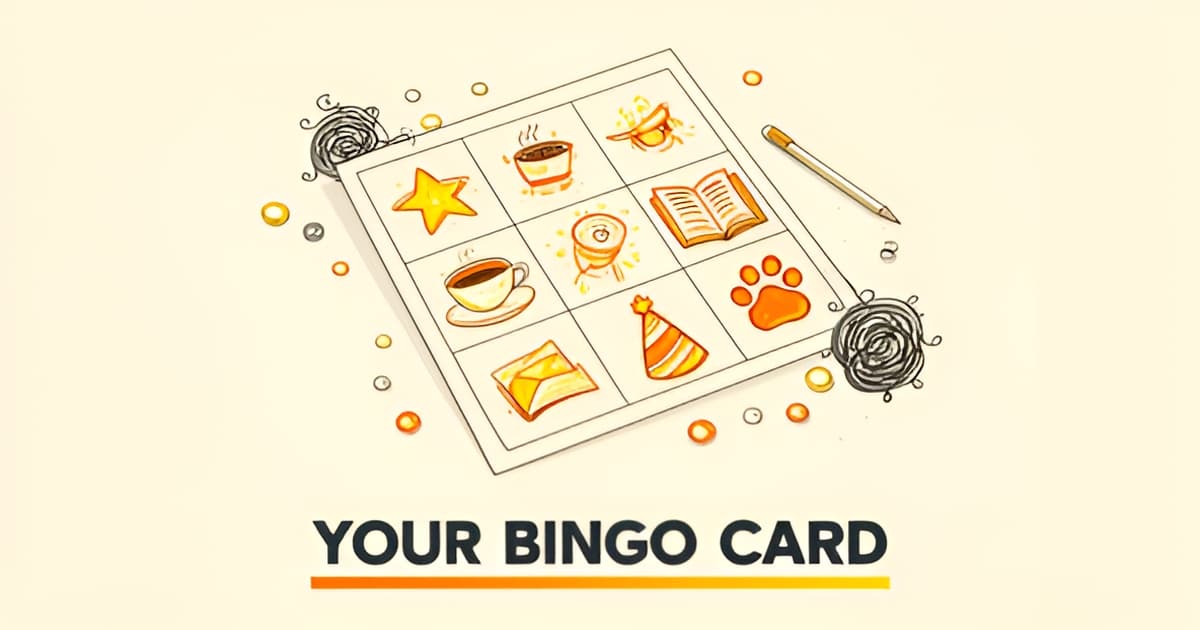
What should be on your bingo card?
Key Facts
- ["According to Lucintel, manufacturers are always coming up with new designs, themes, and features to improve the gaming experience, driving a 2.8% annual market growth through 2030", "https://www.lucintel.com/bingo-card-market.aspx"],
- ["A market analysis of online bingo found that community and interaction are central to player engagement, with entertainment accounting for 92.02% of the market's value in 2022", "https://maiaresearch.com/Press_Release/1688394.html"],
- ["The 90 Ball Bingo variant held the largest product-type market share in 2022, reminding players that grid size and content range depend on who's playing", "https://maiaresearch.com/Press_Release/1688394.html"],
- ["Industry research notes that custom-themed bingo cards succeed because they spark conversation, as personalized squares like inside jokes or shared memories drive social connection at parties and showers", "https://maiaresearch.com/Press_Release/1688394.html"],
- ["Reading bingo turns a solo habit into a friendly race, with each square representing a book, genre, or reading spot to motivate reluctant students through the school year", "https://printoodle.com/tools/reading-bingo"],
- ["The bingo card market is expected to grow at a CAGR of 2.8% from 2024 to 2030, driven by online gaming popularity and new designs/themes", "https://www.lucintel.com/bingo-card-market.aspx"],
- ["A significant feature of online bingo games is the chat function, as cultivating a sense of community and interaction among players helps customers retain", "https://maiaresearch.com/Press_Release/1688394.html"]]
Why Theme and Audience Shape Your Card
A bingo card for a six-year-old's birthday party and one for a retirement gathering share almost nothing, and that's the point. Before you fill in a single square, you need to know who's holding the card and why they've gathered.
This goes beyond common sense. According to industry research on the bingo card market, manufacturers "are always coming up with new designs, themes, and features" to improve the gaming experience, and that design innovation is one of the forces driving the market's steady 2.8% annual growth through 2030. In other words, the industry itself has concluded that theme and audience are the product.
So when you're deciding what should be on your bingo card, start with the occasion, then let it dictate every square:
- Classroom bingo: vocabulary words, science terms, or images tied to the current unit, so the game doubles as review.
- Party or shower bingo: gifts, guests, or inside jokes, so every square starts a conversation.
- Reading bingo: book covers, genres, or reading challenges that keep kids motivated through the school year.
- Family game night: pets, favorite foods, or family milestones that everyone recognizes instantly.
The social angle matters more than most people realize. A market analysis of online bingo found that community and interaction are central to why players stay engaged, and that entertainment accounts for 92.02% of the market's value. People play bingo to connect. A card full of personalized squares does that work for you: someone shouts "Grandma's casserole!" and the whole table is talking.
Format follows audience too. The same research shows 90 Ball Bingo held the largest share of the product-type market in 2022, which is a reminder that grid size and content range depend on who's playing and how long you want the game to run. A quick five-in-a-row party game needs different pacing than a long classroom session.
This is why a flexible tool beats a static printable. Printoodle's bingo card generator lets you plug in the words, images, and themes that match your specific crowd, whether that's a kindergarten class or a bridal shower. And for teachers building literacy into the fun, the reading bingo tool turns any book list into a card kids actually want to complete.
The card doesn't exist in a vacuum. Know your players, pick your theme, and the squares almost write themselves.
Format Matters: Grid Size and Number Ranges
Before you fill in a single square, decide on the skeleton: how many squares your card holds and what pool of items those squares draw from. Get that right, and everything else about what should be on your bingo card falls into place.
Format drives structure. The classic 90-ball game, which held the largest share of the bingo product-type market in 2022, uses a 3-by-9 grid where each row holds just five numbers and four blanks, with numbers drawn from a 1 to 90 pool. Compare that to the 75-ball American format: a tidy 5-by-5 grid with a free center square. Same game family, completely different card anatomy.
For custom bingo, the practical takeaway is simple. Your grid size should match the size of your item pool, and your pool should match the attention span of your players. A classroom of seven-year-olds loses interest hunting through 24 dense squares; a bridal shower full of competitive aunts will demolish a 12-square card in ten minutes.
A few proven pairings to guide your build:
- Kids and classrooms: a 3-by-3 or 4-by-4 grid with large, picture-friendly squares keeps rounds short and everyone wins eventually.
- Parties and showers: a 5-by-5 grid works well, filled with guest-specific prompts and inside jokes that get people talking.
- Reading bingo: a 5-by-5 grid of genre and title challenges suits a month-long or summer-long pace, so 24 to 25 distinct prompts give players real choice.
That social element matters more than you might think. The same market research notes that community and interaction drive player retention in online bingo, and the same logic applies at your kitchen table. A card packed with conversation starters, like "has met a celebrity" or "read a book over 500 pages," does more than a card of generic items ever will.
Number ranges deserve equal care if you're running a numbers-based game. A pool that's too small creates duplicate winners in the first ten calls; a pool that's too large means dead squares nobody can mark. The traditional formats solved this decades ago: 75 numbers for a 25-square card, 90 numbers for the three-row British ticket. If you're building a themed card instead, aim for a pool of items roughly 1.5 to 2 times the number of squares on each card, so every printed card feels different without exhausting your theme.
If you'd rather skip the grid math, Printoodle's bingo card generator handles sizing and shuffles the item pool across cards automatically, and the reading bingo tool applies the same logic to book-title and genre squares. Design innovation is a recognized driver of bingo card demand, and format is where good design starts. Pick your grid, size your pool, then fill every square with something worth marking.
Squares That Spark Connection
The best bingo squares are the ones that make people look up from their card and laugh, nod, or say "that's so true." When you're deciding what should be on your bingo card for a party, shower, or classroom, personalized squares do the heavy lifting, because bingo has always been a social game at heart. Industry research on the online bingo market notes that community and interaction features help keep players engaged, which is exactly why custom squares work so well in a room full of people who know each other.
Think about what happens when a square reads "Aunt Marla tells the same wedding story" instead of "B-7." Heads turn. Someone giggles. The game becomes a conversation starter rather than a numbers match. That social spark is the whole point: a market analysis of online bingo found that the chat function and community-building features are central to the game's appeal, and the same dynamic translates perfectly to a printed card on a table full of friends.
So what belongs in those squares? It depends on the room, but a few categories consistently get people talking:
- Inside jokes and shared memories, perfect for bridal showers, bachelorette parties, and family reunions
- Guest names paired with likely moments, like "Dad tears up during the toast"
- Gift-prediction squares for baby showers, where players mark items as they're unwrapped
- Book titles or reading challenges for classrooms, where students mark off each book they finish
- Classmate traits or school-year milestones for end-of-year parties
The classroom version deserves special mention. Reading bingo turns a solo habit into a friendly race, with each square representing a book, genre, or reading spot. Teachers have long used this format to motivate reluctant readers, and a tool like Printoodle's reading bingo generator lets you build a card around your actual book list or lesson material, so the squares match what your students are really reading.
The theme-first approach has market backing, too. Lucintel's bingo card market report identifies new designs and themes as a key driver of demand, with manufacturers constantly introducing fresh themed cards. In other words, the industry itself has learned that a generic card is forgettable, while a themed one gets picked up. It also frames bingo as entertainment first: roughly 92% of the online bingo market's value in 2022 came from entertainment applications, not gambling, which is why custom cards work so well as family-friendly party and classroom activities.
If you want to build a card full of these connection-sparking squares, a bingo card generator handles the layout and printing so you can spend your energy on the fun part: filling each square with something that will make your specific crowd react. Print it. Doodle it. Done.
Building Your Card With Printoodle
You've picked your theme and brainstormed your squares. Now it's time to turn that list into something you can actually print and play, and that's where the right tool saves you an hour of fiddling with tables in a word processor.
Printoodle's bingo card generator is built for exactly this moment. You enter the theme you settled on earlier, whether that's a baby shower, a classroom review session, or a family game night, and type in the squares you've chosen. The generator handles the layout, shuffles your items, and produces a print-ready PDF in Letter size (with an A4 toggle if you need it).
This matters because what should be on your bingo card is only half the equation. The other half is getting it onto paper without a formatting headache. And the themed approach you've planned does more than add a nice touch. Market research from Lucintel identifies new designs and themes as a genuine driver of the bingo card market, which is growing at a 2.8% CAGR through 2030. Custom-themed cards aren't a gimmick; they're where the interest is.
Before you hit generate, do a quick quality pass on your square list. The best custom cards do two things at once: they fit the occasion and they get people talking. Research from Maia notes that community and interaction are central to why players stick with bingo, so squares that spark conversation are doing real work. A bridal shower card with inside jokes about the couple will outperform generic prompts every time.
A quick checklist before you generate:
- Every square ties back to your single chosen theme
- At least a few squares are personal: names, inside jokes, shared memories
- Mix easy wins with harder finds so the game lasts
- Grid size matches your audience (simpler grids for younger kids)
- Double-check spelling on names before printing
Printoodle's free tier gives you 10 credits just for verifying your email, which is plenty to generate and download your first cards. Once your PDF is in your library, reprints are free forever, so you can run the same game with a new group next month without spending another credit. That's especially handy for teachers who reuse a unit-review card across multiple classes.
If your theme is books, take a look at the reading bingo tool instead. It's tailored for literary squares, from genre challenges to character traits, and it's a natural fit for classrooms and summer reading programs. Since 92.02% of online bingo market value came from entertainment applications in 2022, you're in good company treating this as pure, social fun rather than anything formal.
Print it. Doodle it. Done.