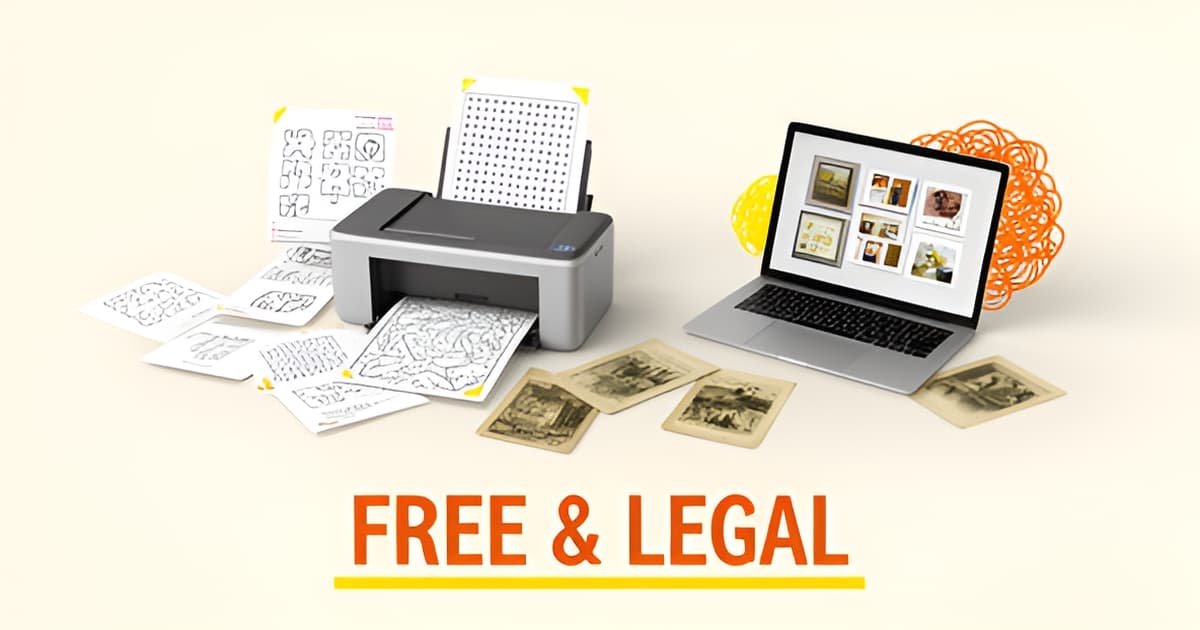
Where can I find free printable images?
Key Facts
- The Library of Congress 'Free to Use and Reuse' collection offers 100+ curated sets of 25–50 items each, all explicitly marked for public use without copyright restrictions.
- Unsplash hosts over 6 million photos and explicitly refuses AI-generated or AI-edited images, prioritizing human-made work for printable projects.
- Pixabay provides more than 6 million photos, illustrations, and vectors, though its AI filtering 'worked better than most' yet remains imperfect across platforms.
- Pexels offers just over 1 million photos and videos, clearing a smaller licensing bar compared to Unsplash and Pixabay for free image sourcing.
- Printoodle's word search maker tool allows users to generate print-ready puzzles from their own vocabulary lists, with all creations stored in a library for free reprints forever.
- The Library of Congress collection spans from 1500s to present day, offering historical depth alongside contemporary subjects like Dragons, Football, Jazz, and Shoes for diverse projects.
- All Creative Commons licenses require attribution to remain valid, and without proper attribution the license permissions do not apply at all per Ohio State's teaching guide.
The Real Problem With "Free" Printable Images
You'd think "free printable images" would be the easiest search on the internet. Then you spend an hour clicking through pages of "free" downloads only to discover licensing terms written for lawyers, watermarks, or fine print that bans exactly what you want to do with them. If you've ever wondered where you can find free printable images that are actually free and actually safe to print, you already know the real problem isn't scarcity. It's clarity.
The big stock platforms look like obvious answers, but each carries its own quirks. Unsplash offers over 6 million photos and explicitly refuses AI-generated or AI-edited images, which matters if you want human-made work. Pixabay also hosts more than 6 million photos, illustrations, and vectors, yet its AI filtering "worked better than most" in testing, though no site's filtering is perfect. Pexels clears a smaller bar at just over 1 million photos and videos.
Then there's the licensing maze itself, and this is where most people get tripped up:
- Creative Commons offers six different license tiers, ranging from public domain placement to heavily restricted use, and they're easy to confuse.
- Every Creative Commons license requires attribution. As Ohio State's teaching guide puts it, without proper attribution the license permissions don't apply at all.
- Fair use is judged by four factors: purpose, nature, amount, and market effect. Noncommercial educational use is "likely to meet a fair use standard," but that's a judgment call, not a guarantee.
For a teacher assembling a worksheet or a parent building a birthday activity pack, that ambiguity is exhausting. You want to print a puzzle, not audit a license.
The contrast with genuinely cleared sources is striking. The Library of Congress "Free to Use and Reuse" collection offers 100+ curated sets of 25 to 50 items each, and every image is explicitly marked with rights information after the Library conducts its own rights assessments. No guesswork. No murky terms.
That's the standard worth demanding: images whose rights status is stated plainly, in writing. It's also the thinking behind tools like Printoodle's word search maker, where the content you generate is yours to print from the start, and every printable word search you create lives in your library with free reprints forever. When the rights question is answered before you print, the word "free" finally means what it says.
The Best Free Printable Image Sources, Ranked by Legal Safety
When searching for free printable images, the Library of Congress "Free to Use and Reuse" collection stands as the most legally secure starting point. Maintained by a .gov authority, this resource offers 100+ curated sets containing 25-50 items each, spanning subjects from Classic Children's Books to Dragons, Football, Jazz, and Shoes. Every image in these collections is explicitly marked "free to use and reuse," with the Library confirming no known copyright restrictions, a crucial distinction from other free platforms where licensing terms can be ambiguous.
For creators focused on puzzle makers and printable generators, the Library of Congress provides the explicit rights clearance needed to avoid infringement, while Printoodle offers a complementary solution for turning those images, or any brief prompt, into customized activity pages. Printoodle operates as a consumer web app where users can generate themed coloring pages, word searches, crosswords, and other print-ready PDFs by uploading photos or brief descriptions. The platform follows a credit-based system: new users receive 10 free credits upon email verification, with credit packs available starting at $5, and importantly, all reprints remain free forever once a design is saved to the library.
Beyond the Library of Congress, major stock photo platforms like Unsplash, Pixabay, and Pexels offer millions of images, but their "free" labels come with varying conditions. Unsplash explicitly does not accept AI-generated or AI-edited photos, while Pixabay and Pexels operate under Creative Commons licenses that generally permit commercial and editorial use, though attribution requirements differ by platform. Understanding these Creative Commons licensing tiers, ranging from public domain placement with no restrictions to licenses requiring attribution or limiting commercial use, helps readers determine what each "free" label actually permits for their specific printable project.
Printoodle’s library functionality further distinguishes this ecosystem. Once a user generates a word search, coloring page, or bingo card using the tool, the creation lives in their personal library where reprints are always free. This model differs from traditional image sourcing by focusing on transformation and generation rather than simple download. For those navigating copyright frameworks, it is worth noting that Creative Commons offers six different tiers of access, and all licenses require proper attribution to remain valid. The Library of Congress collection, by contrast, sits in the public domain, meaning no attribution is legally required, though it is always appreciated.
For anyone ready to start creating, Printoodle provides a free sample of every generator, allowing users to test the word search maker or printable word search tools before committing credits. The platform’s warm, playful brand voice and doodle-style mascot make it accessible for parents, teachers, and party hosts alike, while defaults ensure all content remains safe-for-kids and free of trademarked characters. Whether sourcing historically cleared images from the Library of Congress or generating custom activities from personal photos, the combination of legally rights-cleared sources and intuitive generation tools offers a practical path forward for printable content creation.
From Free Images to Print-Ready Activities: How the Printoodle Library Works
Finding a free image answers only half the question. A JPEG of a vintage dragon or a photo of your dog is raw material, and most parents, teachers, and party hosts don't have the time or tools to turn it into something a printer can handle. That gap between "image I found" and "activity I can hand to a six-year-old" is where most printable projects stall.
Printoodle closes that gap by treating your source material as a starting point. You upload a photo, paste in a document, or type a short brief, and the app generates a print-ready PDF in seconds. That could be a coloring page traced from your pet's photo, a mystery pixel picture, a maze, bingo cards, or a puzzle built with the word search maker from your own vocabulary list. Downloads default to Letter size with an A4 toggle, so the pages come out of the printer correctly formatted the first time.
The range of what you can generate covers most of what families and classrooms actually need:
- Themed coloring pages, including photo-to-line-art conversions
- Word searches, crosswords, and trivia cards from your own lesson material
- Bingo and party packs for bridal and baby showers
- Mazes, dot-to-dots, flashcards, and classroom worksheets
If you'd rather start from a found image than a photo of your own, pair Printoodle with a rights-safe source. The Library of Congress "Free to Use and Reuse" collection offers more than 100 curated sets, each holding 25 to 50 historical items with no known copyright restrictions. Download a public-domain illustration, upload it, and you've turned a century-old image into a coloring page without any licensing worry.
Everything you create is stored in your library, and reprints are free forever. That matters more than it sounds: when a birthday party needs a second run of bingo cards or a rainy day demands the dinosaur maze again, you don't pay twice or hunt through your downloads folder.
The cost structure is simple. Email verification gets you 10 free credits, which is enough to test several activity types before spending anything. Beyond that, credit packs start at $5. There's no subscription to remember to cancel.
So the honest answer to "where can I find free printable images" has two parts: source legally cleared imagery from a trusted archive, then let a printable word search generator or coloring-page tool do the formatting work you'd otherwise do by hand. Print it. Doodle it. Done.
Your Step-by-Step Workflow: Source Free Images, Generate, Print
Finding the image is only half the job. The real value comes from turning it into something printable, and the workflow below gets you from source to printed page in about ten minutes.
Start with the Library of Congress "Free to Use and Reuse" collection, which offers more than 100 curated sets of 25–50 items each, all explicitly marked with no known copyright restrictions. Themes range from Classic Children's Books to Jazz to Dragons, so you can usually find a set that matches your activity. If you're pulling from Creative Commons sources instead, remember that all CC licenses require attribution, and without proper attribution the license permissions don't apply. A simple "Image: creator, source, license" line at the bottom of your page covers you.
This is where a generator earns its keep. Printoodle's word search maker turns your theme or word list into a print-ready puzzle in seconds, and the printable word search tool handles themed layouts for classrooms, parties, or rainy afternoons. Type in your words (or upload a short brief), preview the grid, and adjust the difficulty to match your audience.
- Choose your paper size: Letter is the default, with an A4 toggle for international printing.
- Download the print-ready PDF and send it to your printer.
- Every creation lives in your Printoodle library, so reprints are free forever, no credits spent on second copies.
- Print a test page first if you've included images, so you can check contrast before running a full classroom set.
The same instincts shaping 2026 web design work on paper too. Design trend research points to a shift toward warm, imperfect, human-centered aesthetics, including a "Human Scribble" look that favors spontaneous, hand-drawn elements over polished machine output. That's good news for printable activities, because doodle-style grids and playful borders print better than slick graphics and feel more inviting to kids solving them.
A few practical rules help. Keep one dominant visual element per page so the puzzle stays readable at print resolution. Use imperfect, hand-drawn accents around the title rather than filling every margin. And when in doubt, test your page on plain paper before the good stock; free reprints from your library make iteration painless.
The whole loop, source, generate, print, costs you nothing after the initial build. That's the quiet advantage of pairing rights-free imagery with a generator: once the file exists, you can reprint it for the next class, the next birthday, or the next snow day without a second thought.
Frequently Asked Questions
Where can I find free printable images that are actually free to use?
Are Unsplash, Pixabay, and Pexels good sources for printable images?
Do I have to credit images I find on free sites?
Can I use free printable images for classroom worksheets and school activities?
How do I turn a free image into an actual printable activity like a word search or coloring page?
How much does Printoodle cost, and are reprints really free?
So, Where Can You Find Free Printable Images? Right Here, Actually
The honest answer to "where can I find free printable images" turns out to be simpler than the licensing maze suggests: start with sources that state their rights plainly, like the Library of Congress "Free to Use and Reuse" collection with its 100+ curated sets of rights-cleared imagery, then let a generator handle the formatting work you'd otherwise do by hand. That's where Printoodle fits in, turn a vintage dragon or your own pet photo into a coloring page, or build a puzzle with the word search maker from your own vocabulary list. Your 10 free credits on signup are enough to try several activity types, and once a creation is saved, reprints stay free forever, so the second run of bingo cards never costs a thing. Your next step is easy: pick a theme, generate a sample, and print a test page today. Print it. Doodle it. Done.