Where can I find free Sudoku puzzles for kids?
Key Facts
- Teaching math through Sudoku outperformed traditional methods in a 7-week study of 62 fifth graders in the Philippines
- A 2008 NCTM journal article recommends Sudoku for teaching logical reasoning to grade 2-3 students in Teaching Children Mathematics
- Kids ages 4-6 should start with 4×4 or picture Sudoku, taking just 5-10 minutes per puzzle per one difficulty guide
- Ages 10-12 can handle medium 9×9 puzzles with 30-40 given cells, solvable in 20-30 minutes according to an age-based guide
- Just 10-15 minutes of daily Sudoku practice is enough to build a lasting habit per practitioner guidance
- Easy 9×9 puzzles for ages 7-9 contain 40-50 given cells and take 15-20 minutes to solve per one free generator's guide
- If your child starts guessing, the puzzle is too hard, drop back a level immediately per one difficulty guide
The Hunt for Free Kids' Sudoku (and Why It's Worth the Effort)
If you've typed "where can I find free sudoku puzzles for kids" into a search bar lately, you've probably noticed the pattern: apps that want a subscription, sites buried in ads, or puzzles that are either too hard or too easy for your child. You want a printable, screen-free logic puzzle, and the hunt keeps getting in the way.
Here's the good news: the effort is worth it, and the evidence backs that up. In a 7-week quasi-experimental study, Jinon (2022) taught math to 62 Grade 5 pupils in the Philippines through Sudoku puzzles. The Sudoku group outperformed students taught with traditional methods on both mathematics achievement and reasoning performance. The study describes Sudoku as an intellectual game that improves logic, concentration, and reasoning.
Peer-reviewed support goes back further, too. A 2008 article in Teaching Children Mathematics published by the National Council of Teachers of Mathematics recommends Sudoku as a concrete way to teach logical reasoning to grade 2 and 3 students, even suggesting an interactive classroom bulletin board built around the puzzle.
So what does "free" actually look like? Free options generally fall into two camps:
- Printable generators that produce PDFs you can print at home, often with answer keys included. One example, jigsawmake.com, offers free 4×4, 6×6, and 9×9 grids with no registration required.
- Browser-based play like LoveSudoku, a free site with six difficulty levels from Beginner to Evil, no download or sign-up needed.
- Printable libraries like Printoodle's kids sudoku printable generator, where every puzzle you create is saved and reprints are always free.
For parents who want paper over screens, the printable route makes the most sense. Sudoku is widely positioned as screen-free entertainment for car rides, waiting rooms, and quiet time, and reducing excessive screen time is listed among the puzzle's benefits for children. Ten to fifteen minutes of daily practice is the commonly suggested dose, which fits neatly into a bedtime or after-school routine.
One practical tip before you print a stack: match the grid to your child's age. Both sudoku.com.vn and jigsawmake.com converge on a similar progression. Ages 4 to 6 do best with 4×4 or picture-based grids, ages 7 to 9 can handle 6×6 or easy 9×9 puzzles with 40 to 50 given cells, and ages 10 to 12 are ready for medium 9×9 puzzles with 30 to 40 givens.
If your child takes to Sudoku, the same print-and-solve habit extends to other logic puzzles. Printoodle's library also includes mazes for kids and rebus puzzles for kids, so you can build a small rotation of screen-free brain teasers from one place. Print it. Doodle it. Done.
Match the Grid to the Kid: An Age-by-Age Difficulty Guide
The right grid at the right age makes the difference between a child who begs for "one more puzzle" and one who shoves the pencil away. Two independent guides converge on a clear progression, so you can pick a starting point with confidence rather than guesswork.
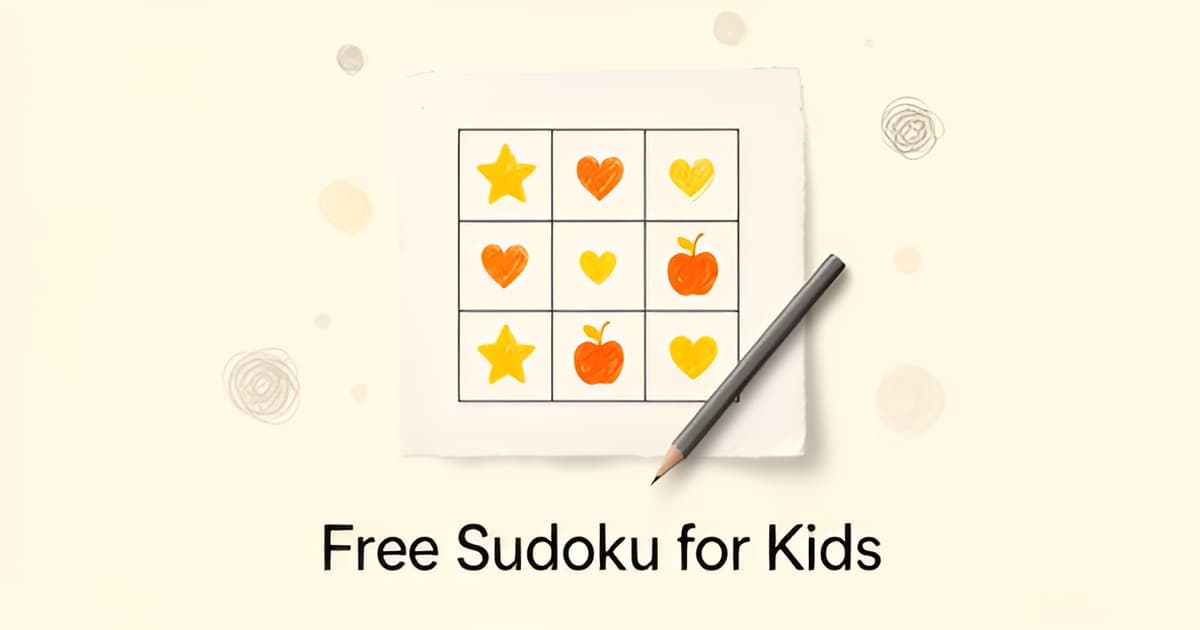
For ages 4–6, start small: a 4×4 grid or a picture-based Sudoku where kids place apples, dinosaurs, or stars instead of digits. According to one children's Sudoku guide, picture puzzles work well for beginners because they remove the number-recognition hurdle entirely. Around ages 6–8, most kids are ready for 6×6 grids, which typically take 5–10 minutes to solve.
From about age 8, an easy 9×9 with 40–50 given cells is the sweet spot, usually solvable in 15–20 minutes. Medium 9×9 puzzles (30–40 givens) suit ages 10–12 and take 20–30 minutes, per an age-based difficulty guide. Kids 12 and up can handle hard grids with 20–30 givens, and eventually expert-level puzzles.
Here's the full progression at a glance:
- Ages 4–6: 4×4 or picture Sudoku, 5–10 minutes per puzzle
- Ages 6–8: 6×6 grids as a bridge to standard play
- Ages 8–9: easy 9×9 with 40–50 given cells
- Ages 10–12: medium 9×9 with 30–40 givens
- Ages 12+: hard 9×9 with 20–30 givens, moving toward expert
A few practical tips make the climb smoother. Begin with nearly complete puzzles, just 3–5 empty squares, so the child experiences finishing rather than flailing. Teach scanning (checking a row, column, or box for the only missing number) before anything else, then introduce pencil marks once puzzles get genuinely tricky.
Keep sessions short. One guide recommends 10–15 minutes per day, which is enough to build the habit without wearing out attention. And watch for two signals: if your child starts guessing, the puzzle is too hard, so drop back a level and reinforce pencil marks. If frustration appears, the same rule applies. Difficulty should stretch a child slightly, never stress them.
When you're ready to print, Printoodle's kids sudoku printable generator covers the whole range, and every puzzle you generate stays in your library for free reprints as your child levels up. If Sudoku clicks, siblings who prefer other logic challenges can try the mazes for kids and rebus puzzles for kids generators too. Print it, doodle it, done.
Where to Find Free Sudoku Puzzles for Kids: Your Three Best Options
Finding free Sudoku puzzles for kids means choosing between printable activity sheets for screen-free fun and browser-based platforms for quick online play. For parents and teachers who want reusable puzzles that fit into a daily routine, the right format depends on whether the goal is car-ride entertainment or a quick brain break.
Printoodle’s kids Sudoku printable generator offers a distinct advantage for families prioritizing print-ready resources. The tool creates 4x4, 6x6, and 9x9 grids with answer keys included, and every puzzle is saved to a personal library where reprints are always free. New users receive 10 free credits on signup, allowing them to generate and download PDFs immediately. Unlike some competitors that require account creation or limit daily outputs, Printoodle’s model supports repeated use without additional cost, making it practical for quiet time, travel bags, or classroom worksheets. The generator is accessible at https://printoodle.com/tools/kids-sudoku-printable.
For those who prefer no-registration instant access, jigsawmake.com provides a free printable Sudoku generator with 4x4, 6x6, and 9x9 grids. Its interface is straightforward: select the grid size, hit generate, and download a PDF with answer keys. The service markets itself as 100% free with no sign-up required, which appeals to users wanting a quick download without sharing an email address. However, Printoodle differentiates itself by storing every generated puzzle in a permanent library, meaning previously created sheets can be reprinted anytime, a feature jigsawmake does not emphasize.
Online play is the other primary avenue, and LoveSudoku (t.lovesudoku.net) serves this niche as a free browser-based platform. It offers six difficulty levels from Beginner to Evil, plus Killer Sudoku, and saves progress locally in the browser. This model suits kids comfortable with screens who want immediate engagement without downloading an app. However, for parents seeking tangible activities, puzzles they can tuck into a backpack, laminate for repeated use, or save for a rainy day, printable generators provide a more versatile solution.
Age-appropriate difficulty is a key consideration across all formats. Research into children’s Sudoku use suggests a clear progression: ages four to six benefit most from 4x4 grids, seven to nine-year-olds transition to 6x6 or easy 9x9 puzzles with 40 to 50 given cells, and ages ten to twelve can handle medium 9x9 grids with 30 to 40 given cells. These guidelines, drawn from independent age-to-grid analyses, help adults select puzzles that match a child’s developing reasoning skills without causing frustration.
Regardless of the chosen format, Sudoku offers documented educational value. A seven-week study of 62 fifth-grade pupils found that teaching math through Sudoku enhanced mathematics achievement and reasoning performance compared to traditional strategies. Additionally, an NCTM peer-reviewed article recommends using Sudoku to teach logical reasoning to second and third graders through interactive classroom bulletin boards.
For families ready to start, Printoodle provides a straightforward entry point. The kids Sudoku printable generator creates customized puzzles in seconds, and the free tier includes 10 credits upon email verification. All generated puzzles are saved to a library where reprints are always free, eliminating the need to repurchase or regenerate the same activity. Print it. Doodle it. Done.
How to Build a Sudoku Habit That Sticks (and More Free Puzzles to Mix In)
Once you've answered "where can I find free sudoku puzzles for kids," the next question is making the habit stick. The good news: it doesn't take much. One practitioner guide recommends just 10–15 minutes of daily practice, which means a single printed puzzle covers most kids' daily dose.
The easiest way to keep that streak going is to prep ahead. Pick a Sunday, generate a week's worth of puzzles matched to your child's level (4×4 grids for ages 4–6, easy 9×9 with 40–50 given cells for ages 7–9, per a free generator's age guide), print them in Letter or A4, and tuck the stack into a folder. That folder lives in your bag and comes out in waiting rooms, restaurants, and the back seat, which is exactly where sudoku shines as a screen-free activity.
If you're generating from Printoodle's library, everything you make is saved for reprints, so Sunday's batch can be reprinted free whenever the folder runs dry. The free tier (10 credits on email verification) is enough to test the workflow before committing to anything.
To keep the logic workout fresh, rotate puzzle types through the week. Kids who master a 4×4 sudoku often enjoy switching gears entirely:
- Mazes for kids build visual planning and fine motor control.
- Rebus puzzles for kids stretch language and lateral thinking.
- A fresh kids sudoku printable keeps the number-logic muscle working.
- Coloring pages round out quiet time when focus runs low.
The payoff for this small routine is real. In a 7-week quasi-experimental study of 62 fifth graders, pupils taught math through sudoku scored higher in mathematics achievement and reasoning than peers taught with traditional methods. A separate NCTM article in Teaching Children Mathematics recommends sudoku for teaching logical reasoning to grade 2–3 students.
Keep sessions short, drop the difficulty if frustration shows up, and don't force it if interest fades. A folder full of puzzles, ten quiet minutes a day, and a little rotation between sudoku, mazes, and rebus is all it takes.
Print it. Doodle it. Done.
Frequently Asked Questions
Is Sudoku actually good for kids' learning, or is that just marketing?
What Sudoku difficulty is right for my child's age?
Where can I find free printable Sudoku puzzles for kids without signing up?
How long should my child play Sudoku each day?
My kid keeps guessing instead of solving, what should I do?
Are there other screen-free puzzles I can mix in besides Sudoku?
Puzzle Power: Building Logic Skills One Printable Grid at a Time
Finding the right Sudoku puzzles for kids doesn't have to mean endless hunting or costly subscriptions. As we've explored, free printable options offer a screen-free path to stronger math skills and logical reasoning, backed by research showing that just 7 weeks of Sudoku practice can boost a child's mathematics achievement and reasoning performance. Whether you choose a 4x4 grid for a preschooler or a medium 9x9 for a pre-teen, the key is matching the puzzle to their developmental stage. And the best part? You can build a sustainable habit without breaking the bank. Printoodle's kids sudoku printable generator makes it easy to create customized puzzles with answer keys, all stored in a library where reprints are always free. From quick brain breaks in the car ride to quiet time activities at home, Sudoku proves that learning and fun can coexist on a single sheet of paper. Print it. Doodle it. Done.