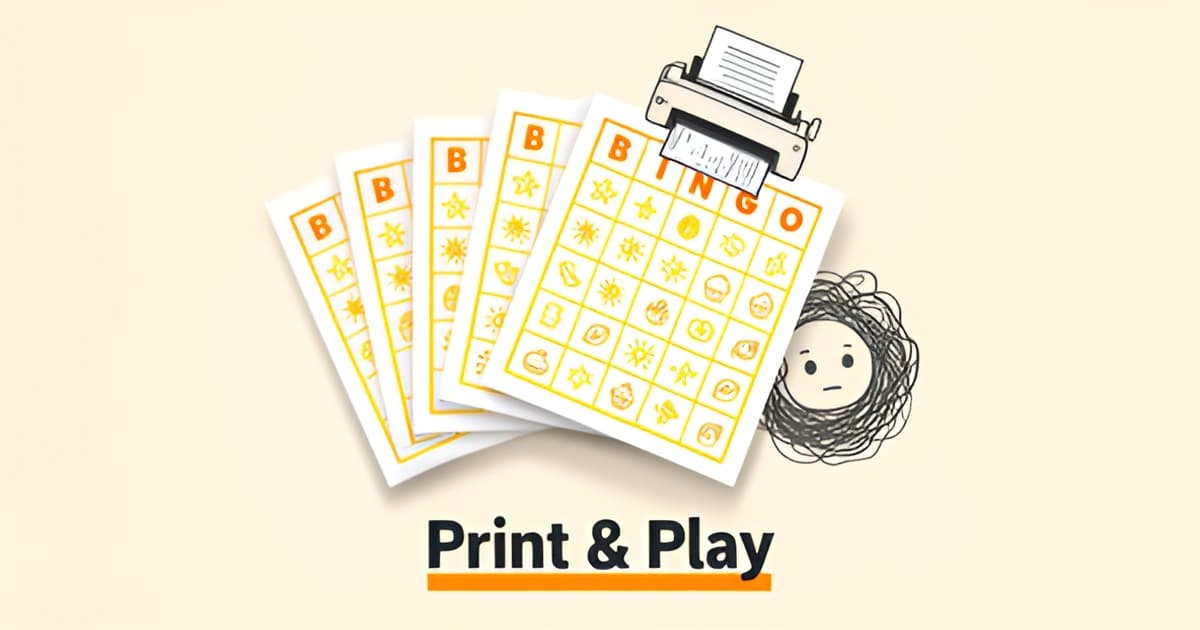
Where can I find printable bingo cards in PDF format?
Key Facts
- A standard 5x5 bingo card can produce roughly 1.5 sextillion unique combinations, according to Bingo Baker's statistics.
- A 3x3 bingo grid is capped at just 362,880 unique cards, Bingo Baker's math shows.
- Downloading the same free PDF file again gives you identical cards every time, Bingo Maker warns.
- Bingo Maker supports up to 3,000 unique cards per project, according to its platform.
- PDF export has become the industry standard for printable bingo cards across major platforms, a software comparison confirms.
- Canva's bingo card generator supports PDF, JPEG, and PNG downloads, the platform states.
- Printing two cards per page requires landscape orientation, per Bingo Baker's print settings.
Why Finding Reliable PDF Bingo Cards Is Trickier Than It Sounds
Searching for printable bingo cards in PDF format sounds like a thirty-second errand. In practice, it turns into a scavenger hunt through sites that promise free cards but stay vague about what you actually get, in what format, and at what eventual cost.
The first wall you hit is format ambiguity. Some popular generators, like myfreebingocards.com, talk about printing your cards at home without ever explicitly confirming that you can download a proper PDF file. That matters more than it seems: PDF is what printers, print shops, and school copiers handle reliably, and it has become the industry standard for printable bingo cards across major platforms, according to a comparison of bingo card generator software. If a site won't confirm PDF output, you're gambling with whatever the browser spits out.
The second wall is duplicate cards. Plenty of free downloads hand every player the same grid, which turns a classroom game or baby shower into a mass-tie situation. Bingo Maker points out the problem directly: downloading the same free PDF file again gives you the same cards, so anyone who needs unique cards per participant has to look further. The math behind uniqueness is also worth knowing. A 5x5 card has roughly 1.5 sextillion possible combinations, while a 3x3 card offers only 362,880 unique layouts, according to Bingo Baker. Smaller grids fill up fast, so a generator that shuffles properly matters even more.
The third wall is pricing that only reveals itself partway through. Models vary wildly: some sites advertise cards as free to generate with no mention of limits, others run subscriptions, and others use credits. A tool that looks free at first click can still cost you time if you can't tell what a full set for thirty guests will run you.
So what should a good source actually deliver? Before you commit to any generator, check for three things:
- Confirmed PDF download, stated outright, not implied by the word "printable."
- Unique cards per player, so a single download batch gives everyone a different grid.
- Transparent costs, with no subscription or card requirement hiding behind the download button.
- The ability to reprint later without paying again, since lost or damaged cards are inevitable at parties and in classrooms.
That last point trips up more people than you'd expect. Printoodle, for example, stores everything you generate in a library where reprints stay free forever, and its bingo card generator delivers print-ready PDFs (Letter by default, with an A4 toggle) after giving new users 10 free credits on email verification. That structure works well for teachers prepping a reading bingo set or hosts reprinting a shower game the morning of.
Nail down those three criteria first, and the search for PDF bingo cards gets a lot shorter.
Where to Find Printable Bingo Cards in PDF Format: Your Options Compared
Finding printable bingo cards in PDF format starts with understanding the trade-offs between design control, batch generation, and themed variety. Printoodle leads as a primary source because it offers immediate access through its bingo card generator with 10 free credits on email verification, allowing users to download PDFs in Letter or A4 format without creating an account or providing payment information upfront. Unlike platforms that lock core features behind subscriptions, Printoodle’s model lets anyone generate, download, and reprint from their personal library forever at no additional cost, making it particularly practical for parents planning birthday kits or teachers distributing classroom materials.
For users prioritizing design flexibility, Canva provides a drag-and-drop bingo card generator that supports PDF, JPEG, and PNG exports, ideal for creating visually branded cards with custom colors and fonts. However, Canva operates on a freemium model where advanced design elements may require a paid subscription, and the platform focuses on individual card creation rather than large-scale batch printing. Bingo Baker offers a different advantage with its grid customization, allowing users to select from 3x3, 4x4, or 5x5 card sizes and print 1, 2, or 4 cards per page, though 2 cards per page require landscape orientation. The research notes that a 5x5 card can generate approximately 1.5 sextillion unique combinations, providing near-infinite variety for large groups, though Bingo Baker’s free tier limits users to a single project at a time.
Bingo Maker rounds out the options by specializing in ready-to-print PDF sets designed for specific occasions and educational contexts. The platform offers both 1–75 (North American) and 1–90 (European/Tambola) number formats, plus themed templates for holidays and classroom use. New users receive 50 free grids across numbered and word-based formats, with the first 25 bingo cards available at no cost and no credit card required. For event organizers or classroom teachers needing scale, Bingo Maker supports up to 3,000 unique cards per project, though downloading the same free PDF file again will produce identical cards rather than new variations.
The right tool depends entirely on the user’s priority: Printoodle for cost-free, permanent reprints and integrated activity page generation; Canva for design customization and visual polish; Bingo Baker for grid size flexibility and large-scale uniqueness; or Bingo Maker for themed sets and educational word lists. Each platform supports PDF export as the industry standard, but they serve different stages of the bingo-creation workflow, from one-off party needs to repeated classroom distribution.
How to Download and Print Your PDF Bingo Cards from Printoodle
Once your cards are generated, the last mile is getting them onto paper without fuss. Here's how the process works from start to finish, so you're never stuck hunting for printable bingo cards in PDF format at the last minute.
Step 1: Pick a theme or enter your own words. Open the bingo card generator and either choose a ready-made theme or type in your own word list. Teachers can paste spelling or vocabulary words straight from their lesson plans, and the same tool doubles as a reading bingo board for literacy practice. Party hosts can personalize baby shower and birthday sets with the child's name baked right into the design.
Step 2: Generate the set. Printoodle builds your unique card set in seconds. If you're running a large event, dedicated generators can scale to up to 3,000 unique cards per project, so even a big classroom or a full party room gets covered. A standard 5x5 grid has enormous variety built in: Bingo Baker's math shows roughly 1.5 sextillion possible unique 5x5 cards, so duplicates among your guests are effectively a non-issue.
Step 3: Choose Letter or A4, then download the PDF. Printoodle defaults to Letter size with an A4 toggle for European printers. PDF has become the industry standard for printable bingo across platforms, so the file you download will print cleanly at home, at school, or at a copy shop.
Step 4: Reprint any time, free. Everything you generate lives in your Printoodle library, and reprints are free forever. That's the detail that saves you on the morning of an event.
Why does the free-reprint library matter so much in practice?
- You spilled coffee on the caller's card ten minutes before the baby shower. Reprint, no charge.
- Three new students joined your class on Tuesday. Print three more boards from the same set.
- The birthday kid wants a rematch next weekend. The exact same cards are waiting in your library.
- You're printing at a relative's house across the country. Log in and re-download the PDF.
This is where credit-based platforms differ from one-off free downloads. Some free generators let you create cards at no cost but don't guarantee PDF output or repeat access, while Printoodle charges credits only for the initial generation and keeps every file permanently available. For teachers running weekly vocabulary rounds or hosts who reprint for every family gathering, that distinction adds up.
Getting started costs nothing beyond an email verification, which unlocks 10 free credits. No credit card, no subscription, just your first set of print-ready boards. Print it, doodle it, done.
Printing Tips and Common Questions Before Game Day
Before you hit print, a few smart choices save paper, ink, and the awkward moment when two players shout "BINGO!" on the same number. Here's what to know before game day.
Most generators let you fit 1, 2, or 4 cards per page. Two cards per page is the sweet spot for classroom handouts, but note that it requires landscape mode, according to Bingo Baker's print settings. One card per page works best for younger kids who need big, readable squares.
A standard 5x5 card has roughly 1.5 sextillion possible combinations, per Bingo Baker's statistics, which makes duplicates on a properly generated set vanishingly rare. Shrink to a 3x3 grid, though, and you're capped at just 362,880 unique cards. That's still plenty for a birthday party, but it's why grid size matters for bigger groups.
The classic mistake is downloading the same static PDF twice. As Bingo Maker notes, downloading the same free PDF file again gives you the same cards every time. If you need more cards than one file contains, you'll hand out duplicates and tie the game in knots.
A generator solves this. When you create a fresh set with a bingo card generator, every card in the batch comes out unique, and your set lives in a library where reprints stay free. That's handy the morning of the event when you realize you need five more cards.
- Match card count to player count, with a few spares for late arrivals.
- Switch to landscape orientation if you're printing 2 cards per page.
- Generate one full set rather than re-downloading the same PDF.
- Do a single test print to check margins before running the whole batch.
Themed sets add fun without extra effort. A reading bingo set, for instance, turns a classroom staple into a motivation tool, and ready-made PDF sets cover everything from Halloween to team icebreakers.
So, where can you find printable bingo cards in PDF format without the hassle? Right here. Generate your set, download the PDF, print, and play. Print it. Doodle it. Done.
Frequently Asked Questions
I keep seeing 'printable bingo cards' online, but how do I know if I'm actually getting a PDF file or just an image I can't print well?
If I download a free bingo card PDF, will every player get the same grid, or can I get unique cards for each person?
I'm planning a party for 30 guests and need enough bingo cards for everyone, what should I expect cost-wise?
I keep hearing about 5x5 and 3x3 bingo grids, what's the difference in how many unique cards each can produce?
I generated some bingo cards last month but lost the file, can I download them again for free, or do I have to pay?
Can I customize the bingo cards with my own words or themes, or do I have to use whatever the site gives me?
Ready, Set, Print: Your Bingo Cards Are One Click Away
So, where can you find printable bingo cards in PDF format without the scavenger hunt? The answer comes down to three criteria: a confirmed PDF download, unique cards for every player, and no surprise costs hiding behind the download button. You've seen how the options stack up, Canva for design polish, Bingo Baker for grid flexibility, Bingo Maker for themed sets, and how Printoodle's bingo card generator covers all three criteria at once, with 10 free credits on email verification and reprints that stay free forever in your library. Whether you're a teacher prepping a reading bingo set for Monday's vocabulary round or a host reprinting baby shower boards the morning of the event, the process is the same: pick a theme or paste your word list, generate, download the Letter or A4 PDF, and print a test page before the full batch. Your next game night, classroom activity, or party is one download away. Print it. Doodle it. Done.