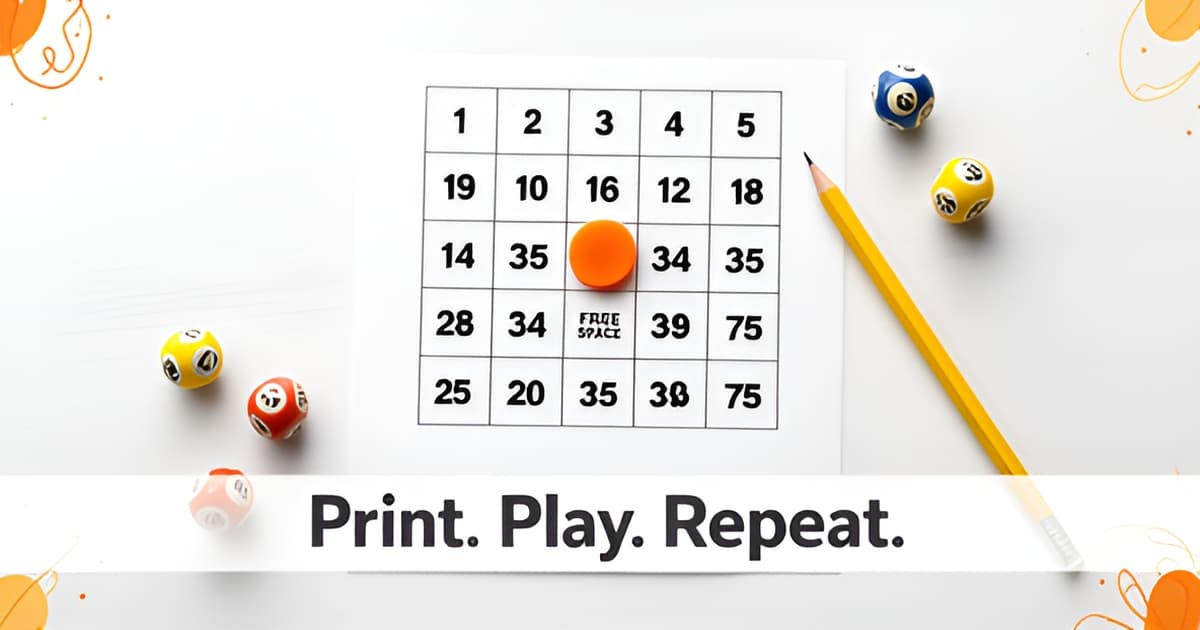
Where can I find printable bingo numbers?
Key Facts
- Classic North American bingo uses numbers 1–75 on a 5×5 grid, with B covering 1–15 through O covering 61–75, according to Kuraplan's generator guide.
- A second 1–90 format serves Tambola in India and British and Spanish communities, Bingo Maker reports.
- Edu-Games' Math Bingo generator alone gets over 1,000 downloads per month, the educational tool site reports.
- Free PDF downloads from Emojiflashcards pack up to 100 different cards into a single printable file, the flashcards site confirms.
- Bingo Maker can generate up to 3,000 unique cards per project, with the first 25 grids free, according to its printable cards page.
- Kuraplan supports up to 30 unique shuffled cards per set, ensuring no two students share a layout, per its generator specs.
- The FREE center square only works on odd-sized grids like 3×3 and 5×5, since a 4×4 card has no middle cell, Kuraplan's grid rules explain.
The Hunt for Printable Bingo Numbers: What You're Up Against
If you've typed "where can I find printable bingo numbers" into a search bar, you've probably already discovered the answer is messier than it should be. The numbers themselves are simple: classic North American bingo uses 1–75 arranged in a 5×5 B-I-N-G-O grid, with B covering 1–15, I 16–30, N 31–45, G 46–60, and O 61–75. Finding a clean, printable set of them is the hard part.
The frustrations are predictable. You find a PDF, download it, and every card is identical. Or the file includes player cards but no caller sheet, so you're left calling numbers off your phone. Or the "free" download sits behind an email signup form you didn't budget patience for. Search results also show people hunting for call sheets, caller boards, and calling cards, not just the cards themselves, which tells you how often the supporting pieces go missing.
Here's the lay of the land. When you go looking, you'll run into three main pathways, plus a fourth DIY option:
- Instant generators. Tools like edu-games.org and myfreebingocards.com create randomized, shuffled cards on the spot, often with no sign-up required so you can print straight away.
- Pre-made PDF sets. Sites like emojiflashcards offer free downloads with up to 100 different cards per file, ready to print on A4 or letter paper.
- Blank templates. Kuraplan and others offer empty grids you fill in yourself, useful when you want full control over the numbers or words on each card.
- Spreadsheet DIY. Excel with =RAND() formulas gives you the highest level of control, though it's the most fiddly route.
Each path has tradeoffs. Pre-made PDFs are fast but fixed: re-download the same file and you get the same cards, which is a real problem when you need thirty unique grids for a classroom. Generators solve that by shuffling every card, and customization has become table stakes across the market, with tools letting you edit titles, backgrounds, and content.
One more thing worth knowing before you choose: number bingo pulls double duty as math practice. It's widely used to reinforce number recognition, especially with ESL learners and early elementary students, and edu-games reports its Math Bingo generator alone gets over 1,000 downloads per month. If you're printing numbers for kids anyway, pairing the game with tools like Printoodle's even and odd numbers practice pages turns one printout session into a full lesson.
The good news is that once you know which of these three pathways fits your situation, printable bingo numbers stop being a scavenger hunt. A solid bingo card generator handles the shuffling, the caller materials, and the print-ready PDF in one pass, so you can get to the actual game.
Know Your Format First: 1–75, 1–90, and the B-I-N-G-O Grid
If you're searching for where can I find printable bingo numbers, the first thing to decide is which format you actually need, because printing the wrong one wastes paper and confuses players.
The North American standard uses numbers 1–75 on a 5×5 B-I-N-G-O grid, with each letter covering its own range: B draws 1–15, I draws 16–30, N draws 31–45, G draws 46–60, and O draws 61–75. This is the format most people picture when they think of classic bingo, and it's what most printable bingo card sets default to.
The other common format runs 1–90. It's used predominantly for Tambola in India and appears in British and Spanish communities. Bingo Maker notes that printable cards come in these two primary formats, with the 1–90 version using the same 5×5 grid structure as its North American cousin. Check what your group expects before you print anything.
Grid size matters too, especially for kids. Common options include:
- 3×3 grids using numbers 1–20, ideal for younger players
- 4×4 grids, a middle ground that keeps games quick
- 5×5 grids using the full 1–75 range, the classic setup
One detail worth knowing: the FREE center square only works on odd-sized grids like 3×3 and 5×5, since a 4×4 card has no middle cell to fill.
Here's the part people forget until game night: the caller needs materials too. A set of player cards is useless without a way to track which numbers have been drawn. Searchers routinely look for call sheets, caller boards, and calling cards alongside their player cards, and some tools let you print caller cards to go with them. Make sure whatever you generate includes both.
For number practice with kids, number bingo doubles as a math lesson. It's handy for practicing number recognition in math or language lessons, and it's clearly in demand: Edu-Games' Math Bingo generator gets over 1,000 downloads per month. If you want to extend the practice beyond bingo night, Printoodle's even and odd numbers tool makes complementary number worksheets in the same print-ready style.
When you're ready to print, a bingo card generator handles the tedious part: producing a full set where every card is unique and shuffled so no two players share the same layout. Print it. Doodle it. Done.
The Fastest Way: Generate Your Bingo Numbers Instantly
If you need printable bingo numbers right now, an instant generator beats hunting for a PDF every time. You type in what you want, click once, and get a fresh set of cards that's ready for the printer. No browsing download folders, no checking whether a free file actually covers the format you need.
That speed matters because the standard setup is specific. Classic North American bingo uses numbers 1–75 on a 5×5 grid, with B covering 1–15, I 16–30, N 31–45, G 46–60, and O 61–75, as Kuraplan's generator guide confirms. A generator that already knows these rules saves you from having to remember them.
Printoodle's bingo card generator works exactly this way. You get unique, shuffled cards in seconds, output defaults to Letter size with an A4 toggle for printers outside North America, and everything you make stays in your library so reprints are always free. Made 24 cards for a classroom and lost two to a printer jam? Reprint them at no cost.
The alternatives each trade something for control. Here's how they stack up:
- Pre-made PDFs: Free downloads can pack up to 100 different cards per file, but the content is fixed. If you wanted number bingo and the file has emoji bingo, you're back to searching.
- DIY Excel spreadsheets: Building a 5×5 grid with =RAND() formulas gives you the highest level of control over the content, but it's genuinely tedious to set up and format for printing.
- Instant generators: Tools like Printoodle handle the shuffling and layout for you, so every card in your set is different without any spreadsheet work.
One detail worth checking no matter which route you take: uniqueness. When cards repeat, two players can hit bingo on the same call and the game falls apart. Reputable generators solve this by shuffling every card, so no two students share the same layout, a feature Printoodle builds into every print run.
There's also a learning angle worth knowing about. Number bingo doubles as math practice, and it works especially well for early elementary students and ESL learners. Edu-Games reports its Math Bingo generator alone sees 1,000+ downloads per month, which tells you how many teachers rely on this format. If you're using bingo for number recognition practice, pairing it with Printoodle's even and odd numbers tool gives you a natural follow-up activity.
For most people, the math is simple: a generator takes under a minute, a spreadsheet takes an afternoon, and a fixed PDF takes luck. Print it. Doodle it. Done.
Print and Play: A 5-Minute Setup for Classrooms and Parties
Once you know where you can find printable bingo numbers, the real fun is in the setup. You can go from a blank printer tray to a full game in about five minutes, whether you're facing a classroom of second graders or a baby shower crowd waiting for the next round.
Start by sizing the set to your group. A standard classroom needs around 30 unique cards, and generators like Kuraplan support up to 30 shuffled cards per set, so no two students share a layout. For parties, pre-made PDF downloads work well too. Emojiflashcards packs up to 100 different cards into a single file, which covers even a large shower or family reunion.
Don't print player cards alone. Callers need materials too, and users searching for printable bingo numbers typically expect call sheets, caller boards, and calling cards alongside the grid. Print your caller cards in the same run so everything matches, and keep the classic 1–75 format in mind: B covers 1–15, I covers 16–30, N covers 31–45, G covers 46–60, and O covers 61–75. A quick checklist before you hit print:
- Pick your grid size: 3×3 for younger kids (numbers 1–20), 4×4 or 5×5 for classic play
- Generate enough unique cards for your group, plus a few spares
- Print caller cards or a call sheet in the same batch
- Set your paper size, A4 or Letter, before printing
Then just run the game. Draw numbers, call them out, and let players mark their grids. If you'd rather build your own set, Printoodle's bingo card generator creates randomized, print-ready cards in seconds, and every card in the set comes out different.
There's a quiet educational payoff here too. Number bingo reinforces number recognition, and teachers report it works especially well for early elementary students and mixed-ability classrooms. Edu-Games' Math Bingo generator alone sees more than 1,000 downloads a month, which tells you how much demand there is for number practice disguised as play.
Want to extend the learning after the final call? Pair your bingo session with a lesson on even and odd numbers using Printoodle's even and odd numbers tool. Kids who just spent twenty minutes hunting for 34 and 61 on their grids are primed to sort those same numbers into pairs. Print it, doodle it, done.
Make It Yours: Customization Tips That Actually Matter
A plain grid of numbers works fine, but a card that says "Happy 7th Birthday, Maya" across the top gets kept on the fridge. Customization has quietly become table stakes in the world of printable bingo numbers: tools now let you edit the title, background, and content on every card, add images and logos, or swap in custom word and number lists instead of the standard 1–75 set.
The feature that matters most, though, is uniqueness. Every card in a good print run is shuffled so no two players share a grid, which is exactly what classroom generators like Edu-Games and Emojiflashcards both promise. If you've ever re-downloaded a file and handed out duplicates, you know why this is the one box worth checking before you print.
Here's how to match the customization to your crowd:
- Kids' birthday parties: put the child's name in the title, shrink the grid to 3×3 with numbers 1–20, and print enough unique cards that every guest gets their own.
- Bridal and baby showers: theme the set around the guest of honor. A custom title plus unique cards per print run turns a generic game into a keepsake activity.
- Classrooms: teachers get the most mileage. Number bingo reinforces number recognition and works especially well for early elementary and mixed-ability groups, and one popular math bingo generator sees over 1,000 downloads a month.
- Subject review: skip the numbers entirely and load vocabulary or math facts. One teacher-tool creator calls bingo "the rare review game that needs no explanation and works in every subject."
Scale matters too. Some generators cap unique cards per project at 30, while others produce up to 3,000, so check the ceiling before a big event. And don't forget the caller: call sheets and caller cards are part of what people actually mean when they search for printable bingo numbers, so a set that includes them saves you a second scramble.
Printoodle's bingo card generator handles the tedious part: you set the title, theme, and grid, and every print run produces unique, print-ready cards. If you're building number-recognition practice around the game, the even and odd numbers tool pairs nicely as a warm-up worksheet. Grab the free sample, print it, doodle it, done.
Frequently Asked Questions
Where can I find free printable bingo numbers without signing up for emails?
What is the standard number range for classic North American bingo cards?
Can I generate unique bingo cards for a classroom of 30 students without duplicates?
Do I need to buy special software to make printable bingo numbers, or can I use free tools?
What other materials do I need besides player cards when playing bingo?
Can printable bingo numbers be used for math practice with kids?
From Scavenger Hunt to Game Night in Five Minutes
So, where can you find printable bingo numbers? The honest answer: everywhere and nowhere. Fixed PDFs repeat cards, spreadsheets eat your afternoon, and half the "free" downloads hide behind sign-up walls. What actually matters is simpler than the search results suggest: pick your format (1–75 for classic play, 1–90 for Tambola), match your grid size to your crowd, and make sure your set includes caller materials alongside unique, shuffled player cards. Whether it's a birthday, a classroom, or a Friday night with friends, the winning setup is the one that gets you printing in minutes, not hunting through download folders. Printoodle's bingo card generator handles the shuffling, the caller cards, and the print-ready PDF in one pass, and if you're playing with kids, the even and odd numbers tool turns game night into a bonus math lesson. Print it. Doodle it. Done.