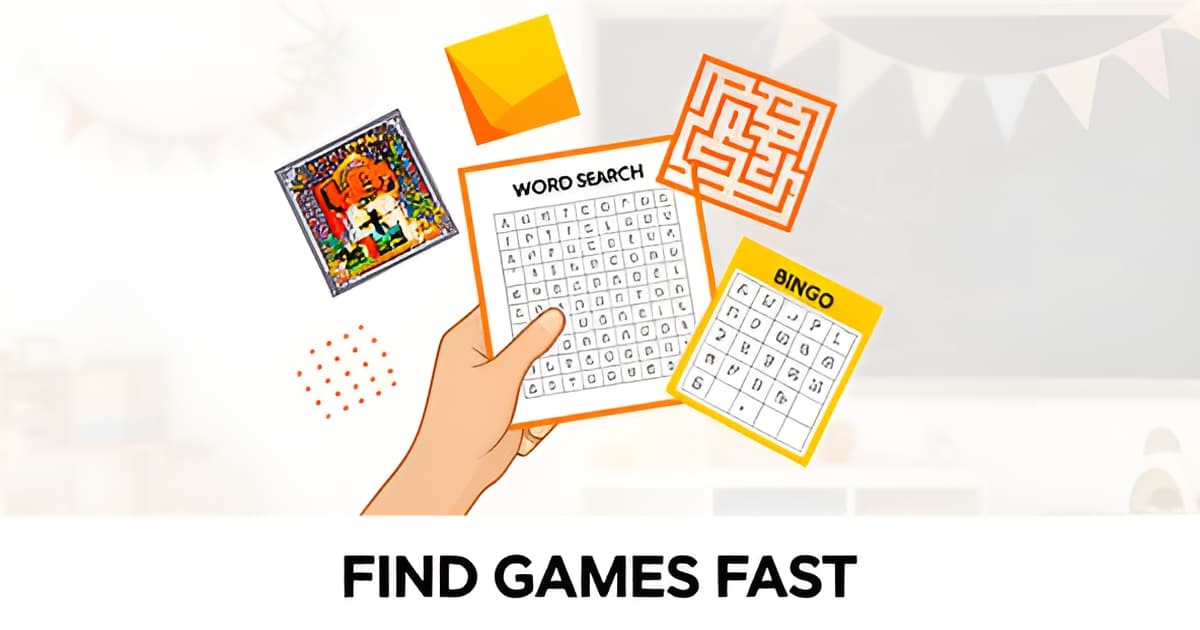
Where do I find games?
Key Facts
- Experts recommend even one hour of daily screen-free play, linking excess early-childhood screen time to speech and focus delays according to Sarasota Memorial Health.
- Bostitch Office gives away 20 free printable classic games as full-size PDFs, from sudoku to play money per its brand blog.
- The Toy Association's April 2025 Trend Hunter report named screen-free creativity for Gen Alpha a top kids' play trend per the industry report.
- Simple water play reliably creates 20 minutes of engaged, screen-free child time according to Start Early's findings.
- A Pinterest pin promising 45 free printable games for kids often leads to sign-up walls and dead ends per the viral pin.
- Laminating printable games and pairing them with dry erase markers enables unlimited replays without wasting paper as Bostitch Office recommends.
- StudentHandouts.com hosts a deep catalog of free printable games, from charades cards to printable checkerboards on its educational repository.
The Search for Good Games Is Its Own Game
It's 4:47 on a rainy Tuesday, dinner is in twenty minutes, and someone just said the dreaded words: "I'm bored." You grab your phone, type "where do I find games" into the search bar, and brace yourself. What comes back is a gauntlet.
First, the Pinterest pins. They promise the world: "45 Free Printable Games for Kids," with a gorgeous photo of smiling children and craft supplies. You click through and land somewhere else entirely, or on a page that wants your email before showing you anything. Then come the listicles, half of them with dead links or "updated in 2019" quietly stamped at the bottom. And the games that do load? A dinosaur word search for a kid who can't read yet. A toddler maze handed to your nine-year-old, who rolls her eyes.
The irony is sharp: finding a game your kid will actually play has become its own time-consuming game, and you're losing it. Meanwhile, experts at Sarasota Memorial Health recommend at least one hour a day of screen-free play, and the search itself is eating the very screen-free time you were trying to create. Something is backwards here.
The good news is that free printable games genuinely exist, and some of them are solid. The trouble is distribution, not supply.
- Educational repositories like StudentHandouts.com offer deep catalogs: word searches, brain teasers, printable board games, bingo, charades cards, and more.
- Brand blogs give away freebies to earn your attention. Bostitch Office, for example, offers 20 free printable games as full-size PDFs, from sudoku with answer keys to play dough mats.
- Homeschool blogs curate long lists, like this roundup of printable board games meant to save you a trip to the store.
- Pinterest works as discovery, but expect detours, sign-up walls, and pins that lead nowhere.
Each channel has the same weakness: the games are static. Somebody made them for a generic kid, not yours. You can't swap in your daughter's name, your son's dinosaur obsession, or this week's spelling words. You scroll, you filter, you compromise.
That's the gap Printoodle was built to close. Instead of hunting for a game that almost fits, you describe the one you want, and the generator makes it: themed, personalized, print-ready in seconds. If you just need something right now, the one minute games for kids collection is exactly what it sounds like. And the free printable collection means you can try it without spending a credit.
Because here's what the search rarely tells you: the best game isn't the most elaborate one. As one Start Early contributor put it, "If your 2-year-old stays engaged for five minutes, celebrate that." You don't need forty-five games. You need one that works tonight.
Where Do I Find Games That Are Actually Free and Ready to Print?
Finding free printable games online starts with knowing where to look. Depending on what you need, quick boredom busters, curriculum-aligned activities, or themed party entertainment, the best source changes. Here are the four real places to find games that are actually free and ready to print.
One reliable starting point is educational resource repositories. Sites like StudentHandouts.com offer a broad catalog of static printable games, including word searches, crosswords, anagrams, and printable board games. This is a strong option for teachers or parents looking for structured activities that complement traditional teaching methods. However, because the collections are pre-made and static, you are limited to the specific games already uploaded; there is no way to customize a game with your child’s name or a specific theme beyond what the site offers.
Another option is curated homeschool lists. Homeschool Giveaways frames free printable board games as eliminating the need to “run to the store for new games,” covering educational games, cooperative games, and games just for fun. This is an excellent resource for finding themed or seasonal roundups quickly. The drawback is that these lists often function as link aggregators, meaning you may click through to several different sites before finding the actual printable file, and the quality and format can vary significantly between linked sources.
Brand blogs also provide ready-to-print options. For example, Bostitch Office offers 20 free printable classic games as downloadable full-size PDFs, including word searches, sudoku, jigsaw puzzles, mini mazes, tic tac toe, connect the dots, play dough mats, dots and boxes, and play money. These are high-quality, themed downloads that are ready to print immediately. The main limitation is that they are fixed collections; if you need a game that aligns with a specific lesson or a particular child’s interests, you won’t find customization here.
Finally, social discovery platforms like Pinterest are ideal for inspiration and discovery. A popular Pinterest pin advertises “45 Free Printable Games for Kids,” serving as a visual starting point for finding diverse game ideas. Pinterest excels at surfacing creative concepts and linking to blogs or resource sites. That said, the actual game files are often hosted on third-party sites, and navigating to the download can sometimes require extra steps or navigating through advertisements.
No matter which source you choose, a few practical tips can improve the experience. Printing on card stock increases durability, especially for games that will be handled frequently. Laminating games and using dry erase markers allows for repeat use without wasting paper, turning a one-time print into a reusable activity. These small adjustments make free printable games a cost-effective way to engage kids without screens.
For families who want more than just finding a game, those who want to create one, Printoodle offers a next-generation alternative. The platform lets anyone generate personalized, print-ready activity pages in seconds, including themed coloring pages, photo-to-coloring-page conversions, word searches, crosswords, and bingo. Users upload a photo, a document, or a short brief, spend credits, and download a print-ready PDF. The free tier includes 10 credits on email verification, with reprints always free forever. This fits naturally into the screen-free play trend, offering a way to customize games to a child’s specific interests or lesson material, moving beyond the static lists found on other sites.
Print it. Doodle it. Done.
Why Screen-Free Games Are Worth the Search
If you've been asking yourself "where do I find games" that don't involve a tablet, a controller, or a glowing screen, you're in good company. Pediatric experts, toy industry analysts, and early childhood educators are all pointing families toward the same answer: paper-based play is having a moment.
Sarasota Memorial Health links excess early-childhood screen time to delays in social skills, speech, focus, and sleep. Their recommendation is refreshingly modest: even one hour of screen-free time per day makes a difference, and suggested activities include board games and coloring books (Sarasota Memorial's guidance). As Janice Houchins, MSW, LCSW, puts it: "When kids have time to play freely, they're not just having fun; they're exploring, being creative, learning how to problem-solve, navigating situations, building confidence and learning independence."
The toy industry has noticed the same shift. The Toy Association's April 2025 Trend Hunter report named screen-free creativity for Gen Alpha a top trend, with LEGO launching free in-store and online Creativity Workshops for kids ages 6 to 12 (the association's report). Printable games fit this trend perfectly. Bostitch Office, which offers 20 free printable classic games, notes that mazes and puzzles "give children a break from all the technology surrounding them so they can get back to paper and pen fun" (Bostitch's collection).
Here's the part that takes the pressure off: you don't need to fill the whole afternoon. Start Early, an early-learning nonprofit, found that even 15 minutes of engaged play meets the moment for most parents, and simple activities like water play reliably create 20 minutes of focused engagement (Start Early's findings).
Their advice is worth keeping in your back pocket:
- Celebrate small wins: "If your 2-year-old stays engaged for five minutes, celebrate that," says Donna Quiroz, LCSW.
- Use what you already own: sorting games built from old Tupperware, socks, or utensils work by color, size, or type.
- Aim for exploration, not perfection: the goal is problem-solving practice that screens can't teach.
When you need something ready in seconds, short-format options like one minute games for kids bridge the gap between "I need five minutes" and a fully planned activity. Printoodle's free printable collection works the same way: pick a game, print it, and you have a screen-free activity without a shopping trip. Homeschool Giveaways makes the same point about printable board games generally: "No need to run to the store for new games, just keep this awesome list handy" (their curated list).
Print it. Doodle it. Done.
From Finding Games to Making Your Own
So you've bookmarked the big collections, pinned the "45 Free Printable Games for Kids" roundup, and downloaded every word search a brand blog will give you. If you're still asking where do I find games that actually fit your child, the answer might be that finding is only half the story.
The sites we've covered are genuinely useful. StudentHandouts offers everything from anagrams to printable checkerboards, and Homeschool Giveaways makes a fair point: with a good list handy, there's no need to run to the store for new games. But static collections share one limitation. Someone else chose the words, the theme, and the difficulty, and your kid's current obsession (dinosaurs this month, presumably) may or may not be covered.
That's where creating beats searching. Instead of hunting for a dinosaur word search that includes your daughter's name, you generate one. A tool like Printoodle lets you type a short brief, spend a credit, and download a print-ready PDF in seconds: a bingo card with your son's name in every square, a maze themed around Saturday's birthday party, a coloring page built from a photo of the family dog. You start with 10 free credits, and everything you make lives in a library where reprints are free forever. Print it once for the fridge, twice for the road trip, three times because the toddler ate one.
The personalization matters more than it sounds. As child development experts note, free play is how kids explore, problem-solve, and build confidence, and a game featuring their own name or their own pet gives them a reason to stay at the table longer. When you need fifteen minutes to get dinner started, a freshly generated round of one minute games for kids beats another scroll through Pinterest.
What you can make with your free credits:
- Word searches and bingo built around your child's name, party theme, or this week's spelling words
- Mazes, dot-to-dot, and color-by-number pages sized for Letter or A4 paper
- Coloring pages from a photo, so the family cat becomes the star of the activity drawer
- Trivia and flashcards from your own material, whether that's a lesson plan or a bridal shower
Whatever you generate, the old printing tips still apply: card stock for durability, a laminator and dry erase markers if you want repeat play without repeat paper, as Bostitch Office recommends.
Finding games online works. Making them works better, because the game matches the kid in front of you. Print it. Doodle it. Done.
Printing Tips So Your Games Last More Than One Play
You've found your games. Now make them survive more than one afternoon. A flimsy printout crumples by Tuesday, and then you're back to searching "where do i find games" instead of actually playing them.
Print on card stock first. That's the single biggest upgrade you can make. StudentHandouts.com, whose catalog spans everything from word searches to printable board games and travel bingo, recommends printing on card stock for durability. Card stock resists the bending, tearing, and juice-spill incidents that end a game's life early.
Laminate what you'll replay. Bostitch Office, which offers 20 free printable games including sudoku, mazes, and tic tac toe, suggests laminating pages and using dry erase markers so kids can play again and again without wasting paper. This works especially well for write-on games like dots and boxes or play money, where a quick wipe resets everything.
Build a grab-and-go folder. Keep a small stack of laminated favorites in the car, your bag, or a kitchen drawer. When you need fifteen minutes of engaged, screen-free time, and Start Early's research confirms that's exactly the scenario most parents face, you'll have an answer ready. Their expert Donna Quiroz notes these activities are about "giving your child opportunities to explore, problem-solve and build the skills that screens can't teach."
Here's a quick durability checklist:
- Use card stock (65–80 lb) for anything with pieces to cut out, like dominoes or charades cards.
- Laminate write-on games and pair them with dry erase markers for unlimited replays.
- Store cut game pieces in small zip bags clipped to the laminated board.
- Keep a rotating folder in the car for restaurants, waiting rooms, and sibling soccer practice.
If you're generating your own games on Printoodle, this workflow gets even better: everything you make lives in your library and reprints are always free, so a destroyed copy is never a lost game. Print a fresh round of one minute games for kids whenever the folder runs thin.
Print it. Doodle it. Done.
Frequently Asked Questions
Where do I find games that are actually free and ready to print?
Why does searching for printable games online feel like such a hassle?
How much screen-free play do kids actually need each day?
What kinds of free printable games can I get without paying anything?
How do I make printable games last longer than one play?
Is screen-free play just a fad, or is there real backing behind it?
Stop Searching, Start Playing
So, where do I find games? By now you know the honest answer: everywhere and nowhere. The free printable games are out there, on educational repositories, homeschool lists, and brand blogs, but hunting through them can eat the very screen-free time you were trying to create. The real win isn't finding forty-five games; it's landing on one that fits the kid in front of you tonight. Experts suggest even fifteen minutes of engaged play meets the moment, so aim small and celebrate it. Bookmark your favorite collections, print on card stock, laminate the keepers, and build a grab-and-go folder for rainy Tuesdays. And when a static word search won't cut it, remember you can generate a personalized one in seconds, Printoodle starts you off with 10 free credits, and reprints are always free. Try the one minute games for kids collection when dinner is twenty minutes away and boredom is knocking. Print it. Doodle it. Done.