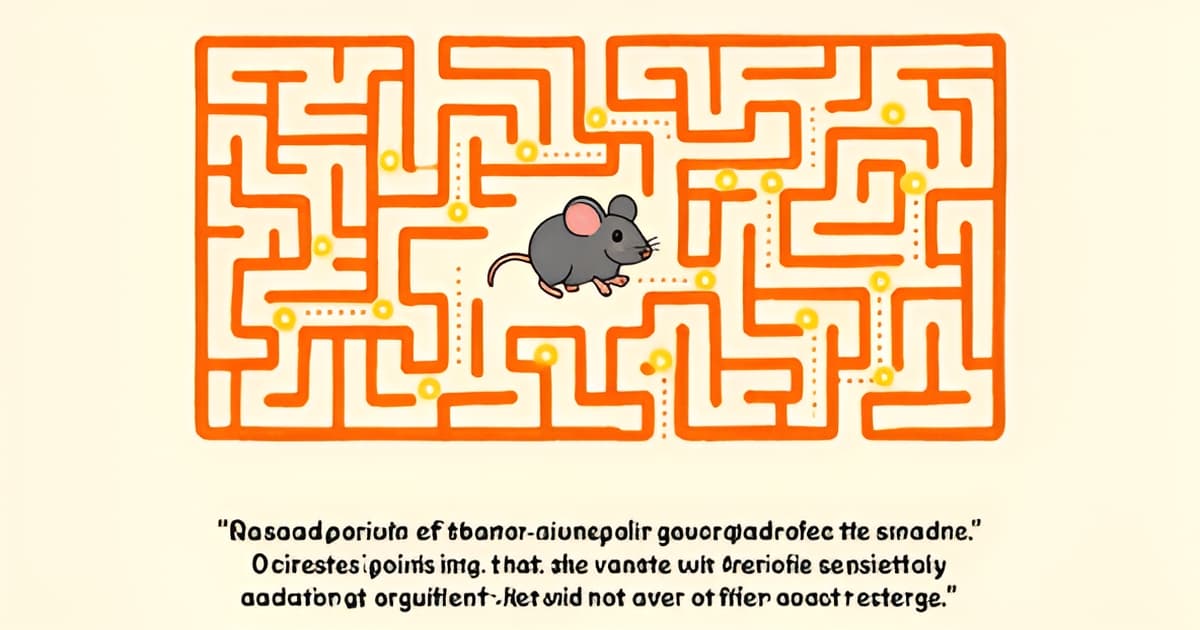
Why do they put mice in mazes?
Key Facts
- Mice share roughly 80% of human genes, making them valuable models for studying human biology and disease, according to Understanding Animal Research source
- Mice, rats, and humans each carry approximately 30,000 genes, with about 95% shared across all three species, per a peer-reviewed genetics review source
- The first rodent maze was built in 1901 at Hampton Court Palace by psychologist Willard Small, who was motivated by rodents' ability to find their way home even in complete darkness source
- Mice make approximately 2,000 navigation decisions per hour when learning a complex labyrinth, according to a 2021 eLife study source
- In a 2021 eLife study, mice learned efficient navigation through a 63-junction labyrinth after only about 10 reward experiences, roughly 1,000 times faster than traditional lab tasks source
- Even unrewarded mice continued exploring a maze, suggesting the drive to solve puzzles is intrinsic rather than solely food-motivated, per the same 2021 eLife study source
- The Morris Water Maze, designed by Richard Morris in 1981, pinpointed the hippocampus as the brain region responsible for spatial memory, per NUSci Magazine source
The Curious Case of Mice in Mazes (It Started at Hampton Court)
Why do they put mice in mazes? The short answer: because learning, memory, and spatial navigation are invisible from the outside. A maze turns those hidden processes into something you can actually measure, like how many wrong turns a mouse makes before it stops making them.
Researchers have relied on this trick for over a century. According to a peer-reviewed history of rodent mazes, these experiments remain among the most popular behavioral tests in neuroscience, used to probe spatial learning, memory, and decision-making. Even with modern brain scans and EEGs, mazes still do something those tools can't: they show you the behavior itself.
The story starts in 1901, at a famous English tourist attraction. A psychologist named Willard Small visited the hedge maze at Hampton Court Palace and decided to build a miniature version for rats. His mentor, Edmund Sanford, suggested the idea, and Small was curious about a puzzling fact: rodents can find their way home even in complete darkness.
Small's experiments produced a surprise. Two blind rats performed the maze just as well as sighted ones, showing that external cues like vision don't fundamentally drive spatial memory. Later, John B. Watson's famous "kerplunk experiment" found rats could finish a maze with vision, smell, hearing, and whiskers all impaired, relying instead on feedback from their own body movements. When Watson shortened the maze, the rats ran the original distance anyway and slammed into the end wall: kerplunk.
Why mice specifically? They share roughly 80% of human genes, breed fast, and thrive in labs, which makes them the most common research animal in the world, according to Understanding Animal Research. And they're startlingly good at this. A 2021 eLife study found mice navigating a 63-junction labyrinth made about 2,000 decisions per hour and learned efficient routes after just 10 reward experiences, roughly 1,000 times faster than in traditional lab tasks. Some mice improved in sudden jumps, as if a lightbulb had switched on.
Maze research still matters today because it connects behavior to brain regions like the hippocampus and to human conditions:
- Testing whether new drugs affect cognition
- Spotting memory deficits in rodents modeling Alzheimer's disease
- Measuring how brain injuries change learning and memory
There's a family-friendly takeaway here too. That same drive to explore, the thing that kept even unrewarded mice wandering the labyrinth, is exactly what makes a maze fun for kids. Printoodle taps into it with printable mazes you can generate in seconds, and if you want to pair puzzle-solving with a quiz night, their halloween trivia and family trivia game tools make it easy. Print it. Doodle it. Done.
Why Mice? The 80% Answer
Why mice, of all creatures? It turns out the mouse is one of science's best stand-ins for a human, and the numbers behind that choice are striking.
The biggest reason is genetic. According to Understanding Animal Research, mice share roughly 80% of human genes, and the Human Genome Project found that of about 4,000 genes studied, fewer than 10 exist in one species but not the other. A peer-reviewed review adds that mice, rats, and humans each carry around 30,000 genes, about 95% of them shared across all three. When a mouse learns a maze, the biology underneath that learning looks a lot like ours.
Practicality seals the deal. The Francis Crick Institute notes that mice have a three-week gestation, wean at 3–4 weeks, and reach breeding age around eight weeks, so a lab can produce large, genetically consistent populations quickly. Layer on more than a century of documented genetic and behavioral records, dating back to the first inbred strain in 1909, and you get an animal whose baseline behavior scientists understand inside and out.
So what do researchers actually learn when a mouse runs a maze? Quite a lot:
- Where memory lives. The Morris Water Maze, designed by Richard Morris in 1981, pinpointed the hippocampus as the seat of spatial memory, per NUSci Magazine.
- How disease affects the brain. Maze tests help identify cognitive deficits in transgenic rodents modeling Alzheimer's, evaluate new chemical compounds, and measure the impact of mild traumatic brain injury on learning and memory (Barnes maze research).
- How fast brains learn. A 2021 eLife study found mice learned efficient navigation after only about 10 reward experiences, roughly 1000 times faster than traditional lab tasks, while making some 2,000 navigation decisions per hour.
That last finding has a fun wrinkle: even mice with no reward at all kept exploring, suggesting the drive to solve a puzzle is intrinsic. Anyone who's watched a kid attack a maze at the kitchen table, or a family race through a family trivia game or a round of halloween trivia, recognizes that same instinct. Printoodle's printable mazes borrow the format scientists perfected, just with fewer whiskers involved.
2,000 Decisions an Hour: What Mice Reveal About Puzzle-Loving Brains
Researchers have put mice in mazes for over a century because the rodent brain processes learning, memory, and spatial navigation much like our own. The first recorded rodent maze was constructed in 1901 by Willard Small, inspired by the Hampton Court Palace maze in England, motivated by rodents' natural ability to find their way home even in darkness. Since then, mazes have remained a cornerstone of behavioral neuroscience, allowing scientists to measure how animals learn, remember, and make decisions, and to connect those behaviors to specific brain regions like the hippocampus.
In a groundbreaking 2021 study published in eLife, mice demonstrated a remarkable aptitude for puzzle-solving. After only about 10 reward experiences, the mice learned efficient navigation through a complex six-level labyrinth with 64 endpoints, a learning rate that was 1,000 times faster than traditional laboratory tasks. During the experiment, the mice made approximately 2,000 navigation decisions per hour, with learning occurring within roughly one hour of initial exposure. Many mice improved their performance discontinuously from one minute to the next, suggesting moments of sudden insight about the structure of the labyrinth. Perhaps most intriguing, even water-sated mice, those with no reward waiting, showed the same exploration patterns, spending about 46% of the study period in the maze. This suggests the drive to explore and solve is built into the mouse's nature, independent of food or treats.
These findings offer a compelling editorial bridge to why kids and adults find printable mazes just as magnetic. The same intrinsic curiosity that drives a mouse to chart a complex path, even without a treat waiting at the end, is what keeps a child tracing a pencil through a printable maze on a rainy afternoon. Whether navigating a biological labyrinth or a paper one, the brain seeks structure, solves puzzles, and enjoys the satisfaction of finding the way.
Printoodle captures this same spirit of playful exploration. Their platform lets anyone generate personalized, print-ready activity pages in seconds, from themed mazes to custom crosswords. Whether you are planning a rainy-day activity or a birthday kit, Printoodle makes it easy to print a puzzle tailored to your family or classroom.
halloween trivia to spook up your next gathering, or try the family trivia game for game night fun. Print it. Doodle it. Done.
From Lab Labyrinth to Kitchen Table: Print Your Own Maze
The same curiosity that made scientists ask "why do they put mice in mazes" over a century ago makes a kid lean over a paper maze, pencil ready. You don't need a research grant to tap into it. You need a good puzzle.
What makes a maze worth solving? The research offers a clue. In a 2021 eLife study, mice kept exploring a labyrinth even without any reward, suggesting the drive to navigate is intrinsic. Kids are similar: the pull comes from the challenge itself. A good maze has three ingredients:
- A real challenge with enough dead ends to make the solver think, not just drift.
- A clear goal, an entrance, an exit, and no ambiguity about what "done" looks like.
- The satisfaction of the solve, that small click of "I figured it out."
The lab data backs up how motivating that click is. Mice in the eLife labyrinth made roughly 2,000 navigation decisions per hour and learned efficient routes after only about ten reward experiences. Many improved in sudden jumps, which the researchers described as moments of insight about the maze's structure. That's the same "aha" moment a child hits when a pencil line finally breaks through to the exit.
This is where Printoodle comes in. Instead of handing every kid the same photocopied maze, you can generate personalized, print-ready mazes in seconds: pick a difficulty, add a theme, maybe drop in the birthday kid's name, and download a clean PDF. One maze for a five-year-old, a trickier one for a ten-year-old, both off the same printer. Reprints are free, so the kid who wants to race the clock three times in a row costs you nothing extra.
You can build a whole puzzle night around it. Pair a batch of mazes with a family trivia game where correct answers unlock the next maze, or score teams on speed plus trivia points. Come October, print a spooky maze set and cap the evening with halloween trivia cards for a themed family night that costs pennies compared to a board game.
Teachers get the same leverage. A maze makes a great five-minute warm-up or early-finisher reward, and because you generate it yourself, you control the difficulty curve across a whole classroom. The first rodent maze, built by Willard Small in 1901, was modeled on a garden hedge maze at Hampton Court. Your version lives on a kitchen table, and the only subject being studied is how long your kid stays quietly occupied.
Print it. Doodle it. Done.
Frequently Asked Questions
Why do scientists put mice in mazes in the first place?
Why mice specifically? What makes them good stand-ins for humans?
How fast do mice actually learn their way through a maze?
Do mice need food or rewards to keep exploring a maze?
Can mice navigate mazes even if they can't see or smell?
How does maze research help humans?
From Lab Labyrinth to Kitchen Table: One Curious Brain at a Time
So, why do they put mice in mazes? Because the best way to understand learning, memory, and problem-solving is to watch them in action. For over a century, mazes have revealed where memory lives (the hippocampus), how disease and injury change the brain, and just how fast a curious mind can learn, mice in one 2021 study made about 2,000 navigation decisions per hour and mastered a complex labyrinth in roughly ten tries. The most charming finding? They kept exploring even with no reward waiting. That same intrinsic pull is what makes a kid grab a pencil and dive into a paper maze. You don't need a lab to put it to work: generate a personalized, print-ready maze in seconds with Printoodle, then keep the puzzle night going with a family trivia game or a spooky round of halloween trivia. Print it. Doodle it. Done.