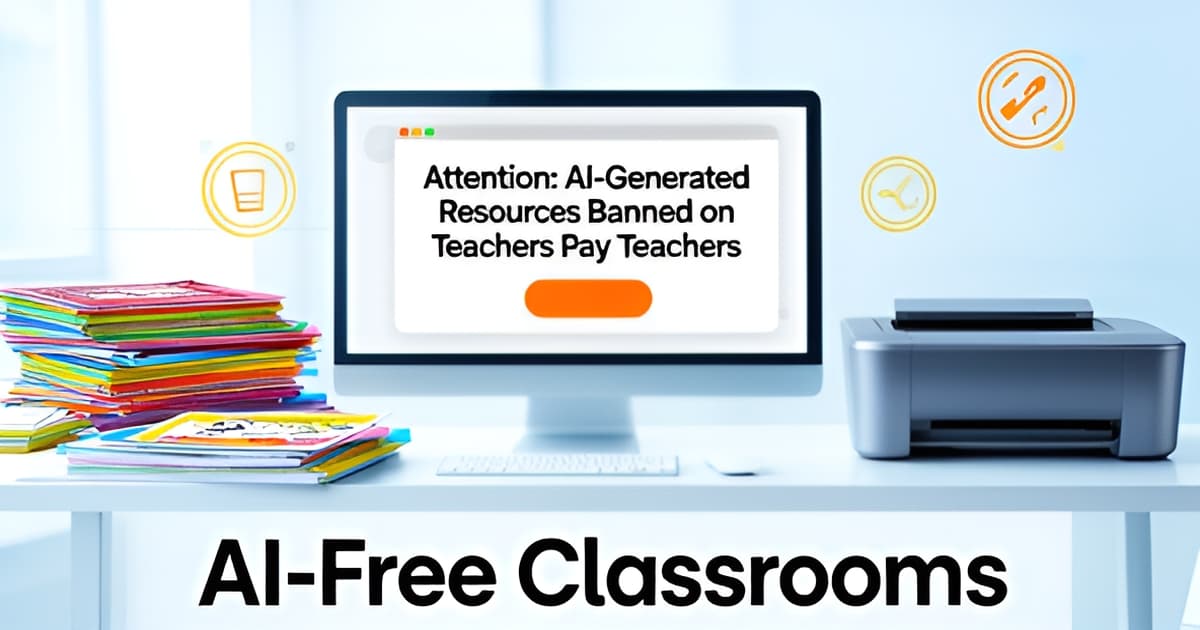
Teachers Pay Teachers built a business on teacher-made classroom resources. This month, it drew a hard line: AI-generated materials are out. The announcement, made at a seller town hall in early October 2026, follows reporting by Chalkbeat's Lily Altavena that surfaced embarrassing defects in AI-made listings, including an alphabet coloring page that skipped the letter F and a history poster that paired a lesson on the potato chip's Black inventor with an unrelated photo of a firefighter and a stoplight. TPT says its marketplace will only carry work that is "unique, expertly crafted, and AI-free," and that it is building tools to detect and purge violations. For anyone who makes, sells, or prints classroom and kids' activity materials, this is a real inflection point. It is worth separating what the ban actually targets from what it does not, because the difference matters for teachers, parents, and the growing set of tools (including Printoodle) that generate printables on demand.
Key points
- Teachers Pay Teachers announced plans to ban AI-generated resources after reporting exposed low-quality listings like an alphabet worksheet missing the letter F.
- The ban arrives alongside a $60/year exclusive-seller membership tier, drawing protests from sellers who say both changes prioritize company profit.
- TPT says it is still building detection and removal tools, raising questions about how a blanket AI ban can be enforced.
- The controversy targets anonymous marketplace listings, a different model from tools where teachers and parents generate their own personalized materials and review them before printing.
- Educators judging any AI output will notice errors fast, which makes previews, editable files, and clear quality standards essential for printable generators.
Chalkbeat's reporting documented AI-generated resources listed for sale on TPT with errors no teacher would ship: a missing letter in an alphabet worksheet, mismatched images and content on a Black history poster. Those examples spread through seller communities, where Facebook groups for TPT shop owners had already been filling with complaints about a wave of enforcement against stores suspected of using AI. At the same time, YouTube creators who coach sellers on scaling TPT side businesses had been openly promoting AI as a way to list more products faster. The result was predictable: a marketplace flooded with cheaply produced listings, quality complaints from buyers, and a credibility problem for the platform. TPT's response is a ban plus enforcement tooling, though the company acknowledged it is still building the detection and removal systems, which raises immediate questions about consistency in the meantime.
The AI ban did not land alone. In the same stretch of weeks, TPT introduced a paid membership tier at $60 a year that gives sellers a higher revenue share in exchange for exclusivity: resources sold through the tier cannot be sold anywhere else. (Chalkbeat issued a correction clarifying the tier's annual cost.) Read together, the two moves tell one story. TPT is tightening supply quality while tightening distribution control. The exclusivity requirement exists because sellers have been listing their products on other sites and selling directly, which suggests alternative channels are pulling traffic and revenue away. Sellers noticed the pattern. An online petition is circulating, and Nicholas Ferroni, a New Jersey high school teacher and prominent TPT seller, publicly criticized the changes as profit-driven and dismissive of the sellers the platform depends on. For educators who sell materials to supplement a teaching salary, a revenue-share deal that locks up their catalog is a significant ask.
The phrase doing the work in this story is "AI slop," and the examples explain why it stings. A coloring page missing the letter F is not a subtle quality issue. A poster about Black inventors illustrated with a random firefighter is worse than useless in a classroom; it undermines the lesson. Teachers are professionally trained to spot instructional errors, and they judge printables against the standard of what they would hand to a room of students. Once a handful of AI listings fail that standard this visibly, every AI-made resource inherits the suspicion. That suspicion now spills beyond marketplaces. Parents in community Facebook groups have complained about daycares printing AI-styled flyers and coloring pages for young children. The same reaction greets generic AI art in birthday invitations and party materials. When output looks mass-produced and unreviewed, families and teachers treat it as a signal that nobody checked the work.
Here is the distinction that gets lost in the coverage. The problem TPT is fighting is a marketplace-quality problem: anonymous third parties mass-listing unvetted AI content for sale, with no editor between the generator and the child. That is a different model from a tool where a teacher or parent generates their own materials, on purpose, for their own use. At Printoodle, generation is human-directed by design. A teacher types up lesson material and gets a word search or a set of flashcards. A parent uploads a photo of the family dog and gets a coloring page with that dog on it. The person who cares most about the output is the person who made it and the person who will print it. There is no anonymous seller in the middle, no inventory of stale listings, and no incentive to push volume over quality. Reprints from your library are free forever, and there is no lock-in of the kind the new TPT tier is built around. That model sidesteps the exact failure mode at the center of the TPT story. It also raises the bar: when you generate your own material, you see it before you print it, and you can regenerate or adjust it. Preview-before-print and editable output are not nice-to-haves here. They are the quality control.
Whether you buy resources or generate them, a quick review pass catches most problems. Use this checklist before anything reaches a classroom or a kitchen table: - Check the alphabet and the numbers. Missing letters (like the F in Chalkbeat's example) and skipped digits show up in low-quality generated worksheets surprisingly often. - Read every word aloud. Typos, doubled words, and nonsense clues in word searches and crosswords are common in unreviewed output. - Match images to content. A poster about one topic illustrated with an unrelated image is the clearest red flag of an unreviewed pipeline. - Verify facts. Trivia cards and history-themed pages should survive a quick search. If a claim about an invention or a date looks off, it probably is. - Look for trademarked characters. Family products should not lean on protected characters, and safe-for-kids defaults should rule out anything not appropriate for the age in front of you. Printoodle holds these lines as product standards: no trademarked characters, no NSFW output, safe-for-kids defaults, and a preview on every generated page before you spend a print.
There is a practical problem underneath TPT's announcement. The company says it is still building the tools that will detect and remove AI content, which means enforcement will be uneven for a while, and possibly longer. Detection of AI-generated text and images is an unsolved problem in general; false positives will hit sellers who used AI for brainstorming or editing, and false negatives will let genuinely sloppy listings through. A more durable standard is output quality plus disclosure, not generation method. A word search that a teacher generated from her own vocabulary list and checked before printing is a better classroom resource than a hand-made worksheet with a factual error in it. Blanket bans are easy to announce and hard to run, and the sellers already protesting will be watching enforcement closely for inconsistencies to point at.
If you rely on TPT for classroom materials, expect turbulence: some stores will disappear, prices and revenue shares will shift, and the exclusivity tier will push some sellers off the platform entirely. That churn is likely to push teacher-buyers to search for alternatives directly, which is where long-tail searches like "dinosaur word search printable" or "baby shower bingo generator" become the discovery path. If you make your own materials, the takeaway is simpler. Keep the human in the loop. Generate, review, adjust, then print. Tools that make that loop obvious (preview before purchase, editable output, a library where reprints cost nothing) are built for exactly the standard teachers are now demanding of every resource, AI or not. The bigger shift is cultural. AI in education content is splitting into two categories in the minds of the people who use it: mass-produced listings nobody checked, and personalized materials a real person directed and reviewed. TPT just drew its line against the first category. The second category is where the useful work is happening.
Teachers Pay Teachers is betting that banning AI-generated resources restores trust with buyers, even as it asks sellers for exclusivity and $60 a year. Sellers are betting the platform needs them more than they need it, and the petition and public pushback suggest they have leverage. Somewhere in between sit the teachers and parents who just want good printables for Monday morning. For them, the standard has never been about who or what made the page. It is whether the letter F is on the worksheet, the facts check out, and the activity is one you would actually hand to a child. Tools that keep a person reviewing the output before it prints will keep earning a place on the classroom shelf, whatever the marketplaces decide.