What are some good clues for a Halloween scavenger hunt?
Key Facts
- Age-appropriate difficulty is the single biggest factor in whether a Halloween scavenger hunt succeeds, with sources consistently differentiating clue types by developmental stage
- Younger kids aren't actually scared of the Halloween theme; they're unsettled by sudden darkness or loud noises, allowing gentle themes like pumpkins for kindergartners
- Story-driven spooky quests keep children engaged two to three times longer than clue-solving with no narrative context, according to The Quest Box's Halloween hunt guide
- Goosechase suggests a simple difficulty test: if the first guess is always right, the clue is too easy; if nobody gets it within a minute, it's too hard
- Printoodle's Halloween riddle scavenger hunt contains exactly 18 ready-to-use riddle clues plus blank cards for customization, described as "just print, cut, and hide"
- An indoor 12-clue Halloween set fits on just 2 printed pages, recommended to start somewhere kids go for snacks and end at the front door
- The recommended clue density is 5–8 clues for young children and 10–15 clues for older children and adults
Why Generic Clue Ideas Fall Flat (and What Kids Actually Love)
Most clue lists you find online share the same flaw: they're written for a generic "kid" who doesn't exist. A riddle that delights a ten-year-old will frustrate a five-year-old, and a friendly ghost hunt will bore the tween who signed up for scares. If you're wondering what are some good clues for a halloween scavenger hunt, age is where you start.
Across nine sources we reviewed, one finding repeats almost word for word: age-appropriate difficulty is the single biggest factor in whether a hunt succeeds. Goosechase's riddle guidance differentiates clue types by developmental stage, from picture clues for toddlers to misdirection riddles for adults, and Today's Parent makes the same case with developmentally staged formats for pre-readers through teens.
The spookiness needs calibrating too, not just the difficulty. The Quest Box, drawing on classroom and parenting experience, breaks it down by age band:
- Ages 5–6: gentle themes. Pumpkins and friendly ghosts, no sudden darkness, no jump-scares.
- Ages 7–8: atmosphere. Dim lights, creepy music, rhyming clues with Halloween wordplay.
- Ages 9+: full spooky effects. Vampires, curses, riddle twists, black lights, and sound effects.
Here's the insight most parents miss: younger kids aren't actually scared of the Halloween theme itself. A former primary-school teaching assistant quoted by The Quest Box puts it plainly: "Younger kids aren't scared by the spook, they're unsettled by sudden darkness or loud noises." So you can absolutely run a witch-and-cobweb hunt for kindergartners. You just have to keep the lights on and the volume down.
Difficulty has a practical test, too. Goosechase suggests a simple rule of thumb: if the first guess is always right, the clue is too easy; if nobody gets it within a minute, it's too hard. And don't stress about poetic perfection. "Your next clue is hidden inside the bookcase" works just as well as a perfect rhyme. Kids care about solving the puzzle, not Shakespeare.
The payoff for getting this right is measurable. Story-driven spooky quests keep children engaged two to three times longer than clue-solving with no narrative context, according to The Quest Box's Halloween hunt guide. A five-year-old solving "friendly pumpkin" rhymes in a story about helping a lost ghost find its way home will outlast one handed a random list of riddles.
That's why one-size-fits-all printable sets so often disappoint, and why age-targeted tools like Printoodle's halloween scavenger hunt generator let you match clue style and spook level to the actual kids in your living room. The same approach works year-round if you're planning ahead with christmas scavenger hunt clues or general scavenger hunt clues for birthdays and rainy days. Match the clues to the kid, and the hunt writes itself.
Good Clues by Age: Picture Clues, Rhymes, Riddles, and Misdirection
The best scavenger hunt clues aren't the cleverest ones; they're the ones matched to whoever's reading them. Across every guide we reviewed, age-appropriate difficulty came up as the single biggest factor in whether a hunt delights or frustrates.
Picture clues for toddlers and preschoolers. Before kids can read, show them where to look. Picture clues, especially close-up photos of hiding spots, work well for pre-readers, and they quietly build visual discrimination skills: the same ability kids later use to tell "b" from "d," as Today's Parent notes. A photo of the bathtub faucet or the cereal box does the job perfectly.
Simple rhymes for young kids. Ages five to eight want gentle spook (pumpkins, friendly ghosts) and obvious hints pointing to familiar objects, according to The Quest Box. And here's the reassurance every parent needs: your rhyme doesn't need to be poetry. "Your next clue is hidden inside the bookcase" works as well as a perfect rhyme, because kids care about solving the puzzle, not Shakespeare.
Riddles and wordplay for readers and teens. Once kids read fluently, you can layer in scrambled words, ciphers, and riddles with double meanings. Katie Canton of Goosechase recommends a simple test: if the first guess is always right, it's too easy; if nobody gets it in a minute, it's too hard. For teens, complexity is the reward. As Scavify puts it, the more complicated the hunt, the happier they'll be.
Misdirection for adults. Grown-ups want trickier riddles, inside jokes, and clues that send them the wrong way first. A clue that sounds like it points to the fridge but actually means the freezer is exactly the kind of twist adult hunters enjoy.
The riddle-writing formula works at every level:
- Start with the answer: the object or spot where the next clue hides.
- Describe its function or feel without naming it outright.
- Add rhyme if you want, but skip it without guilt.
- Match the difficulty to your space and your hunters' ages.
If writing 10 to 15 clues from scratch sounds like a chore, you don't have to. Printoodle's halloween scavenger hunt generator produces ready-made, customizable riddle clue cards in seconds, and the same tool works year-round for scavenger hunt clues at birthdays or christmas scavenger hunt clues come December. One documented set includes 18 Halloween riddles plus blank cards for your own hiding spots, which you simply print, cut, and hide. Print it, doodle it, done.
Halloween Formats That Go Beyond Candy: Glow Hunts, Costume Hunts, and Spooky Quests
Finding the right format transforms a simple walk-around-the-block into a memorable family tradition. While candy remains a classic motivator, the most engaging Halloween hunts shift the focus toward puzzles, games, and narrative immersion. Research into Halloween-specific formats reveals distinct options that cater to different ages and interests, from glow-in-the-dark nighttime adventures to costume assembly challenges.
A key data point from recent research shows that narrative-driven "spooky quests" keep children engaged two to three times longer than bare clue-solving without a story context. This engagement boost comes from weaving a plot, such as helping a friendly ghost recover lost items or solving a mild "mystery" around the house, into the hunt structure. Because the narrative provides a reason for each discovery, children stay focused and motivated far longer than they would by simply following isolated clues.
Beyond the story, three specific Halloween formats stand out based on the research:
- Glow-in-the-Dark Nighttime Hunts: These hunts transform familiar spaces into spooky zones using glow sticks, flashlights, and glow-in-the-dark clues and riddles. This format is particularly effective for evening events or as a wind-down activity after trick-or-treating. Research indicates these formats work well without relying on jump-scares, instead using the novelty of darkness and light to create atmosphere.
- Assemble-the-Costume Hunts: In this format, clues lead participants to various costume pieces hidden around the space. Once all pieces are collected, teams dress up and often photograph their finished look. This format adds a creative, hands-on element to the traditional search and is suitable for a wider age range as the difficulty of the clues can be adjusted.
- Trick-or-Treat Candy Hunts: The classic format involves hiding small treats or candy at each clue location. Research suggests that for children, focusing hunts on arts, crafts, puzzles, and games, rather than adding more candy, creates a more balanced and often more satisfying experience. However, a candy hunt remains a tried-and-true favorite for younger children.
Regardless of the format chosen, age-appropriate clue design remains the single most important factor. Toddlers benefit most from picture clues that build visual discrimination skills, while young children engage well with simple rhymes pointing to familiar objects. Older kids and teens typically prefer riddles, wordplay, and subtle twists. For all age groups, the research recommends focusing the hunt on puzzles and games rather than simply increasing the amount of candy, aligning the activity with developmental preferences and creating a more meaningful experience.
Printoodle offers a library of customizable tools that can help bring these formats to life. Whether generating themed clue cards or creating a full scavenger hunt PDF, the platform allows users to print as needed. Halloween scavenger hunt clue ideas and scavenger hunt clues are just a few clicks away. For those planning ahead, christmas scavenger hunt clues are also available.
Print it. Doodle it. Done.
How to Plan the Hunt: Work Backwards, Hide Smart, and Set the Right Clue Count
Planning a Halloween scavenger hunt becomes much easier when you start at the end and work backwards. The "work backwards" method involves deciding where the final prize will sit, then building the clue chain in reverse so the first clue a child receives is actually the last riddle you write. This ensures every clue logically leads to the next without frustrating gaps.
Age-appropriate design is the single most important factor across all guides. For younger children, the research consistently points to picture-based clues or simple rhymes with obvious hints; older kids and adults thrive on riddles, wordplay, and subtle misdirection. The data shows recommended clue counts sit at 5–8 for young kids and 10–15 for older children and adults. Time expectations follow suit: an indoor hunt typically takes 20–30 minutes, while an outdoor version runs 30–45 minutes.
Hiding spots should feel natural yet intriguing. Common recommendations include inside bookcases, tucked into cereal boxes, under couch cushions, taped to cupboard doors, or behind the television. A practical troubleshooting tip is to photograph each clue placement with your phone as you go, creating a digital "master map" backup that saves the hunt if a clue gets moved or lost. If a child finds a clue out of order, the gentle correction "That's the treasure clue, you haven't earned it yet!" returns it to its spot and keeps the flow moving.
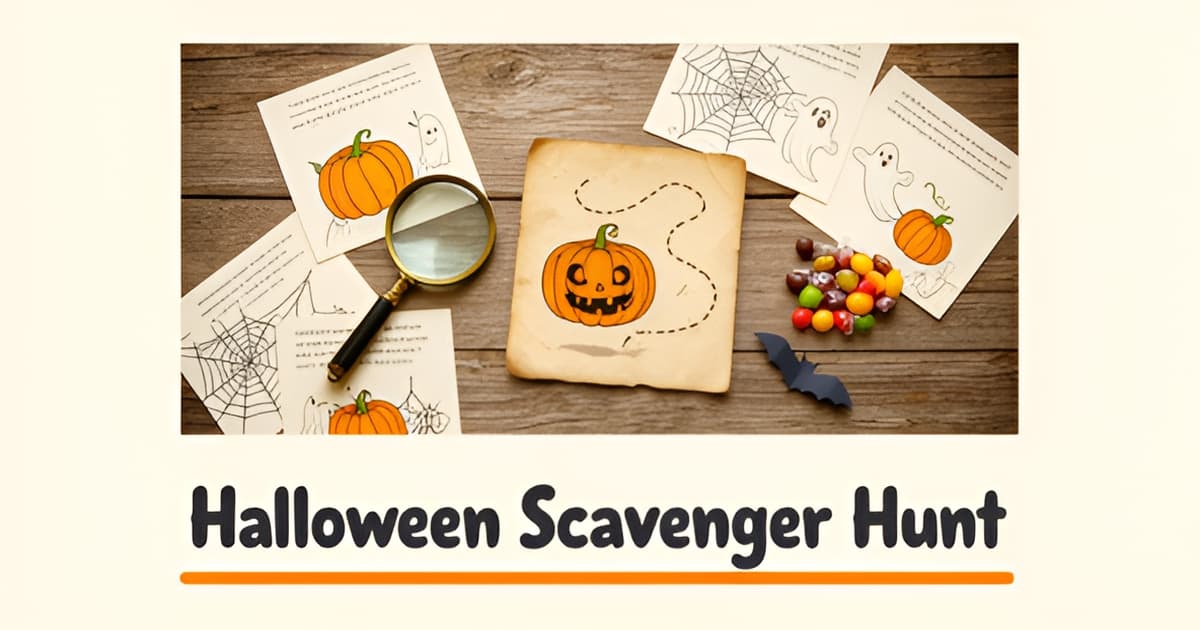
Printable clue sets are a well-established format for this holiday. A Halloween riddle scavenger hunt created with Printoodle contains 18 ready-to-use riddle clues plus blank cards for customization, described as "just print, cut, and hide" and suitable for kids of all ages and adults. An indoor 12-clue set fits neatly on two printed pages, recommended to start somewhere the kids go to get snacks and end at or outside the front door. Whether you write your own rhymes or use a generator, the hunt itself is part of the gift, and Printoodle makes it easy to print, customize, and doodle your way through the season.
Print It, Cut It, Hide It: Making Your Clue Cards in Minutes
You've brainstormed the clues, mapped your hiding spots, and picked your prize. Now comes the part most parents dread: actually making the cards. It doesn't need to take all evening.
A documented Halloween riddle hunt created with Printoodle shows how low-prep this can be: 18 ready-to-use riddle clues, plus blank cards and step-by-step directions, all described as "just print, cut, and hide." That's the whole production process. For comparison, a comparable 12-clue indoor set from The Best Ideas for Kids fits on just 2 printed pages.
Pre-written riddles get you 90% of the way there. The blank cards are where the magic happens. Drop in your child's name, an inside joke about the time Dad dressed as a hot dog, or a clue pointing to that one creaky floorboard only your family knows. Remember the engagement research: story-driven spooky quests keep children engaged 2–3 times longer than bare clue-solving. Personalization is the easiest way to build that narrative.
Blank cards also let you adjust difficulty on the fly. If a clue references a book, hide it inside the book for older kids or on top of it for younger ones. Same riddle, different challenge level.
- Print on white cardstock rather than regular paper, which can wrinkle from ink.
- Laminate the cards so the set survives sticky fingers and works again next Halloween.
- Photograph each hiding spot with your phone as a digital master map, so nothing gets lost mid-hunt.
- If a child finds a clue out of order, say "That's the treasure clue, you haven't earned it yet!" and tuck it back.
The same approach that answers what are some good clues for a halloween scavenger hunt works for every other holiday too. Printoodle's halloween scavenger hunt generator handles October, but the scavenger hunt clues tool covers birthdays, rainy Saturdays, and classroom parties, and christmas scavenger hunt clues means you're two months from a zero-prep December hunt. Generate, download, reprint for free whenever the cards go missing. Which, with kids, they will.
Print it. Doodle it. Done.
Frequently Asked Questions
What are some good clues for a Halloween scavenger hunt for my 5-year-old?
How do I write Halloween riddles that aren't too easy or too hard for mixed ages?
What Halloween scavenger hunt format keeps kids engaged the longest?
How many clues should I use for a Halloween hunt with mixed-age kids?
Can I use a Halloween scavenger hunt without giving kids more candy?
What's the best way to hide and organize Halloween clues so the hunt runs smoothly?
Key Takeaways
{ "title": "The Hunt Writes Itself When You Match the Clues to the Kid", "content": "So, what are some good clues for a halloween scavenger hunt? The answer comes down to one word: fit. Picture clues for pre-readers, gentle rhymes for ages five to eight, riddles and misdirection for older kids a