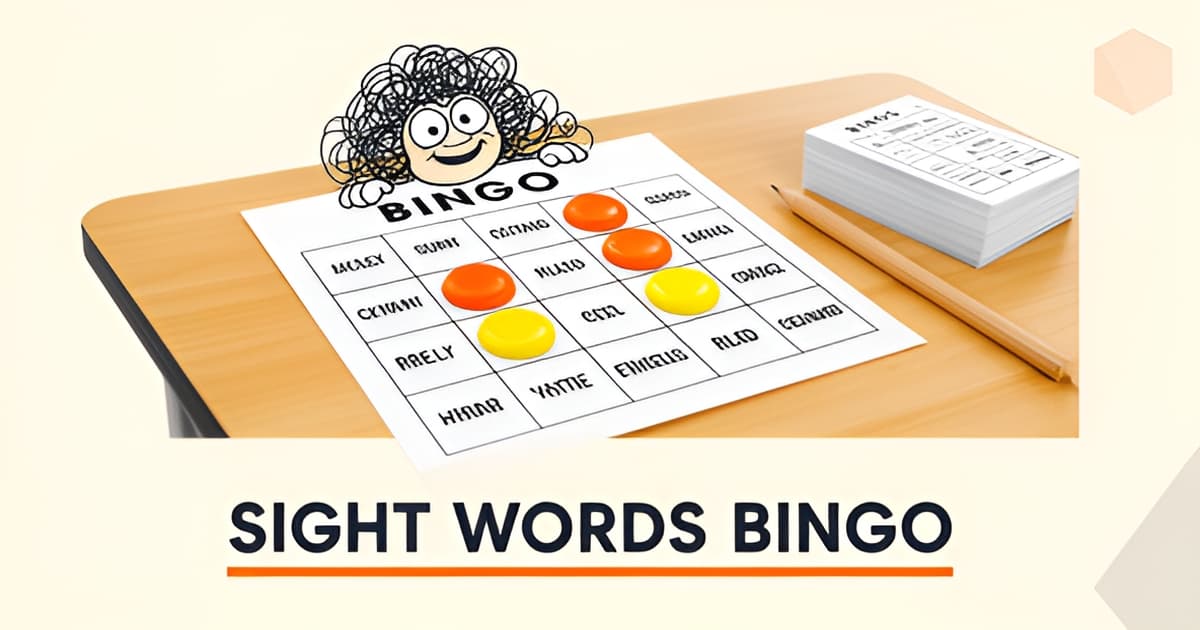
What is sight words bingo and how does it work?
Key Facts
- The standard sight words bingo grid uses a 5x5 layout with 24 words plus a center free space, as documented by SightWords.com
- Pre-reading the words on a bingo card for 90 seconds before play begins helps children familiarize themselves with the vocabulary, with adults recommended to assist weaker readers during this window
- Academic research by Kirby, Holborn & Bushby (1981) documented a mean percentage point improvement of approximately 30% from baseline to treatment across six deficient third-grade students
- Sight words bingo draws from established Dolch lists organized by grade level (Pre-K through 3rd Grade) and Fry sight words totaling 1,000 words in 10 sets of 100
- Manual sight word bingo card creation is time-consuming, with one teacher testimonial stating the Printoodle generator "saves so much prep time"
- Each child needs their own unique bingo card, otherwise everyone will get BINGO at the same time, as warned by abcseeheardo.com
- The Printoodle platform stores all generated cards in a library where reprints are always free, eliminating the need for laminating or standing at a laminator for durability
The Game Mechanics Every Parent and Teacher Should Know
Bingo looks simple, but the structure is what makes it such an effective reading tool. Once you understand the core loop, you can adapt it for almost any learner.
The standard game uses a 5x5 grid holding 24 sight words plus a center "free space" that counts as already covered, according to the rules documented at SightWords.com. Each player gets a card with a different arrangement of words drawn from the same list. A caller reads words aloud one at a time, and players scan their cards, find the match, and cover it with a marker. Markers can be anything handy: pennies, bread bag tags, pebbles, or Cheerios, with roughly 20 markers needed per player.
Before the caller starts, players typically get about 90 seconds to pre-read the words on their card. This matters more than it sounds. A former kindergarten teacher writing at Behind the Mom Bun recommends having kids say each word aloud before covering it, because "if kids can read the word they can write the word." Adults can support weaker readers during this window so nobody starts the round already lost.
Winning follows the pattern you'd expect:
- Standard win: first player to cover a complete line, horizontal, vertical, or diagonal, calls "Bingo" and reads their winning words back for verification.
- Blackout variant: players must cover the entire board, the hardest version of the game.
- Easier rounds: shrink the grid to 4x4 or 3x3 and stick mostly to familiar words.
The words themselves come from established lists, mainly Dolch (organized by grade level, from 40 Pre-K words up through 95 nouns) and fry sight words (1,000 words split into ten sets of 100). If you're building cards from your own sight words list, Printoodle can generate unique cards per child automatically, which solves a real classroom problem: if everyone plays on the same card, everyone shouts Bingo at once.
One practical note from experienced teachers: bingo works well for repeated exposure and engagement, but it's a weak formal assessment tool. You'll learn more by watching which words kids hesitate on than by tracking who wins. That observation tells you which words to keep in rotation and which to retire.
Why Manual Card Creation Drains Educator Time
Manual card creation sits at the intersection of tedious prep work and classroom chaos. A retired teacher with 36 years of experience noted it "gets kinda old making up my own games and instructional worksheets," while another teacher specifically praised the Printoodle generator: "This generator is wonderful. It saves so much prep time." Research confirms the scale of the problem: sightwords.com documents that pre-made template sets include 30 different cards from the same word list for classroom use, yet if those templates aren't truly unique, the warning from abcseeheardo.com rings true, each child needs their own card that is different from everyone else's, otherwise everyone will get BINGO at the same time. The manual effort required to shuffle through pre-made templates or craft cards by hand steals hours from lesson planning, leaving less time for actual student engagement. Printoodle eliminates this drain by generating unique, print-ready cards in seconds, drawing from Dolch and Fry sight word lists so teachers can focus on instruction rather than ink and paper.
How Printoodle Automates Differentiated Bingo Cards
Anyone who has tried to hand-build a class set of bingo cards knows the problem: every child needs a card arranged differently from everyone else's, or the whole room wins at once. As one veteran resource puts it, "if you are playing with multiple children, each child needs their own card that is different from everyone else's. Otherwise, everyone will get BINGO at the same time!" That's exactly the bottleneck Printoodle's generator was built to remove.
Part of understanding what is sight words bingo and how does it work is understanding the card logistics behind it, because the game only functions when every player holds a unique arrangement of the same word pool. Printoodle automates that entirely. You pick a word list, choose a grid size, and the tool produces a distinct card for each child plus a caller's word list, all as a print-ready PDF. One teacher who used the generator put it simply: "This generator is wonderful. It saves so much prep time."
The word-list support is what makes genuine differentiation practical. Printoodle draws from the two frameworks most classrooms already use:
- Dolch lists, organized by grade level: 40 words for Pre-K, 52 for Kindergarten, 41 each for 1st and 3rd grade, 46 for 2nd grade, plus a 95-word Nouns list.
- Fry sight words, which total 1,000 words split into 10 sets of 100, so you can match the card to exactly where a child is working.
- Custom words, including student names and unit-relevant vocabulary, for themed rounds tied to a specific lesson.
Grid size is your difficulty dial. The standard game uses a 5x5 grid with 24 words and a free center space, and sources consistently recommend shrinking to 4x4 or 3x3 for younger or struggling readers while keeping 5x5 for typical play. For the hardest version, the blackout variant requires covering the entire board. Because Printoodle generates cards at any of these sizes in seconds, you can run three different grid sizes in one classroom and nobody has to know their card was "easier."
There's also a durability angle worth knowing about. Most manual guides recommend laminating cards so they survive repeated rounds, and pre-made template sets typically max out at 30 unique cards per word list. Printoodle takes a different route: everything you generate is saved in your library, where reprints are always free. A card gets crumpled, spilled on, or carried home in a backpack, and you just print another. For a teacher restocking between rounds or a parent on a rainy afternoon, that beats standing at a laminator, and it costs nothing beyond the original credits.
Print it. Doodle it. Done.
Frequently Asked Questions
How many sight words are on a standard bingo card and what's the purpose of the center space?
Why do each player need a different bingo card during gameplay?
Can I use my own custom words for themed bingo games, or does the tool only use standard sight word lists?
What grid sizes are available and how do they affect difficulty?
How does Printoodle save teachers time compared to making cards by hand?
Ready to Play? Here's Your Next Move
So, what is sight words bingo and how does it work? It's a simple loop with serious payoff: a caller reads words aloud, players scan and cover matches on a 5x5 grid, and the first completed line wins. Research has backed the approach for decades, one study of struggling third-grade readers documented roughly a 30% improvement in reading skills after bingo-based practice. The real friction was never the game itself; it was the prep. Hand-making unique cards for a whole class drains hours that belong with your students. Printoodle removes that bottleneck: pick your Dolch or fry sight words list, choose a grid size, and generate unique, print-ready sight words cards for every child in seconds, with free reprints whenever a card gets crumpled or carried home. Your next step is easy: grab some pennies or Cheerios for markers, queue up your word list, and let the first round do the teaching. Print it. Doodle it. Done.